 Isabelle Augenstein
 Tanmoy Chakraborty
 Emilio Ferrara
 Filippo Menczer
 Preslav Nakov
 Greta Warren
Contributions
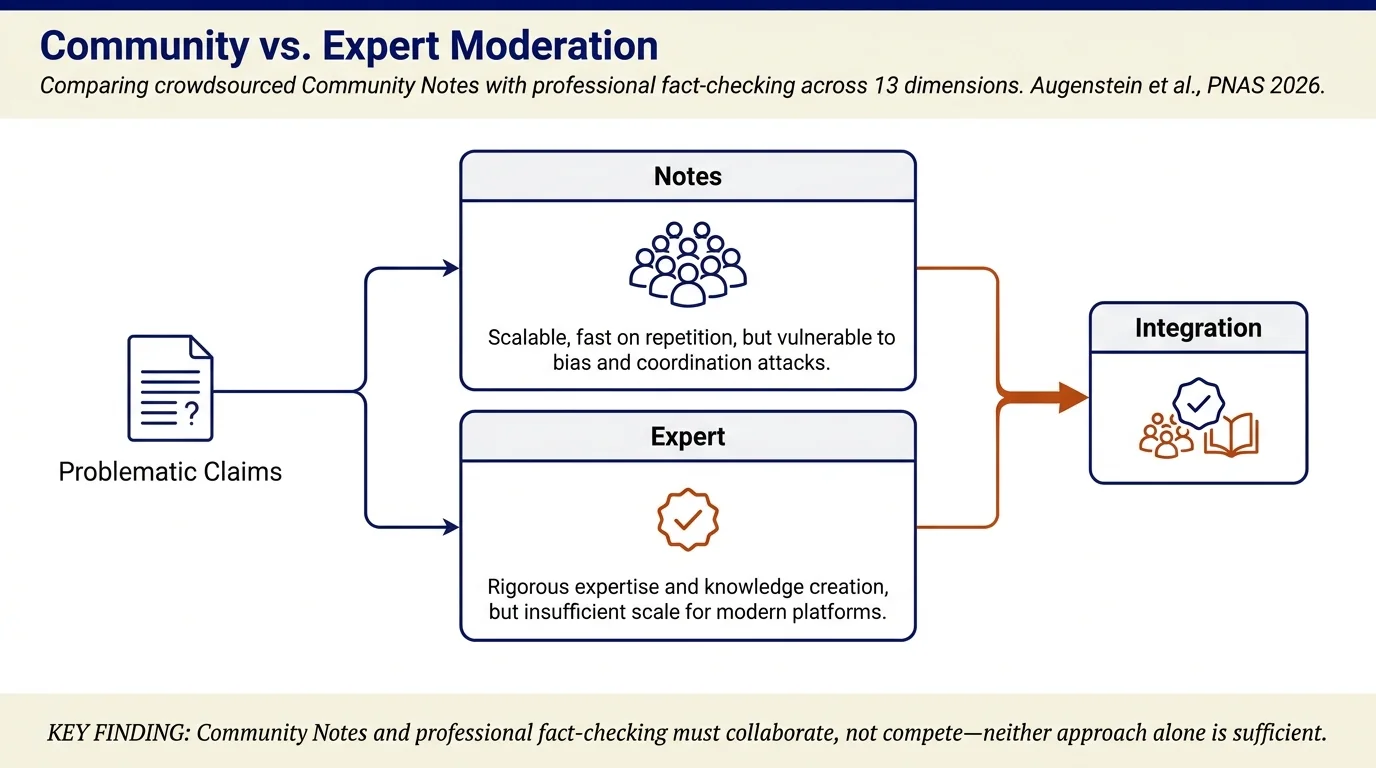
- Systematic comparison of community-based fact-checking (Community Notes) versus professional fact-checker-based moderation across 13 dimensions: volume, breadth, speed, democratic process, bias, transparency, expertise, robustness, legitimacy, impact on beliefs, impact on spread, psychological harm, and labor practices.
- Evidence that Community Notes, while faster on repetitive claims, face bottlenecks in reaching consensus and publishing, especially on partisan political claims.
- Analysis of vulnerabilities in crowdsourced moderation: susceptibility to coordination attacks, cognitive biases in lay raters, and political asymmetries in which claims get flagged.
- Concrete recommendations for integrating the two approaches: distributing workload by risk/complexity, using experts to adjudicate stalled notes, flagging high-risk claims for professional follow-up, and using AI to detect coordination and merge fragmented information.
Method
The authors conducted a critical literature review and stakeholder analysis. They compiled evidence from academic research, platform studies, and empirical investigations of Community Notes deployment on X. The core method is structured comparison: Table 1 (3 pages) lays out both approaches' claimed benefits and evidence-based critiques across 13 dimensions, drawing on 100+ references. They frame the central tension: platforms claim Community Notes is more trustworthy and scalable than expert moderation, but research shows mixed evidence.
Results
Scalability claims do not hold uniformly. Volume: only ~20% of proposed Community Notes are published, and published notes fall far short of covering problematic content. Breadth: knowledgeable users on polarized platforms often don't encounter claims outside their filter bubble. Speed: notes posted on X have 15+ hour average delays; many never reach consensus.
Bias and robustness gaps are substantial. Notes for Republican politicians are proposed and rated more helpful than notes for Democrats. The majority of sources cited in notes are left-leaning. Community moderation is vulnerable to coordinated attacks (documented coordinated pushback to suppress true notes).
Expertise gap is fundamental. Verifying complex, high-stakes claims (health, science, economics) requires specialized training. Community Note writers tend to focus on low-risk, repetitive misinformation or repackage existing professional fact-checks. Creating new knowledge—the core fact-checker skill—is rare in crowd efforts.
Legitimacy remains contested. Platforms frame Community Notes as independent and democratic, but research finds expert juries still viewed as more legitimate by the public unless crowds are large, ideologically balanced, qualified, and allowed real deliberation.
Ethical costs are overlooked. Platforms do not provide psychological support for volunteers exposed to graphic content. Fact-checking is skilled labor but Community Notes relies on unpaid volunteers, devaluing the profession.
Notes
Strengths: This is the most comprehensive and even-handed critical analysis of Community Notes to appear in a top venue. The authors avoid strawmanning either approach; Table 1 is exceptionally detailed. The perspective that both approaches are complementary (not alternatives) is well-supported by their evidence synthesis. The recommendations are concrete and implementable.
Nuances: The paper is a perspective (not empirical research), so some claims rely on citing individual studies rather than meta-analyses. The analysis leans heavily on X's implementation; Meta's newer adoption and TikTok's planned use get less scrutiny. The psychological-harm section is brief despite raising real legal liability concerns.
Why it matters: As Meta explicitly defunds professional fact-checkers in favor of Community Notes, this paper documents what will be lost (expertise, speed, training, accountability) and what crowd efforts cannot deliver (consensus on politicized claims, complex claim verification). It provides a blueprint for platform designers and policymakers who want moderation that actually works.
Research gaps flagged: The paper calls for transparency mandates across platforms and randomized controlled trials comparing moderation interventions head-to-head. Almost all evidence cited comes from X due to data availability; independent research on Meta's approach and scalability will be essential.