 Preslav Nakov
Contributions
The paper introduces three main contributions:
-
CustChecker — a modular, configurable fact-checking pipeline allowing users to select and combine claim processors (from RARR, FacTool, Factcheck-GPT), evidence retrievers, and verifiers, with extensible plugin architecture supporting custom solvers.
-
LLMEval — a unified evaluation framework for assessing LLM factuality across seven benchmark datasets (Snowball, SelfAware, FreshQA, FacTool-QA, FELM-WK, Factcheck-Bench, FactScore-Bio, and FactQA, covering 6,480 total examples); produces fine-grained factuality reports across diverse domains (history, biography, science, mathematics, sports, etc.).
-
CheckerEval — a leaderboard framework evaluating automatic fact-checkers on their ability to identify false claims and correct them, with measurement across accuracy, latency, and cost across multiple pipelines (RARR, FacTool, FactScore, Factcheck-GPT).
Method
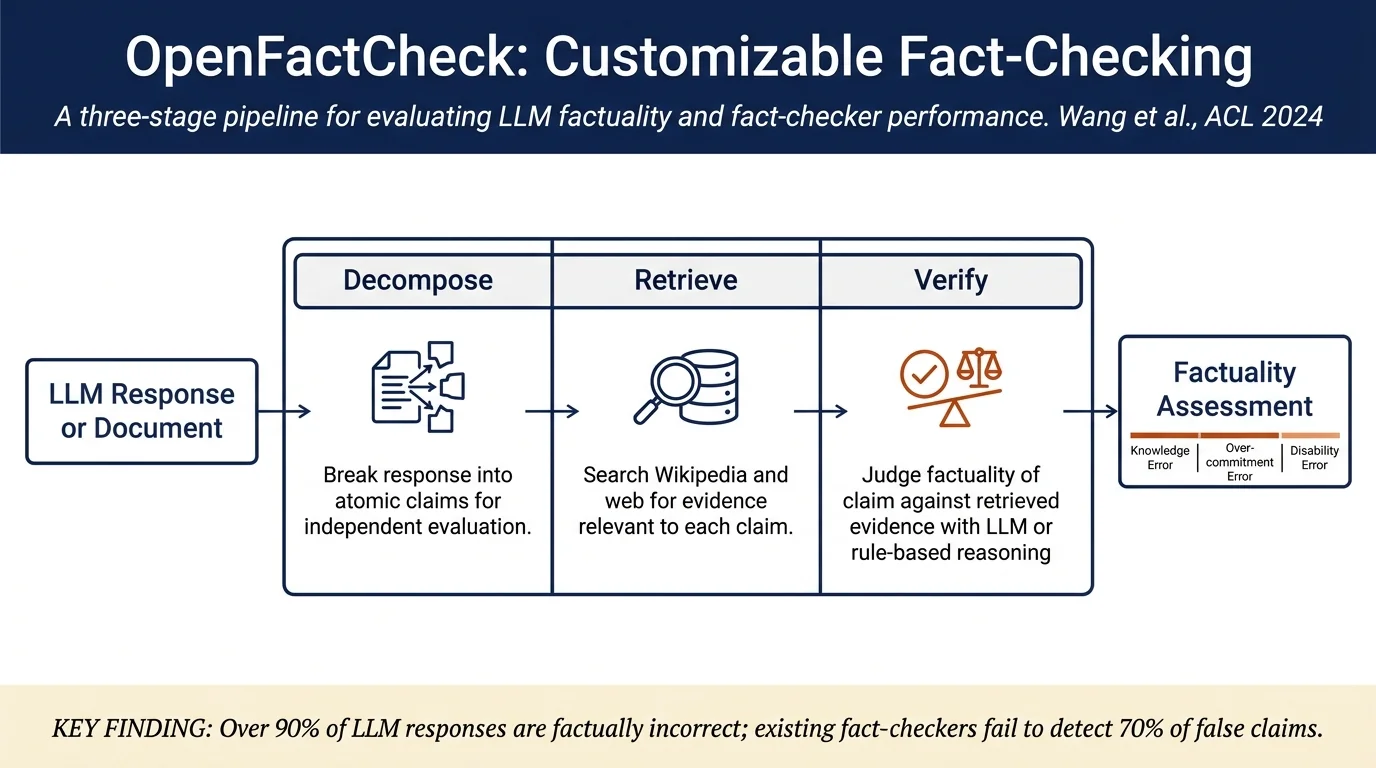
CustChecker architecture: Three-step pipeline with configurable task solvers:
- Claim processing: Decomposes documents or LLM responses into atomic claims
- Evidence retrieval: Searches relevant passages (Wikipedia, web via Serper API)
- Verification: Judges claim-document factuality; may apply Factcheck-GPT's decontextualization to refine extraction
Implements message-passing mechanism with success flags to guarantee intermediate outputs align with downstream inputs; supports partial pipeline entry for flexible workflows.
LLMEval datasets:
- Snowball (3,692 labeled + 815 unknown = 4,507 total): hallucination when model immediately outputs incorrect answer; cover math history, graph search, sports history
- SelfAware (3,369 answerable + unanswerable mix): tests unknown-knowledge awareness
- FreshQA (600 open-domain, fast-changing): rapidly-evolving answer questions
- FacTool-QA, FELM-WK, Factcheck-Bench: previously-published benchmarks
- FactQA (newly collected, 6,480 examples): spans 482 domains, 4,740 unique topics via LLM question collection from multiple corpora (Snowball, SelfAware, FreshQA, etc.)
Error types identified:
- Type1 (Knowledge error): Model lacks relevant knowledge, hallucinating or overconfident
- Type2 (Over-commitment error): Model fails to recognize false premises or provides inaccurate inappropriate responses
- Type3 (Disability error): Model unable to retrieve up-to-date information for rapidly-changing claims
Results
LLM factuality evaluation:
-
90% of LLM-generated open-domain QA claims are factually incorrect across datasets
- GPT-4 shows best performance (71.7% accuracy on Snowball, 71.8% average across three datasets); LLaMA-2 significantly lower
- <10% of open-domain claims are factually incorrect overall, suggesting models poorly calibrate confidence on unknown knowledge
- Fine-grained evaluation reveals type-specific error prevalence: knowledge errors dominate (65%+ across datasets), over-commitment errors frequent (5-30%)
Fact-checker evaluation:
- Automatic systems (RARR, FacTool, FactScore, Factcheck-GPT) all struggle to differentiate false from true claims
- Best F1 score on Factcheck-Bench: 0.63 for false-claim detection vs. 0.71 for true-claim detection (asymmetric performance)
- Verification results on three datasets (Factcheck-Bench, FacTool-QA, FELM-WK) show precision/recall variance across checkers
- Latency/cost tradeoff: FacTool (Serper + GPT-3.5-Turbo) costs $0.02 per atomic claim; Factcheck-GPT (SemanticAPI + GPT-4) 20x more expensive
Key observation: Automatic fact-checkers rely heavily on Wikipedia/web evidence; evidence retrieval effectiveness critical to final verification accuracy; reliance on external knowledge sources creates vulnerability to data voids and temporal decay.
Notes
Strengths:
- Comprehensive unified framework addressing three distinct but related problems (customization, LLM evaluation, fact-checker benchmarking)
- Large-scale FactQA dataset with fine-grained domain and error-type annotations (6,480 examples across 482 domains)
- Practical engineering: modular pipeline design with extensible plugin architecture enables production deployment
- Thorough evaluation across multiple LLMs and fact-checkers with both accuracy and cost metrics
- Public code and data release (https://github.com/yuxiaw/openfactcheck)
Limitations:
- LLMEval datasets remain limited in scale and diversity compared to web-scale misinformation; heavy bias toward academic domains (history, biography, mathematics) in top-20 domains
- Evaluation measurement depends on external knowledge sources (Wikipedia, web search); evidence availability and temporal staleness affect reproducibility
- Fact-checker asymmetry in performance (high precision on true claims, lower on false) may reflect evaluation dataset design rather than fundamental system limitation
- Paper focuses on English; multilingual generalization untested
- Error-type taxonomy (Knowledge/Over-commitment/Disability) is post-hoc; predictive models for detecting error types prospectively not developed
Future directions:
- Integration of new SOTA LLMs (GPT-4o, newer open models)
- Multilingual and cross-lingual fact-checking evaluation
- Exploration of formal verification approaches for mathematically-grounded claims
- Development of error-type-specific mitigation strategies