 Isabelle Augenstein
 Preslav Nakov
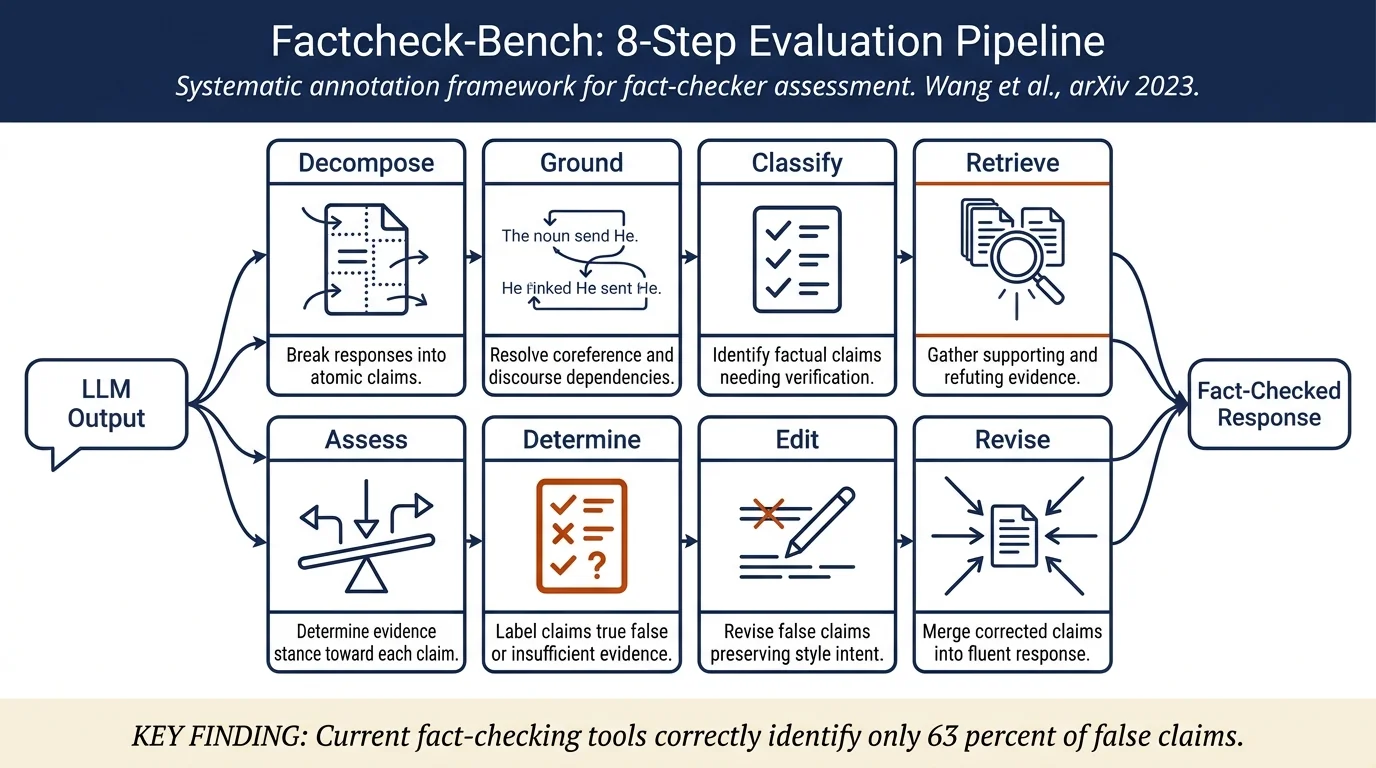
Contributions
- An end-to-end, fine-grained annotation framework for evaluating fact-checkers via eight subtasks: decomposition, decontextualisation, checkworthiness identification, evidence retrieval and collection, stance identification, correction determination, claim editing, and response revision.
- Factcheck-Bench-GPT, an open-domain document-level fact-checking benchmark with 94 ChatGPT-generated examples, 311 sentences, 678 atomic claims, and 661 checkworthy claims with multi-stage annotations.
- Empirical comparison of several fact-checking systems (FacTool, FacScore, Perplexity.ai) showing current systems struggle with identifying and correcting false claims.
Method
The annotation framework decomposes factual error detection into eight structured subtasks designed to enable granular evaluation of automated fact-checkers:
- Decompose: Break long LLM responses into context-independent atomic statements, preserving the original intent without information loss.
- Decontextualise: Handle discourse dependencies and coreference relations so claims can be verified independently.
- Identify checkworthy claims: Distinguish factual claims requiring verification from subjective opinions and commonsense statements.
- Retrieve and collect evidence: Use Google Search and other retrieval methods to gather relevant supporting or refuting documents; re-rank retrieved passages for relevance.
- Identify evidence stance: Classify whether evidence supports, partially supports, refutes, or is irrelevant to each claim.
- Determine correction: Decide whether a claim requires revision given the evidence; label as true, false, or not-enough-evidence.
- Edit claims: Revise false claims by deleting, replacing, or modifying text while preserving original style and intent.
- Revise response: Merge corrected claims back into a coherent, fluent final response.
The dataset construction prioritizes examples with high annotation quality: annotators are senior researchers familiar with fact-checking, and two raters independently label all examples before consensus-building. The final dataset includes 94 (question, response) pairs with detailed annotations across all eight subtasks.
Results
The benchmark contains 94 examples across 311 sentences and 678 atomic claims (661 checkworthy). Key findings:
- Decomposition: ChatGPT outperforms baselines in breaking responses into atomic claims. For 211 of 277 sentences, automatic and human decompositions agree (edit distance=0.11, semantic similarity $\text{SimCSE}$=0.955).
- Checkworthiness: ChatGPT achieves 81.4% accuracy; LLaMA2 reaches 69.3%. One-third of claims require manual evidence retrieval even with automatic methods.
- Evidence retrieval: Approximately two-thirds of automatically retrieved evidence is irrelevant. For claims with sufficient evidence, manual assessment is needed to determine sufficiency.
- Stance identification: Current models (ChatGPT, LLaMA2) achieve F1 scores around 0.5 for stance prediction. The label refute is frequently misclassified.
- Verification: FacTool (best false-claim detection, F1=0.63) still lags far behind human performance. Models struggle especially with open-domain false claims.
- Revision: Intrinsic metrics (edit distance, semantic similarity via BERT) show revised responses preserve original content; human preferences indicate raters favor responses without unnecessary changes.
Notes
Strengths: The eight-step framework is comprehensive and practical, capturing the full pipeline of fact-checking from decomposition to response revision. High-quality annotations from expert raters and detailed analysis of system failure modes (e.g., irrelevant evidence retrieval, refute misclassification) provide valuable diagnostic insights for future research.
Limitations: The dataset is small (94 examples) and English-only; the authors plan multilingual extensions. Inter-claim dependencies are acknowledged but not fully addressed—some claims cannot be evaluated independently. Quality of automatically-retrieved evidence is a bottleneck; relevance-improved retrieval methods are needed.
Open questions: How do multimodal fact-checkers perform on this benchmark? Can fine-tuned models on this data improve detection of false claims in LLM outputs? Do revision strategies that preserve response naturalness also preserve factual accuracy?