 Preslav Nakov
Contributions
- A novel token-level uncertainty quantification framework for detecting LLM hallucinations by measuring claim-level uncertainty directly from the model's probability distributions.
- Claim-Conditioned Probability (CCP): A method that quantifies the uncertainty of atomic claims by aggregating token-level confidence scores, designed specifically to filter out claim-type uncertainties and surface only genuinely unreliable information.
- A benchmark for evaluating token-level UQ methods based on automatically fact-checked biography generation using FactScore, covering English, Chinese, Arabic, and Russian.
- Extensive empirical evaluation showing CCP achieves ROC-AUC 0.66–0.71 across four English LLMs (Mistral 7b, Vicuna 13b, Jais 13b, GPT-3.5-turbo) and consistent improvements in multilingual settings.
- Ablation studies demonstrating the importance of CCP's design choices (aggregation method, NLI context, functional word handling).
Method
The core insight is that LLMs' token-level probability distributions encode different types of uncertainty: (1) claim-type uncertainty (which claim to generate), (2) surface-form uncertainty (which synonyms/phrasings to use), and (3) claim-content uncertainty (whether the specific information is reliable). The paper identifies that only the third type is relevant for hallucination detection.
CCP formula: Given a generated sentence $x_j$ at position $j$ and a claim type, CCP measures:
$$CCP(x_j) = P(\text{Meaning}(x_1, \ldots, j) | x_<j, \text{ClaimType}(x_1, j)) \cdot x_<j)$$
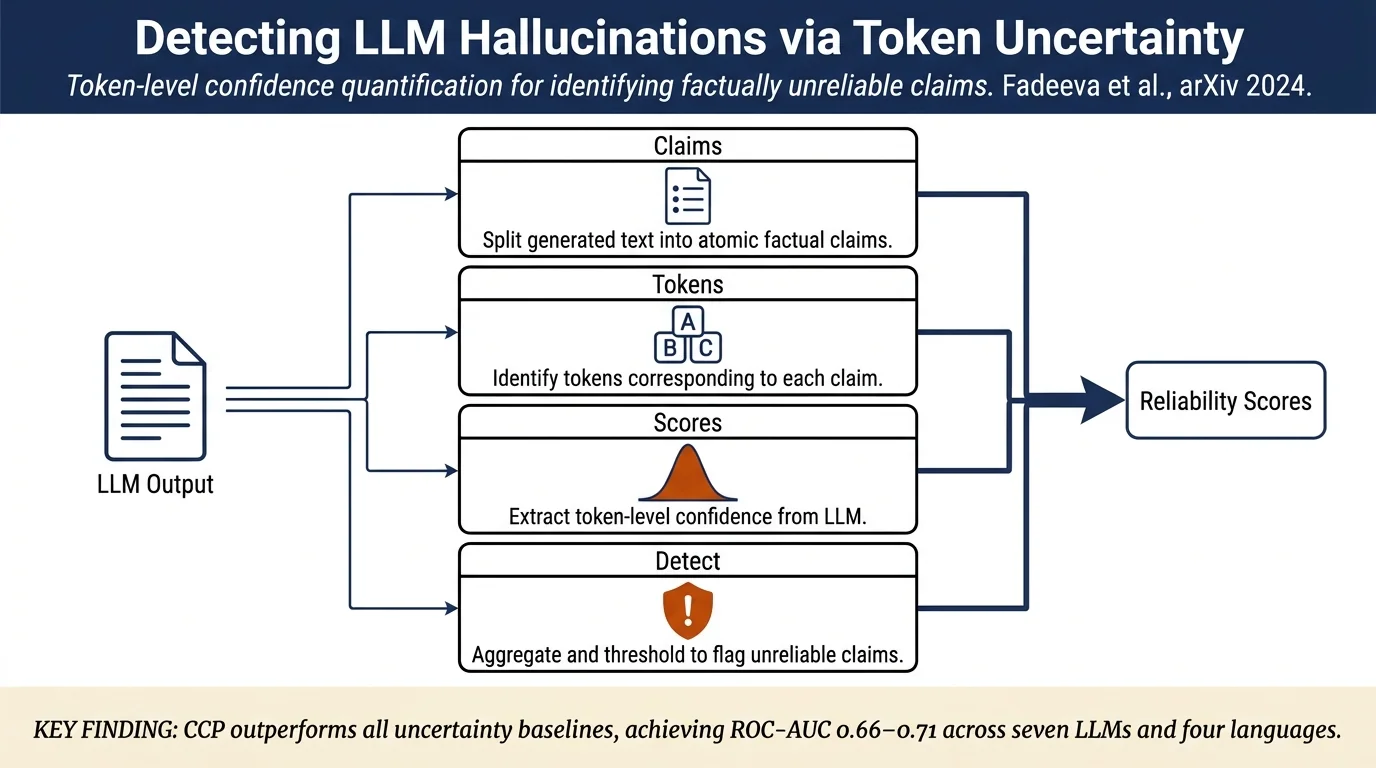
The method works by:
- Splitting LLM-generated text into atomic claims (e.g., using GPT-4).
- For each claim, identifying the words in the generated output that correspond to that claim type.
- Extracting token probabilities for those words from the LLM's output distribution.
- Aggregating token probabilities into a claim-level confidence score via the geometric mean.
- Thresholding claim-level scores to flag unreliable claims for downstream fact-checking.
The paper also introduces novel Natural Language Inference (NLI) techniques to map alternative tokens back to claim meanings, ensuring that semantic paraphrases (e.g., different phrasings of the same field of study) do not inflate uncertainty artificially.
Results
English (FactScore automatic labels):
- CCP ROC-AUC: 0.66 ± 0.01 (Mistral 7b), 0.66 ± 0.01 (Vicuna 13b), 0.71 ± 0.03 (Jais 13b), 0.58 ± 0.01 (GPT-3.5-turbo)
- CCP outperforms all baselines (maximum probability, perplexity, token entropy, P(True)) across models. Exception: P(True) is competitive on GPT-3.5-turbo (ROC-AUC 0.53).
Human annotation (English, Vicuna 13b):
- CCP ROC-AUC 0.78 (human annotation) vs. FactScore's 0.72 (automatic labels), confirming the method is reliable even with more rigorous evaluation.
Multilingual results (manual annotation):
- Chinese (Yi 6b): CCP 0.64 ROC-AUC (baseline: Max Prob 0.52)
- Arabic (Jais 13b): CCP 0.33 ROC-AUC (baseline: Max Prob 0.26)
- Russian (Vikhr 7b): CCP 0.68 ROC-AUC (baseline: Max Prob 0.63)
Ablation findings:
- Aggregation method: geometric mean outperforms arithmetic, exponential, and minimum aggregations.
- NLI context: using the claim prefix with NLI provides better results than sentence-level context.
- Functional words: handling stop words appropriately (treating them as confidence 1.0) improves performance.
Notes
Strengths:
- Strong empirical results with consistent improvements across diverse model architectures and languages.
- No external knowledge source required—CCP operates purely on LLM outputs, making it practical and scalable.
- Thorough ablation studies justify design choices and validate the importance of handling different types of uncertainty.
- Rigorous evaluation using both automatic (FactScore) and human annotation, with explicit acknowledgment of evaluation challenges (e.g., context loss in FactScore).
Limitations and open questions:
- Performance on GPT-3.5-turbo is notably weaker (0.58 ROC-AUC) than on open-source models, suggesting approach may be less effective for decoder-heavy or instruction-tuned models.
- Results on Arabic and other non-English languages show lower absolute performance, possibly due to smaller model sizes or limited training data.
- Evaluation is limited to biography generation; generalization to other domains (news, medical, scientific claims) remains unexplored.
- The method requires splitting text into atomic claims, which itself is a bottleneck (the paper uses GPT-4 for this). Error propagation from claim splitting could affect downstream performance.
Relevance to GUIDE: This work directly addresses the core problem GUIDE tackles: detecting when generated text contains misinformation. The paper's focus on factual hallucinations in LLM output is highly relevant to the broader challenge of content verification and automated fact-checking in the era of generative AI.