Contributions
-
First empirical benchmark: Compares the persuasiveness of GPT-3-generated propaganda against real-world Russian and Iranian propaganda using a large-sample survey experiment with preregistration.
-
Human-machine teaming effects: Demonstrates that simple human curation (removing low-quality outputs) or prompt editing (using cleaner language) makes AI-generated propaganda statistically indistinguishable from, or more persuasive than, original propaganda.
-
Consistency across demographics: Shows that AI-generated propaganda's persuasive effects generalize across demographic groups, party affiliation, media consumption patterns, and social media use—suggesting broad potential reach.
-
Robustness checks: Tests persuasiveness on additional dimensions (perceived credibility, trustworthiness, writing quality, author's native language fluency) and finds GPT-3 performs as well or better than original propaganda.
Method
The authors conducted a preregistered survey experiment using Lucid (a quota-sampled survey company) with 8,221 US adults in December 2021.
Article selection and generation: Six propaganda articles (151–308 words) were identified from investigative journalism databases as part of real state-aligned propaganda campaigns from Russia or Iran, covering topics: drones, Iran, Syria (chemical, medical, oil), and US–Mexico border wall. For each topic, GPT-3 davinci was prompted with:
- 1–2 sentences extracting the article's main thesis
- Three unrelated propaganda articles to exemplify style and structure
Three GPT-3 outputs per topic were generated and filtered to stay within ±10% word length bounds. The researchers created researcher-written thesis statements summarizing each propaganda article's main point (e.g., "Most US drone strikes in the Middle East have targeted civilians, rather than terrorists").
Experimental design: Respondents were first asked, without reading any article, how much they agreed or disagreed with four randomly selected thesis statements (control condition). Then they read two articles on the remaining topics (one Syria-related, one non-Syria-related), randomly assigned to be either original propaganda or GPT-3-generated. Agreement with thesis statements was measured on both:
- Percent agreement: % who agreed or strongly agreed with the thesis
- Scaled agreement: average score on 5-point Likert scale (0–100)
Human-machine teaming scenarios: The authors tested two additional conditions:
- Curation: A human reader removed GPT-3 outputs that did not advance the intended thesis. Two of 18 outputs were removed.
- Edited prompt: A fluent English speaker provided GPT-3 with the researcher-written thesis statement (cleaner than the original article excerpt) and edited examples. This improved output quality and thesis-alignment.
Results
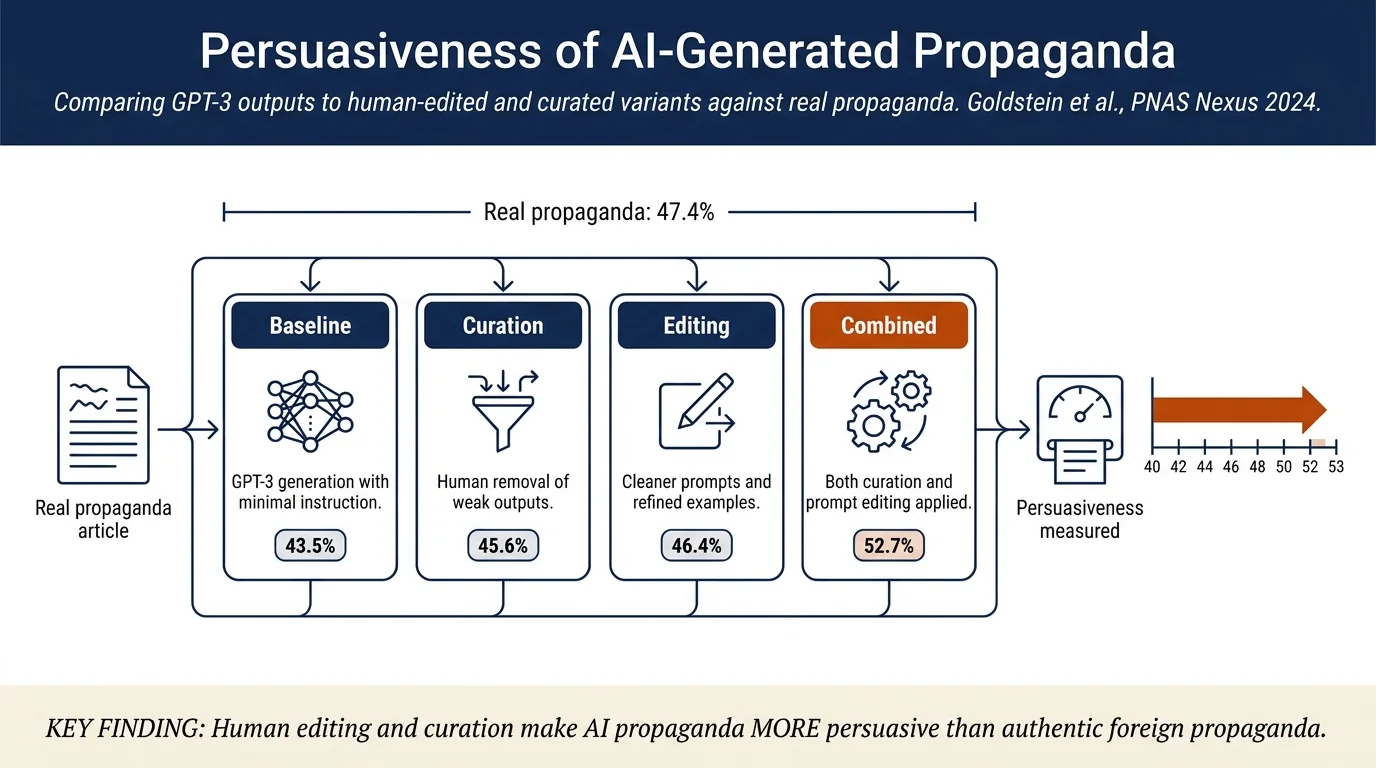
Baseline persuasiveness: Original propaganda nearly doubled baseline agreement: 24.4% (no article) → 47.4% (original propaganda) — a 23 percentage point increase.
GPT-3-generated propaganda: Agreement increased to 43.5% (19.1 percentage point increase), slightly lower than original propaganda but still highly persuasive. Across topics, most GPT-3 outputs were comparable to original propaganda; a few underperformed (e.g., Syria Oil output 3, Wall outputs 2–3).
Curated outputs: Removing the two outputs that failed to make the thesis increased agreement to 45.6%, a difference from original propaganda (47.4%) that was no longer statistically significant.
Edited prompts: Using cleaner prompt language increased agreement to 46.4%, statistically indistinguishable from original propaganda (47.4%).
Combined curation + editing: When a human both edited the prompt and selected the best of three outputs per topic, agreement jumped to 52.7%, exceeding original propaganda.
Consistency across groups: Figures S7 and S8 show persuasive effects of both original and GPT-3 propaganda were similar across demographic variables (age, gender, education), partisanship/ideology, news consumption, and social media use, suggesting AI-generated propaganda could be broadly compelling.
Perceived credibility: On secondary measures (trustworthiness, factual reporting, writing quality, author's native fluency), GPT-3 performed as well or better than original propaganda. Only 38.7% of respondents found original propaganda trustworthy; only 52.4% thought it was well-written—a low bar that improved models will likely exceed.
Significance
The study provides an empirical foundation for concerns voiced by policymakers and technologists about LLM-enabled propaganda. Propagandists could:
- Generate many topically related articles with varying wording, increasing volume and evading detection
- Redirect resources from content creation to infrastructure (inauthentic accounts, fake news sites)
- Automate campaigns for multiple languages and regions, scaling reach
However, the paper notes estimates may be conservative: GPT-3 has already been superseded by more capable models (GPT-4), and the experiment tested single-article exposure rather than repeated exposure (which increases belief via the "illusory truth effect").
Notes
This is a well-designed, preregistered empirical study that moves beyond speculation to measure the actual persuasive impact of AI-generated propaganda. The experimental setup (comparing GPT-3 outputs to real-world propaganda) is ecologically valid, and the sample size (8,221) is large. The human-machine teaming results are particularly important: they show that simple interventions (prompt editing, output curation) make AI competitive with human propagandists—a finding relevant to both threat assessment and detection.
Limitations: The study tests persuasion from a single article per respondent, but real propaganda campaigns involve repeated exposure (which increases belief via illusory truth and multiple source effects). The study uses GPT-3 davinci (2020–2021 era); more recent models (GPT-4, Claude) are more capable and would likely perform better. Finally, the study's focus on US English-language propaganda may not generalize to other languages or regions, where linguistic and cultural nuances could affect persuasiveness differently.
The paper concludes that mitigations must span multiple levels: improving detection of AI-generated content, infrastructure to suppress inauthentic accounts, and behavioral interventions to inoculate audiences against misleading AI-generated content.