 Andrew J. Flanagin
 Miriam Metzger
Contributions
- Empirical assessment of whether disinformation gains persuasive power when forwarded by close social contacts versus distant acquaintances
- Comparison of how positive versus negative false claims affect politician evaluations
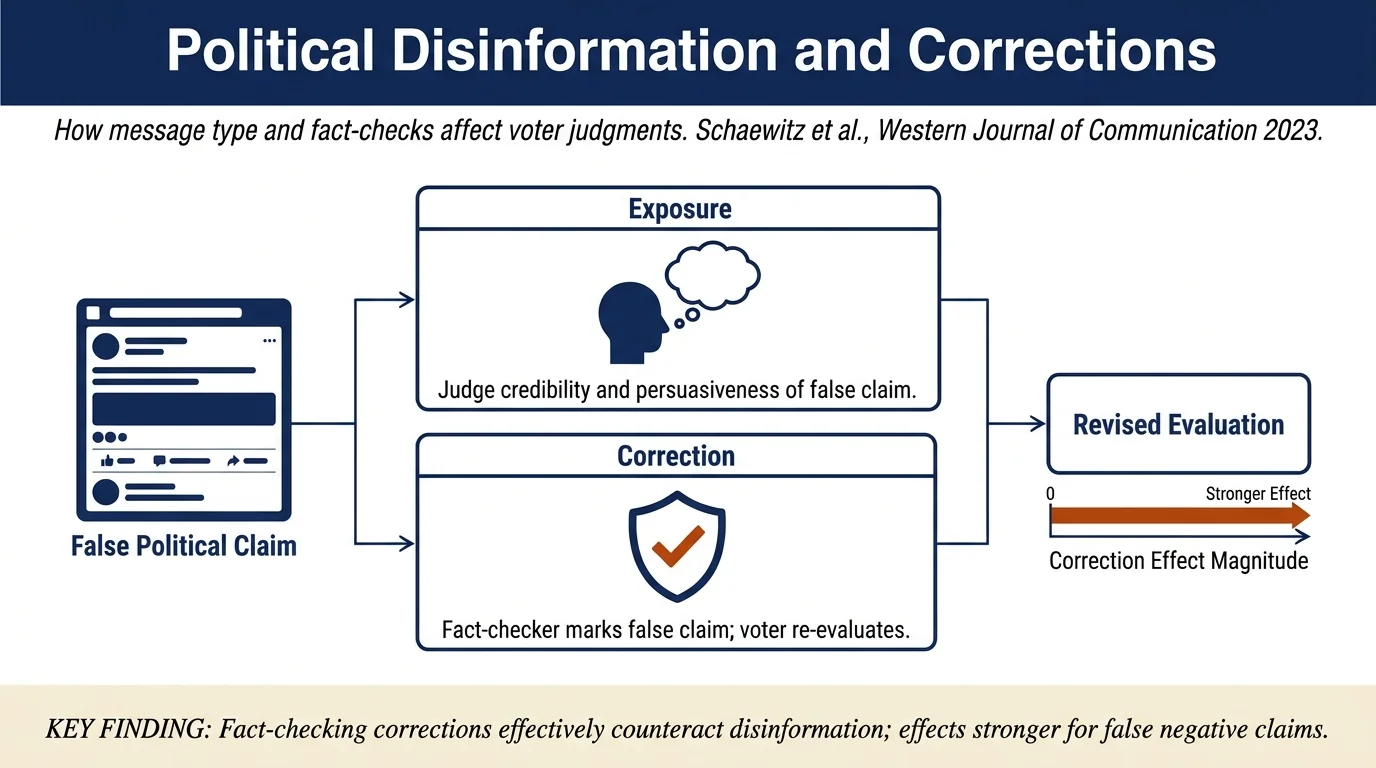
- Evidence that fact-checking corrections can mitigate disinformation effects on social media, with differential efficacy by message valence
- Demonstration that corrections to false negative claims show stronger remedial effects than corrections to false positive claims
Method
Study 1 (N=80 German participants, 2×2 lab design): Participants viewed fake Facebook posts attributing either positive or negative claims to German politicians, ostensibly shared by either a strong tie or weak tie. Fake news posts evaluated on credibility and entertainment value; politicians rated on reliability, trustworthiness, and competence before and after.
Study 2 (N=66, simplified 2-condition design): Participants saw fake posts presented as coming directly from a news feed (not shared by social contacts). Posts either positive or negative. After evaluation, participants received either no correction or a correction from a fact-checking organization (marked as false, authored by Online News). Participants re-evaluated the politician post-correction.
Both studies used semantic differential scales for politician evaluations. Exploratory Factor Analysis identified credibility and entertainment value as independent factors. ANOVA tested main and interaction effects.
Results
Study 1 findings:
- False positive disinformation rated more credible ($M=3.83$) than false negative ($M=3.14$)
- False negative posts perceived as more entertaining ($M=4.51$ vs. $M=3.49$ positive)
- Tie strength had no significant effect on credibility or entertainment ratings, contrary to hypothesis
- Perceived reach (how many others saw the post) was highest for negative claims shared by strong ties ($M=4.48$)
Study 2 findings:
- No main effect of message valence when posts presented from news organization rather than social contact
- Strong correction effect: evaluation of politician changed significantly after falshood was revealed ($F(1,76)=4.40$, $p=.039$)
- Interaction with valence: individuals corrected about false negative claims evaluated the politician significantly more positively post-correction ($M=4.41$ vs. pre-correction $M=4.02$); false positive correction led to more negative reassessment ($M=3.04$ vs. $M=3.45$)
- Suggests corrections to negative disinformation may trigger "backlash" (more negative) rather than pure correction, while positive disinformation corrections reverse prior positive evaluations
Notes
Strength: Ecologically valid Study 2 design using actual Facebook UI mockups and professional fact-checker framing; mixed experimental-observational design bridges lab realism gaps. Well-measured constructs (credibility vs. entertainment independently factored).
Limitations: Small sample sizes limit generalization; only German politicians and contexts; limited disinformation stimulus (four messages total). No pre-exposure baseline for politician evaluations (limits ability to assess over-correction). Unclear whether findings extend to other message types (health misinformation, conspiracy narratives).
Open questions: How do individual differences in media literacy or prior political attitudes moderate these effects? Does correction timing (immediate vs. delayed) affect persistence? Do corrections shared by other tie types (friend posting a fact-check) show different efficacy than institutional fact-checkers?