 Miriam Metzger
 Andrew J. Flanagin
 Christo Wilson
Contributions
- Challenges the assumption that all misinformation sharing implies belief; people share false claims for varied reasons, some intentionally.
- Taxonomizes motivations for sharing misinformation: unintentional sharing (same as news sharing), and intentional sharing motivated by sarcasm, education, collective fact-checking, entertainment, and debate.
- Demonstrates using 2.5M+ comments that a substantial portion of social media discourse surrounding misinformation expresses disbelief rather than endorsement.
- Proposes that critical social media commentary functions as a "curative" to misinformation, via social influence from skeptical sharers' commentary.
Method
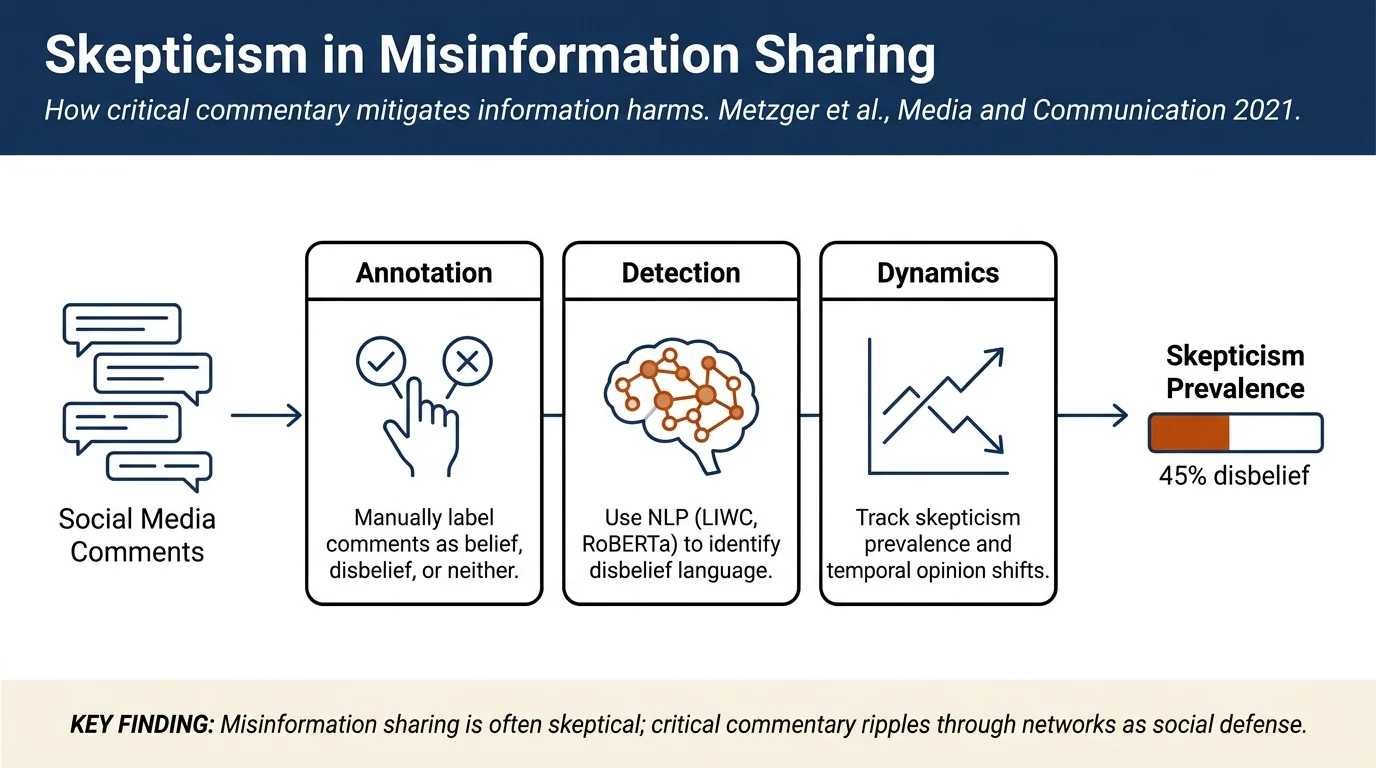
The paper reviews existing literature on news-sharing motivations, then proposes a broadened framework for misinformation sharing that includes novel motivations (sarcasm, education, collective fact-checking). To test these ideas empirically, the authors conducted a four-step study:
-
Data collection: Identified 6,809 comments on Twitter posts containing misinformation fact-checked by PolitiFact (Jan–June 2019). Posts were filtered to those with >50 comments to reduce noise.
-
Manual annotation: Two independent coders labeled each comment as expressing belief, disbelief, or neither in the misinformation. Inter-annotator agreement: 66.7% ≥80%, 88.9% ≥70%. A third coder resolved disagreements.
-
Language analysis: Used LIWC and ComLex lexicons to identify language differences between belief/disbelief comments. Applied RoBERTa (transfer-learning NLP classifier) to build an automated detector (F1 ≈ 0.86 for disbelief, 0.80 for belief).
-
Scale analysis: Deployed the classifier on a larger dataset of 1.7M+ Facebook/Twitter/YouTube comments on 5,303 fact-checked claims (Snopes/PolitiFact, through Jan 2018). Analyzed prevalence of dis/belief by claim veracity and temporal trends.
Results
Disbelief prevalence: Comments expressing disbelief rose slightly with claim falsity: 12% disbelief (true claims), 14% (mixed), 15% (false claims). Belief decreased: 26% (true), 21% (mixed), 20% (false). Critically, 45.9% of comments showed neither belief nor disbelief.
Language markers: Disbelief comments contained significantly more falsehood-awareness language (lie, propaganda, fake, false, fact, research), negative emotions, negation (no, not), and character judgments (stupid, dumb, liar). Belief comments contained more exclamation, positive emotions, and discrepancy language (should, would).
Temporal effect: Very small time effect—disbelief increased 0.001% and belief decreased 0.002% per day post-publication. At scale this represents meaningful opinion shifts, possibly driven by exposure to critical comments from skeptical sharers.
Notes
Strengths: This paper makes a valuable corrective to deterministic models of misinformation harm. The key insight—that sharing misinformation doesn't imply belief, and that skeptical commentary can ripple through networks—opens new research directions on defensive uses of social media. The empirical scale (2.5M+ comments) and use of RoBERTa for automated labeling lend credibility. The literature review on news-sharing motivations is thorough.
Limitations: The 45.9% "neither belief nor disbelief" category indicates that most comments do not signal explicit credibility stances, limiting the evidence for social influence mechanisms. The temporal effects are extremely small, and causality (whether critical comments cause opinion change or merely correlate) remains unproven. The study is limited to fact-checked claims and English-language platforms, which may skew toward higher-literacy audiences. The paper also does not validate that readers interpret sarcasm or educational sharing as intended—that's left as future work.
Follow-ups: Experimentally test whether exposure to skeptical comments actually changes recipients' credibility beliefs (via design like Colliander 2019). Measure how often sharers explicitly frame their misinformation posts with critical commentary, and how consistent that framing is. Examine whether certain types of misinformation (partisan vs. non-political) elicit different disbelief rates.