 Brendan Nyhan
 Jason Reifler
Contributions
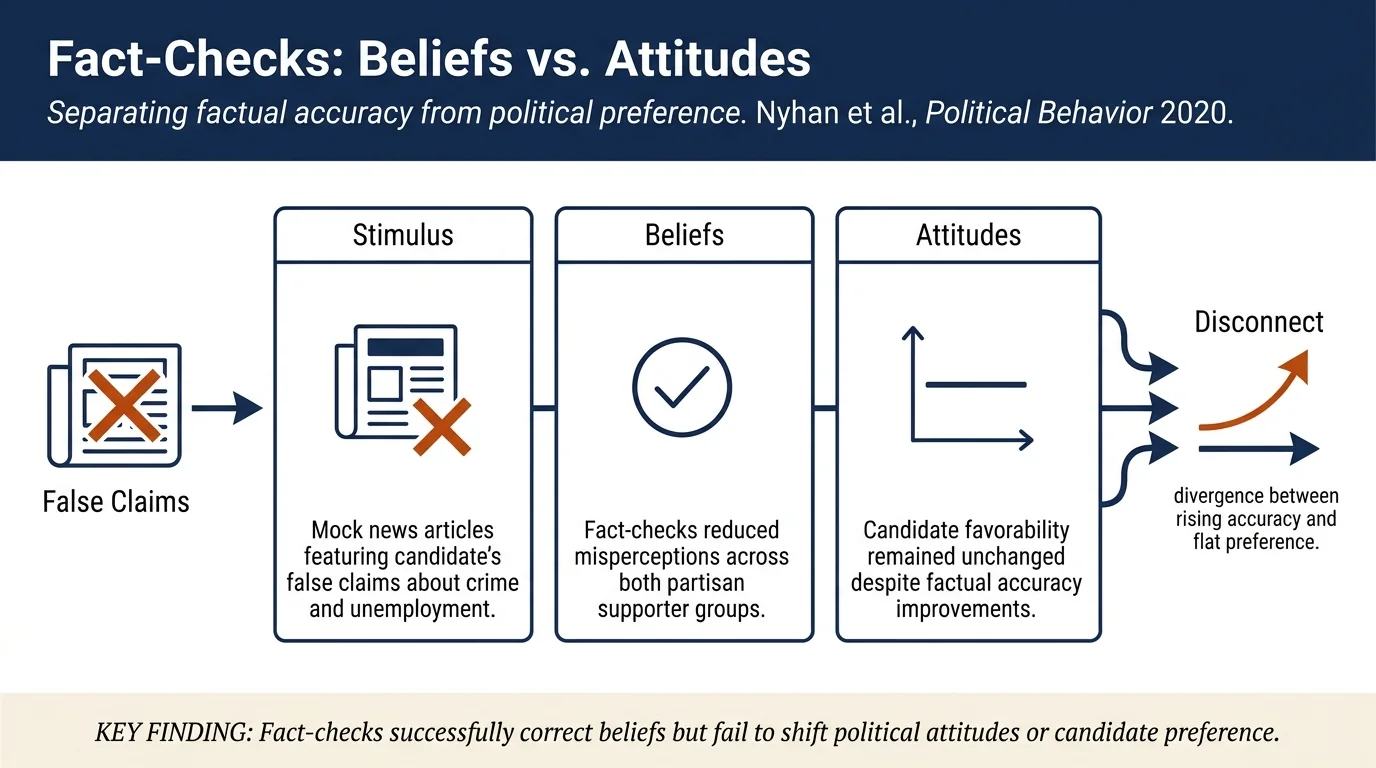
- Evidence that journalistic fact-checks can overcome motivated reasoning and reduce misperceptions about factual claims, even among partisan supporters of the candidate making the claim
- Demonstration that fact-check effectiveness generalizes across two distinct factual domains (crime and unemployment) during a high-stakes electoral context
- Documentation that motivated resistance to fact-checks exists but does not prevent belief correction in both studies
- Finding that factual accuracy improvements do not translate to changes in candidate evaluation or voting preferences, separating the effectiveness of corrections on beliefs from their political consequences
- Test of whether counter-attitudinal frames (denials, source denigration) amplify resistance to fact-checks
Method
Two experiments were conducted during the 2016 U.S. presidential campaign using realistic journalistic stimuli based on actual candidate statements:
Study 1 (Crime): Participants from Morning Consult (n=1,203) and Mechanical Turk (n=2,983) read mock news articles about Trump's claims that violent crime had increased dramatically. Treatment conditions included:
- Control: article without any political content
- Rising crime message: summary of Trump's claims
- Fact-check alone: article with FBI statistics showing long-term crime decline
- Fact-check + denial: article with fact-check plus Manafost statement challenging FBI credibility
- Fact-check + denial + source denigration: article with fact-check, denial, and claim that FBI cannot be trusted
Outcome measures assessed: factual beliefs about crime trends, perceptions of article accuracy and fairness, and favorability toward Trump.
Study 2 (Unemployment): Similar design tested during the first presidential debate (n=1,546 Mechanical Turk workers). Participants watched the debate and were randomly assigned to see coverage with or without a fact-check of Trump's claim about job losses in Michigan and Ohio during his convention speech. Additional wave conducted 5 days post-debate measured persistence of effects.
Results
Study 1 findings:
- Fact-checks significantly reduced crime misperceptions among both Trump and Clinton supporters (effect = −0.94 for Trump supporters, −0.61 for Clinton supporters on perceived crime trend, p < .01)
- Exposure to Trump's corrected unemployment claim decreased misperceptions among Trump supporters after the first debate (Table 4: effect = −0.34, p < .01)
- Counter-attitudinal frames (denial, source denigration) showed some evidence of differential effects between partisan groups, but did not prevent belief correction
- Critical finding: None of the fact-check treatments produced statistically significant effects on Trump favorability in either study (Table 3: all p-values non-significant)
Study 2 findings:
- Similar pattern: fact-checks improved accuracy about unemployment changes (decreased perceived increase) among both Clinton and Trump supporters (p < .05)
- Effects persisted at 5-day follow-up, indicating durability of factual corrections
- No corresponding changes in candidate evaluation or vote choice
Table 1 results: Fact-check reduced crime misperceptions by −0.94 standard errors among Trump supporters and −0.61 among Clinton supporters, compared to uncorrected conditions. Fact-check denial treatments (−0.74) and denial with source denigration (−1.12) also reduced misperceptions.
Interpretations: Participants in Studies 1 and 2 accepted fact-checks even when counter-attitudinal. Trump supporters evaluated articles as more accurate when fact-checks were present (Figure 2), though some viewed them as less fair. However, accurate factual beliefs did not lead to attitude change toward Trump, suggesting "literal" acceptance of facts without "serious" downstream political consequences.
Notes
This paper is important for showing both the promise and limitations of fact-checking: fact-checks do work to correct factual beliefs, even among partisan audiences and even when counter-framed. However, the disconnect between factual accuracy and candidate preference is theoretically significant and practically sobering. The finding that motivated resistance to corrections exists but does not prevent belief updating contradicts some earlier characterizations of motivated reasoning as an absolute barrier to correction. The paper's use of actual 2016 campaign statements and realistic journalistic formats strengthens ecological validity compared to laboratory corrections. The inability of fact-checks to shift candidate favorability has important implications for whether fact-checking interventions can meaningfully affect electoral outcomes, suggesting fact-checkers succeed at their stated mission (factual accuracy) but may overestimate their political influence.