Contributions
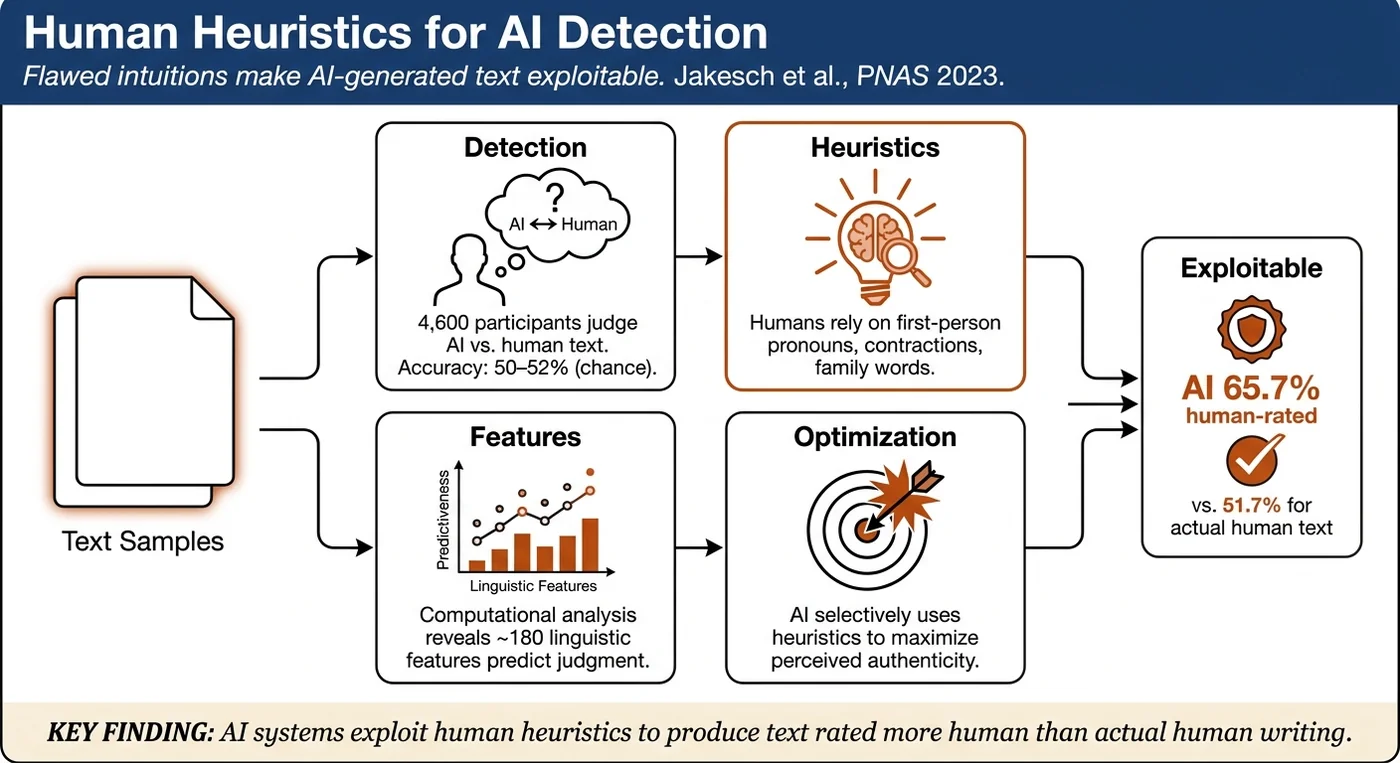
- Demonstrates that human detection of AI-generated self-presentations remains at chance level (50–52%) across professional, dating, and hospitality contexts, unimproved by monetary incentives or feedback training.
- Reconstructs the flawed heuristics humans use to detect AI-generated language through qualitative analysis, computational feature extraction, and crowdworker labeling.
- Shows that some heuristics (nonsensical content, repetition) are functionally aligned with actual AI-generation patterns, while others (grammatical errors, rare bigrams, long words) are inversely or unrelated to actual source.
- Demonstrates that AI systems can be optimized to exploit human heuristics, producing self-presentations rated as human 65.7% of the time—significantly higher than unoptimized AI (51.6%) and actual human text (51.7%).
- Proposes "AI accents"—deliberate design choices to make AI-generated language intuitively recognizable to humans—as a mitigating strategy.
Method
Experimental design: Six experiments structured as simplified Turing tests. Participants (N = 4,600 total) read online self-presentation profiles in three contexts—professional (Guru.com job profiles), romantic (OkCupid dating profiles), and hospitality (Airbnb host profiles)—and judged on a five-point Likert scale whether each was human-written or AI-generated. Half of each set was human-authored; half was generated by fine-tuned GPT-2 or GPT-3.
Main experiments: Three contexts, two language models, 7,600 total self-presentations rated (2,000–3,000 per experiment). Hospitality context used fine-tuned GPT-2 (774M parameters); professional and dating contexts used fine-tuned GPT-3 (13B parameters). Experimental treatments included monetary incentives (dating) and trial-by-trial feedback (professional) to test whether increased effort improved detection.
Feature analysis:
- Qualitative coding of open-ended participant explanations (two independent coders, 40% cited content, 28% grammar, 24% tone, 8% form).
- Computational extraction of ~180 language features: personality measures, sentiment, perspective, readability, emotional language, psychological features (LIWC).
- Crowdworker labeling task (N = 1,300): 7,000 self-presentations labeled for nonsensical content, grammatical issues, repetition.
- Logistic regression models predicting perceived AI-generation and actual AI-generation from selected features.
Validation experiments: Three additional experiments tested whether AI-optimized self-presentations (selected by trained classifiers to maximize predicted human rating) would be rated as more human than both unoptimized AI text and actual human text.
Results
Detection accuracy: Across three main experiments, participants identified source at 50.3% to 52.2% accuracy—indistinguishable from chance. Neither monetary incentives (51.6%, dating) nor trial-by-trial feedback (51.2%, professional) improved accuracy. No demographic group outperformed others.
Heuristic analysis (Table 1):
- Aligned heuristics (participant intuition matched ground truth): nonsensical content (1.10× more likely perceived as AI; 1.23× actually AI); repetitive content (1.08× perceived; 1.47× actual); conversational words (0.95× perceived; 0.90× actual).
- Misaligned heuristics (participant intuition inversely predictive): grammatical issues (1.05× perceived as AI but 0.85× actually AI); rare bigrams (1.04× perceived; 0.67× actual); long words (1.03× perceived; 0.78× actual); contractions (0.95× perceived but 1.13× actually AI).
- Nonindicative heuristics (used by participants but uncorrelated with source): first-person pronouns, family words, word count, authentic words, past-event focus.
Crowdworker labeling: AI-generated self-presentations rated as nonsensical 13.6% (vs. 9.6% human) and repetitive 12.7% (vs. 7.1% human). AI text had fewer flagged grammatical issues (14.8% vs. 19.6%). A classifier using nonsensical/repetitive labels achieved 58.8% accuracy—outperforming participants by ~7 percentage points—suggesting detectable differences exist but humans do not exploit them effectively.
Prediction models: A logistic regression on 15 selected features predicted participant judgments at 57.6% accuracy on held-out data. A language model classifier (GPT-2 sequence classification head) achieved 58.1% accuracy, showing that flawed heuristics are learnable by machines, making AI-generated text predictable and manipulable.
Validation experiments: Across three contexts, AI-optimized self-presentations were rated as human 65.7% of the time (95% CI), compared to 51.6% for non-optimized AI (p < 0.0001) and 51.7% for actual human text (p < 0.0001). Effect was strongest in professional context (71% for optimized). Optimization used different classifiers per context (regression-based for dating, language-model-based for hospitality, ensemble for professional) to maximize generalizability.
Notes
Strengths:
- Large-scale empirical study (4,600 participants, 7,600 judgments) across multiple social contexts, increasing robustness.
- Multimethod approach combining qualitative explanations, computational feature analysis, and crowdworker labeling provides independent triangulation of heuristics beyond self-report.
- Strong validation design: optimization classifiers trained on main-experiment features successfully produce text perceived as "more human than human," demonstrating predictability and manipulability.
- Addresses a timely and consequential problem—the integration of large language models into everyday communication raises real risks of scaled deception.
- Proposes concrete mitigation (AI accents) rather than just identifying the vulnerability.
Limitations & Open Questions:
- Results limited to current-generation models (GPT-2, GPT-3) and current human heuristics; future model advances or cultural shifts may invalidate findings.
- Self-presentations are a narrow, high-stakes genre; generalizability to other AI-generated content (news, code, images) unclear.
- Crowdworker labeling task used relatively simple labels (nonsensical, repetitive, grammatical); more fine-grained linguistic features might better explain ground truth.
- Validation experiments show exploitability in principle but don't address deployment-scale attacks or sustained deception over time.
- No investigation of whether domain expertise (e.g., journalists, hiring managers in the relevant field) improves detection beyond chance.
Significance for the field: The paper challenges the assumption that human-likeness in AI-generated text signals progress in machine intelligence. Instead, it frames inability to detect AI as a sign of human vulnerability to intuitive but misaligned heuristics. This reframes the problem: rather than focusing on making AI harder to detect, the field should consider "AI accents"—deliberate design choices to preserve human intuitive judgment while deploying AI-generated language responsibly.