 Manoel Horta Ribeiro
 Homa Hosseinmardi
 Robert West
 Duncan J. Watts
Contributions
- Demonstrates that isolated platform-level deplatforming of a major fringe social media site was ineffective at reducing overall user activity on fringe social media
- Introduces methodological innovation: uses longitudinal Nielsen panel data to track passive consumption across multiple platforms, addressing prior studies' reliance on active-engagement metrics (tweets, posts) that underestimate actual user behavior
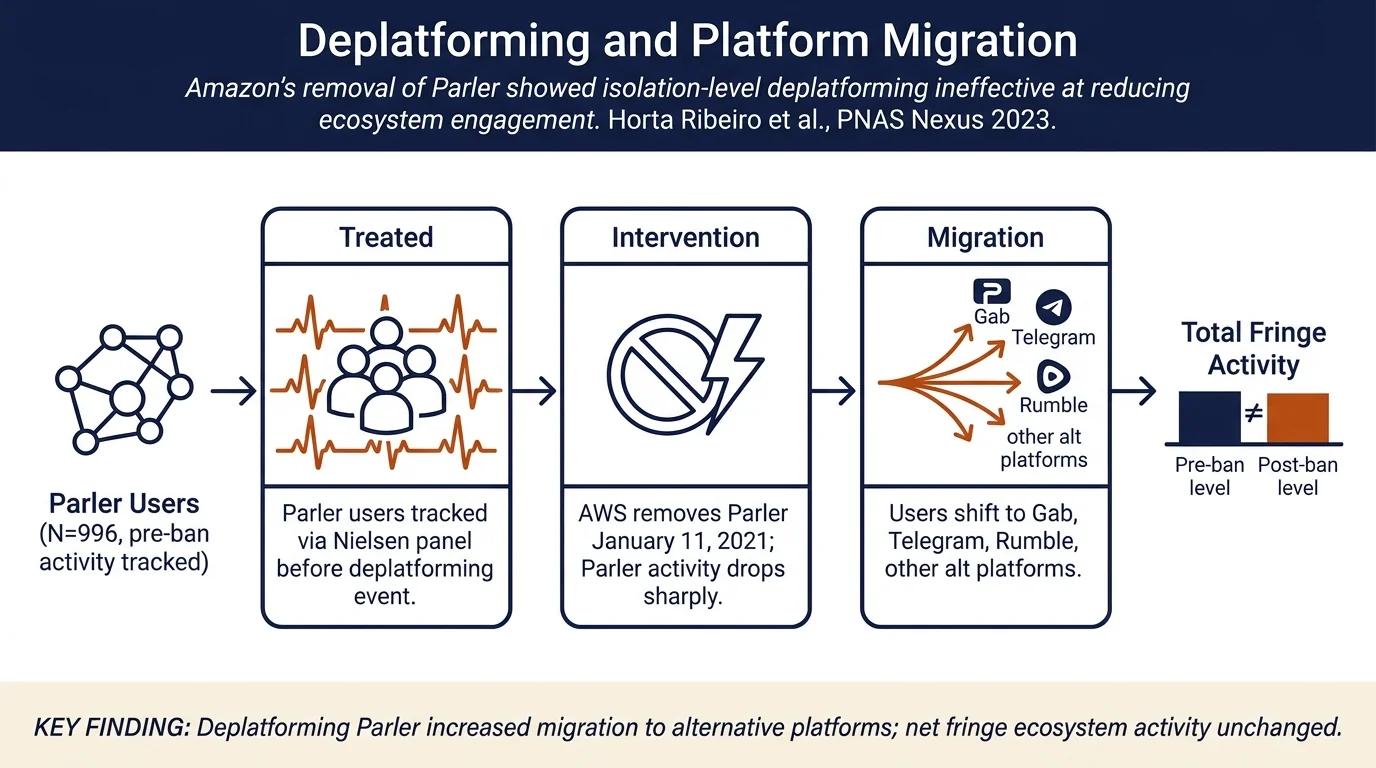
- Provides causal evidence via difference-in-differences analysis (N=996 treated users matched on sociodemographics and pre-intervention activity) that deplatforming Parler increased migration to alternative platforms without net reduction in fringe-platform engagement
- Extends scope beyond single-platform studies to encompass the full ecosystem of fringe social media where users might migrate (Gab, Rumble, Telegram, 4chan, Bitchute, Minds, MeWe, DLive, Locals, 8kun)
Method
The study uses two large panels from the Nielsen Company (adjusted to be representative of US desktop users: N=76,677; mobile users: N=36,028) tracked from August 2020 to June 2021. The authors analyze daily active user rates (visiting website or app on a given day) for Parler and other fringe social media platforms (collectively defined following Freelon et al.'s "Alt-tech" platforms: sites with lenient moderation policies that attracted groups espousing fringe or extreme views).
Identification strategy: A difference-in-differences (DiD) approach compares two matched groups over pre-intervention (December 2020) and post-intervention (January 11 – February 25, 2021) periods:
- Treated group: Users who spent over 3 minutes on Parler in December (N_desktop=135; N_mobile=209)
- Control group: Users active on other fringe platforms but not Parler in December (N_desktop=265; N_mobile=387)
Matching via coarsened exact matching on sociodemographics and pre-intervention activity (Scott binning) achieved exact matches on demographic features and low standardized mean differences for pre-intervention activity (0.028 for desktop; 0.011 for mobile), yielding final matched samples N_desktop=400, N_mobile=596.
The model estimates the causal effect $\delta$ as the difference in probability of daily activity between treatment and control groups across pre- and post-intervention periods: $Y_{it} = \gamma P_t + \lambda T_i + \delta P_t T_i + \epsilon_{it}$, where $P_t$ indicates post-deplatforming period and $T_i$ indicates treatment assignment. Parallel pre-intervention trends across all subgroups suggest the identifying assumption (trends would remain constant absent intervention) is credible; placebo testing on mainstream social media (Facebook, Twitter, YouTube) confirmed zero treatment effects, validating the approach.
Results
Aggregate trends (Figure 1): Parler's percentage of daily active users spiked following the 2020 election (desktop: 0.83%; mobile: 1.54%) and again after January 6 (desktop: 0.96%; mobile: 3.5%). Upon deplatforming on January 11, Parler's daily active users declined sharply. Critically, activity on other fringe platforms surged simultaneously, so that total fringe social media activity during the shutdown (January 11 – February 25) exceeded pre-shutdown levels. Mainstream social media activity (Facebook, Twitter, YouTube) remained constant, excluding confounding factors.
Causal effects (DiD analysis, Figure 2E):
- Activity on Parler itself: Significant decrease in daily probability of Parler use for both desktop (−7.4 pp; 95% CI [−10.4, −4.4]) and mobile (−17.6 pp; 95% CI [−21.7, −13.5])
- Activity on other fringe social media: Significant increase for treated users on desktop (10.9 pp; 95% CI [5.8, 15.9]) and mobile (15.9 pp; 95% CI [10.2, 21.7])
- Net effect across all fringe social media (Parler + others): Small and not statistically significant, indicating that migration to alternative platforms roughly compensated for the drop-off in Parler activity
Notes
This brief report makes a methodological and empirical contribution to the deplatforming literature. The use of Nielsen panel data tracking consumption rather than production addresses a critical limitation in prior work: users need not post or tweet to influence their information diet. The finding that isolation deplatforming (removing one platform without coordinated action across the ecosystem) fails to reduce overall ecosystem engagement aligns with network resilience literature (Johnson et al., 2019) showing that online hate communities are robust to uncoordinated interventions.
The study's focus on the Parler case—a snapshot event during exceptional political unrest—may not generalize to deplatforming of individual actors (Twitter accounts, YouTube channels) or smaller communities, which the authors acknowledge. Additionally, the DiD identifying assumptions (parallel pre-intervention trends, no unmeasured confounders) are plausible but testable: the parallel trends appear credible visually and placebo tests strengthen the case, though unobserved factors (e.g., media attention spikes) cannot be ruled out definitively.
The implications are significant for platform governance: isolated deplatforming appears ineffective without ecosystem-wide coordination. The paper suggests platforms would benefit from simultaneous action across multiple fringe sites or proactive intervention during periods of political unrest rather than reactive bans.