 Andrew M. Guess
 Eric Merkley
 Brendan Nyhan
 Jason Reifler
Contributions
- Tests the persistence and durability of fact-check effects using multiwave, preregistered survey experiments
- Directly examines the gap between immediate and long-term effectiveness of corrections on factual beliefs
- Demonstrates heterogeneity in treatment effects by political disposition and media trust across three countries
- Provides evidence on spillover effects to non-targeted beliefs and the role of repeated exposure
- Shows that political polarization and distrust in authorities moderate fact-check effectiveness
Method
The authors conducted 2×2 within-subjects experiments across three countries. In the United States and Great Britain, participants completed four survey waves; in Canada, participants completed either one or two waves. In each wave, respondents rated the perceived accuracy of both true and false COVID-19 claims on four-point scales. Treatment conditions exposed participants to either one or multiple fact-checks (or placebo articles in control conditions), with randomization varying across waves to test persistence and repetition effects. Outcome measures included perceived accuracy of targeted false claims and unrelated COVID-19 claims. Analyses used ordinary least squares regression with HC2 robust standard errors to account for repeated-measures design and multiple comparisons.
Results
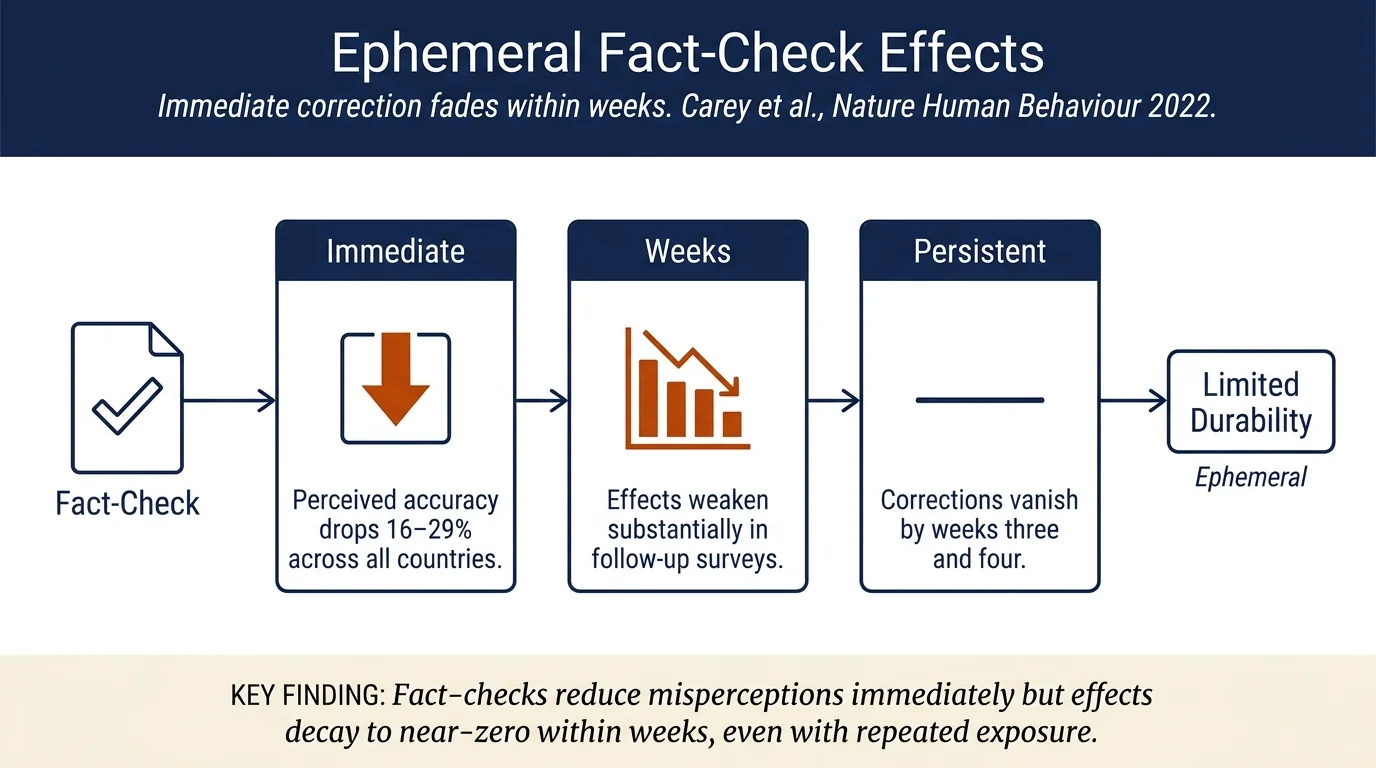
Targeted false claims: Exposure to fact-checks significantly reduced the perceived accuracy of targeted COVID-19 false claims. Treatment effects ranged from 16% to 29% across the three countries in the initial post-treatment wave. These reductions were statistically significant and substantial in magnitude.
Persistence: A central finding is the ephemerality of these effects. While fact-checks produced immediate reductions in targeted misperceptions, the effects either decayed substantially or disappeared entirely in subsequent survey waves (weeks to months later). In the US, treatment effects in wave 2 of one sample were reduced to essentially zero by wave 3; in wave 2 of another sample, effects diminished to near-zero by wave 3. Greater Britain and Canada showed similar patterns of rapid decay.
Spillover effects: Fact-checks showed minimal spillover effects to related, non-targeted COVID-19 claims. When the analyses examined accuracy judgments on beliefs about claims that were not directly targeted by the fact-checks, fact-checks did not significantly improve accuracy on these unrelated items.
Political heterogeneity: Political attitudes and trust in authorities moderated treatment effects. For example, in the US, fact-checks were more effective among Trump approvers in wave 2 (reducing misperceptions by ~41%), whereas they were less effective or even ineffective among those with low trust in health institutions. In Great Britain, the interaction between leader approval and fact-check exposure varied, with fact-checks having larger effects among those who disapproved of their national leader.
Repeated exposure: Exposure to multiple fact-checks in later waves did not substantially increase the durability of effects or produce cumulative gains relative to single exposure.
Notes
This paper makes an important distinction between immediate effectiveness and durable impact of fact-checks. While fact-checks clearly work in the moment to reduce misperceptions, the rapid decay suggests that fact-checking as a standalone intervention may have limited staying power without complementary strategies (e.g., repeated exposure, trusted messenger framing, media literacy). The finding of political heterogeneity highlights the role of motivated reasoning and trust deficits in moderating persuasion. The paper is methodologically rigorous (preregistered, multiwave, multiplewave, multi-country) and addresses an important policy question for public health communication during crises. A limitation is that the study tests only a small set of COVID-19 claims and relies on stated beliefs rather than behavioral outcomes.