 Firoj Alam
 Shaden Shaar
 Giovanni Da San Martino
 Preslav Nakov
Contributions
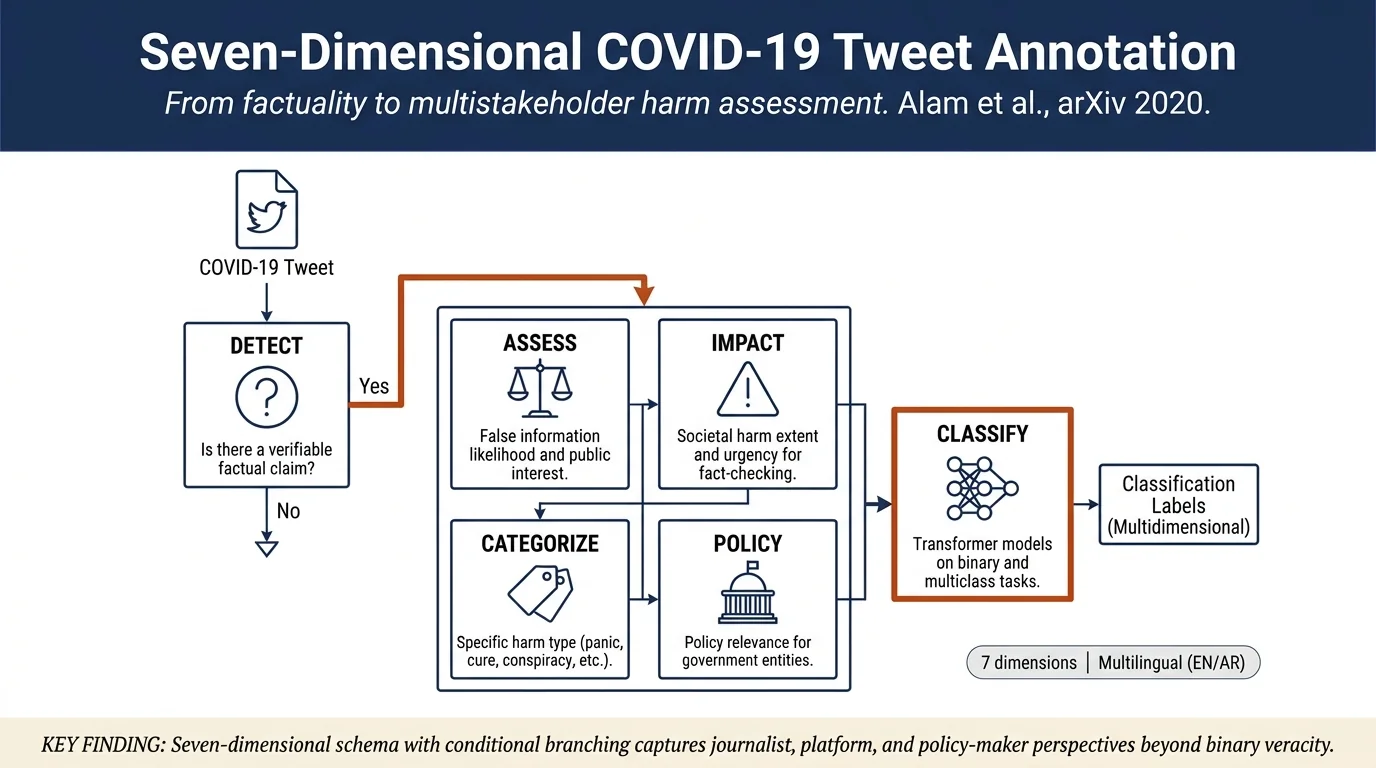
- Comprehensive seven-question annotation schema combining perspectives of journalists, fact-checkers, social media platforms, policy makers, and society—extending beyond binary true/false labels to capture nuanced harm and policy relevance
- Volunteer-based crowdsourcing annotation platform built on MicroMappers, supporting English and Arabic with dynamic conditional branching (Q2–Q7 shown only if Q1 is positive)
- Pilot annotated dataset: 504 English tweets and 218 Arabic tweets with manually verified labels across all seven questions
- Inter-annotator agreement analysis (Fleiss Kappa) showing high agreement for objective questions (Q1: $\kappa=0.9$), moderate for subjective dimensions ($\kappa=0.4$–0.5), and substantial for fact-checking urgency (Q5: $\kappa=0.8$)
- Experimental evaluation using BERT, RoBERT, ALBERT, mBERT, XLM-r, and AraBERT on binary and multiclass settings; demonstration that transformers substantially outperform FastText and majority-class baselines
- Explicit data release and open call for community participation in crowdsourcing
Method
The annotation schema is organized around seven questions:
Q1: Verifiable factual claim (objective). Does the tweet contain a verifiable factual claim (e.g., statistics, definitions, predictions, laws, correlations, images, videos)?
Q2–Q5 conditional on Q1=Yes:
Q2: False information (subjective, 5-point Likert). To what extent does the tweet appear to contain false information? (1 = definitely no false info, 5 = definitely contains false info)
Q3: Public interest (5-point Likert). Is the tweet of interest to the general public? (Claims about cures, case numbers, government measures, rumors, conspiracies typically score high.)
Q4: Societal harm (5-point Likert). To what extent is the tweet harmful to society, persons, companies, or products?
Q5: Fact-checking urgency (categorical, not ordinal). Should a professional fact-checker verify the claim? Options: (A) no need to check, (B) too trivial to check, (C) yes, not urgent, (D) yes, very urgent, (E) not sure.
Q6–Q7 always shown:
Q6: Harm type (categorical). Is the tweet harmful to society? Options: (A) no, not harmful, (B) no, joke or sarcasm, (C) not sure, (D) panic, (E) xenophobic/racist/prejudicial/hate-speech, (F) bad cure, (G) rumor/conspiracy, (H) other.
Q7: Government entity relevance (categorical). Should this tweet receive attention from a government entity or policy maker? Options: (A) no, not interesting, (B) not sure, (C) yes, categorized as Q6, (D) yes, other, (E) yes, blames authorities, (F) yes, contains advice, (G) yes, calls for action, (H) yes, discusses action taken, (I) yes, discusses cure, (J) yes, asks a question.
Annotation workflow: Tweets are shown with text only for Q1; if Q1=Yes, the full tweet (as it appears on Twitter, with links and thread context) is shown for Q2–Q7. Annotators can access instructions throughout.
Pilot annotation used three stages: (1) independent annotation of 25–50 examples by 2–5 annotators; (2) group discussion to resolve disagreements; (3) full-author discussion of unresolved cases. After each stage, guidelines were refined if needed and all previous annotations for affected questions were reconsidered.
For modeling, standard preprocessing (hashtag removal, URL/username replacement with special tokens) followed by 10-fold cross-validation. Transformer models (BERT, RoBERTa, ALBERT for English; mBERT, XLM-r, AraBERT for Arabic) fine-tuned for three epochs; due to instability, ten runs per configuration with best model selected on dev set. FastText baseline used Common Crawl embeddings.
Results
Binary classification (coarse-grained):
For English, BERT outperformed other models on 6 of 7 tasks (weighted $F_1$ scores). Key findings:
| Q | Majority | FastText | BERT | mBERT | RoBERTa | ALBERT |
|---|---|---|---|---|---|---|
| Q1 (factual?) | 45.6% | 72.8% | 87.6% | 88.3% | 90.6% | 86.5% |
| Q2 (false info?) | 79.2% | 82.6% | 86.9% | 83.1% | 82.9% | 83.9% |
| Q3 (public interest?) | 72.7% | 77.2% | 84.3% | 81.6% | 80.8% | 79.6% |
| Q4 (harmful?) | 43.5% | 69.6% | 84.0% | 82.7% | 83.8% | 78.5% |
| Q5 (fact-check urgency?) | 36.1% | 63.1% | 81.3% | 80.0% | 73.7% | 72.7% |
| Q6 (harm type?) | 69.3% | 71.6% | 86.1% | 76.8% | 81.0% | 79.2% |
| Q7 (gov relevance?) | 50.0% | 69.9% | 89.3% | 81.9% | 84.7% | 79.0% |
For Arabic, results are more heterogeneous; mBERT performed best on 4 of 7 tasks. FastText achieved competitive results, particularly on Q5 (78.6%) and Q6 (79.4%), likely due to character n-gram robustness in morphologically rich Arabic.
Multiclass classification (fine-grained):
Substantially lower scores (5–10 classes per question) but all models outperform majority-class baselines. mBERT succeeded on 4 of 6 English multiclass tasks; FastText outperformed transformers on Arabic multiclass, again suggesting that transformer overfitting is an issue on small datasets.
Data statistics:
- Q1 binary distribution: 61% YES (English), balanced across languages
- Q2 (false info): 73% judged to contain no false information (most tweets deemed credible)
- Q3 (public interest): 79% YES (skewed, expected given high-retweet sampling)
- Q4 (harmful): diverse distribution, no strong class imbalance
- Q5 (fact-check urgency): 38% "not urgent", 27% "no need to check", only 14% "very urgent"
- Q6 (harm type): 66% "not harmful" or "joke/sarcasm"
- Q7 (gov relevance): 64% "not interesting", 16% "blames authorities"
Notes
Strength: The seven-question schema is a significant methodological contribution. Fact-checking is not just about binary veracity; harm, public interest, and policy relevance are equally important for real-world deployment. The multistakeholder framing (journalists, fact-checkers, platforms, policy makers, society) is explicit and grounded in practical workflows. The conditional branching (Q2–Q5 only if Q1=Yes) reflects how annotation labor should be allocated.
Strength: Multilingual scope (English and Arabic in the pilot; platform supports arbitrary additions) reflects global nature of the infodemic. Crowdsourcing platform is openly available via MicroMappers, lowering barriers for downstream research and community participation.
Weakness: Pilot dataset is small (722 total tweets for annotation), limiting multiclass model development. Class imbalance on several tasks (Q3 Arabic: 95% YES) makes standard $F_1$ uninformative; authors acknowledge but do not apply cost-sensitive learning, threshold tuning, or macro-averaged metrics.
Weakness: Subjective questions (Q2–Q4) show moderate agreement ($\kappa=0.4$–0.5), which the authors note is typical for such tasks but suggests annotator uncertainty. No analysis of which tweet properties or question framings led to disagreement.
Data availability: Dataset is publicly released at http://doi.org/10.7910/DVN/XYK2UE with separate annotation links for crowdsourcing (English and Arabic), supporting reproducibility and future contributions.
Position: This paper frames COVID-19 disinformation as a "first global infodemic" and argues that the problem is not merely about factuality but about combinatorial harm (fake cures, panic, racism, xenophobia, mistrust in authorities). This holistic view presages later work on intent-aware and harm-aware misinformation detection.