 Gordon Pennycook
 David Rand
Findings
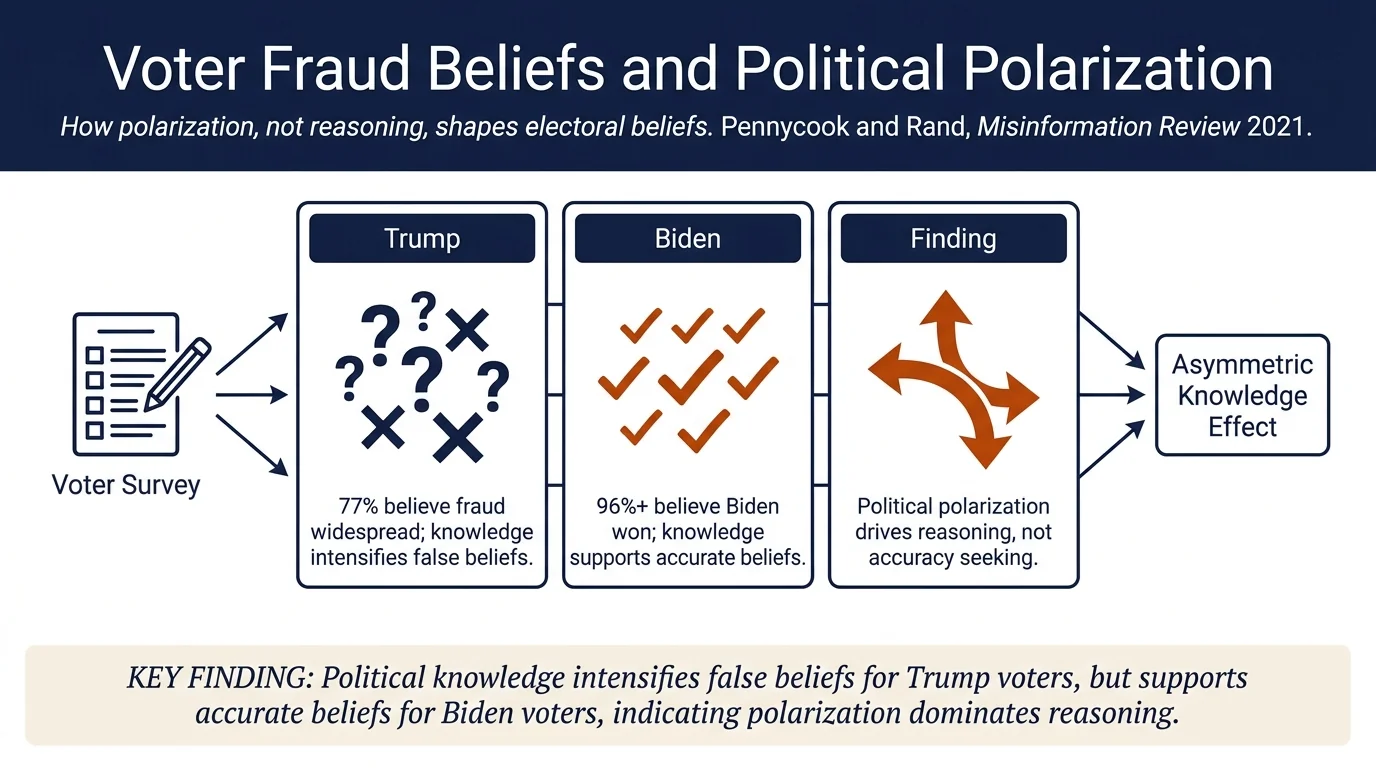
Widespread false beliefs about election fraud: A majority of Trump voters (77%) indicated that voting in the U.S. is prone to fraud (35% strongly agreed); 78% believed mail-in voting specifically is prone to fraud (46% strongly agreed). In contrast, only 26% of Biden voters believed voting is prone to fraud in general, and 27% believed mail-in voting is prone to fraud.
False beliefs about the election outcome: 65% of Trump voters believed Trump won the 2020 election (mean belief of 83 on a 0–100 scale where 100 = definitely Trump won). 67% of Trump voters believed Trump won the popular vote. By contrast, virtually all Biden voters (96%+) believed Biden won the election.
Perceived legitimacy of Biden's presidency: Only 22% of Trump voters agreed that Biden was legitimately elected. When asked what would increase perceived legitimacy, results showed: 21% would accept Biden if Trump lost his legal challenges, 6% only if Trump lost but did not concede, 11% only if Trump conceded but did not lose his challenges, and 40% would remain unconvinced regardless of these outcomes.
Political knowledge paradox: Trump voters with higher levels of political knowledge (measured via fact-based political knowledge test) and those more closely following election news held more false beliefs about whether voting is prone to fraud and whether Trump won the election. This pattern was reversed for Biden voters: higher political knowledge predicted more accurate beliefs. The correlation between media trust in mainstream outlets (CNN, MSNBC, New York Times, Washington Post, NPR, CBS, ABC, NBC) and reduced belief in fraud was significant for Trump voters ($r = -.410$), and trust in conservative outlets (Breitbart) weakly increased fraud belief ($r = -.159$).
Low partisan violence: Levels of partisan spite and endorsement of political violence were relatively equivalent between Trump and Biden voters. Substantial majorities of both groups (63.5%) rejected the idea of sacrificing U.S. economic prosperity to hurt the other party. Majorities also rejected violence justifications. Though 12% of Trump voters indicated willingness to protest if Trump did not concede, most indicated they would "do nothing in particular" (56%).
Method
Online survey administered November 10, 2020 (three days after the election was called for Biden by all major news organizations). Participants recruited via Lucid (Coppock & McClellan, 2019) with quota-matching to U.S. national distribution on age, gender, ethnicity, and region. Sample of 617 Trump voters and 1,036 Biden voters ($N_{\text{total}} = 2,667$ recruited; 2,194 retained after inclusion criteria).
Inclusion criteria required: (1) participants indicated voting for Trump or Biden in the following manner—when asked "Regardless of how you plan to vote, who do you support for President?", responses were matched to the electoral college from their state; (2) participants answered a brief open-ended attention-check question correctly ("Puppies is to dogs is is as kittens is to [blank]?"); (3) participants completed the survey.
Measures included: beliefs about election fraud prevalence (general and mail-in specific), beliefs about 2020 election outcome (general and popular vote), acceptance of Biden's legitimacy, conditions under which Trump voters might accept Biden (Trump losing court challenges, Trump conceding, etc.), forecasted behavior if Biden becomes President without Trump conceding, partisan spite, political violence endorsement, media trust in mainstream and fringe outlets, news consumption frequency and type, political knowledge (fact-based multiple choice), and cognitive reflection (4-item CRT).
Contributions
- Provides population estimate of voter-fraud false beliefs among Trump and Biden voters three days after the 2020 election
- Demonstrates that political knowledge correlates with increased false beliefs among Trump voters, contradicting classical reasoning theory and suggesting polarization dominates accuracy in political contexts
- Shows that 40% of Trump voters would reject Biden's legitimacy even if Trump conceded or lost all legal challenges
- Identifies media trust and news engagement as correlates of false election beliefs, with asymmetric patterns by political identity
Notes
Published as a research note immediately after the 2020 election, this study provides a crucial baseline snapshot of voter-fraud false beliefs during peak polarization. The key insight—that political knowledge correlates with increased false beliefs among Trump voters—challenges the classical reasoning account predicting that analytical thinking drives accuracy. Instead, the findings suggest that among highly polarized electorates, reasoning ability may be deployed defensively to justify partisan positions rather than to converge on truth.
The asymmetry between Trump and Biden voters is notable: knowledge and reasoning predicted more accurate beliefs for Biden supporters but more false beliefs for Trump supporters. This suggests either asymmetric polarization, differential elite cue adoption, or asymmetric media ecosystem effects.
One limitation is the quota-based (rather than probability) sampling, which may underrepresent the most committed Trump supporters who avoid surveys. The timing—three days after the election—captures baseline beliefs before the extended legal challenges, media campaigns, and social messaging that followed. The finding that 40% of Trump voters would remain unconvinced even under scenarios where Trump loses his legal challenges or concedes has significant implications for democratic legitimacy and suggests that electoral legitimacy, once challenged, proves difficult to restore through institutional or political mechanisms alone.