 Dean Eckles
 David Rand
Contributions
- First large-scale field experiment directly testing downstream consequences of peer-to-peer corrections on social media sharing behavior
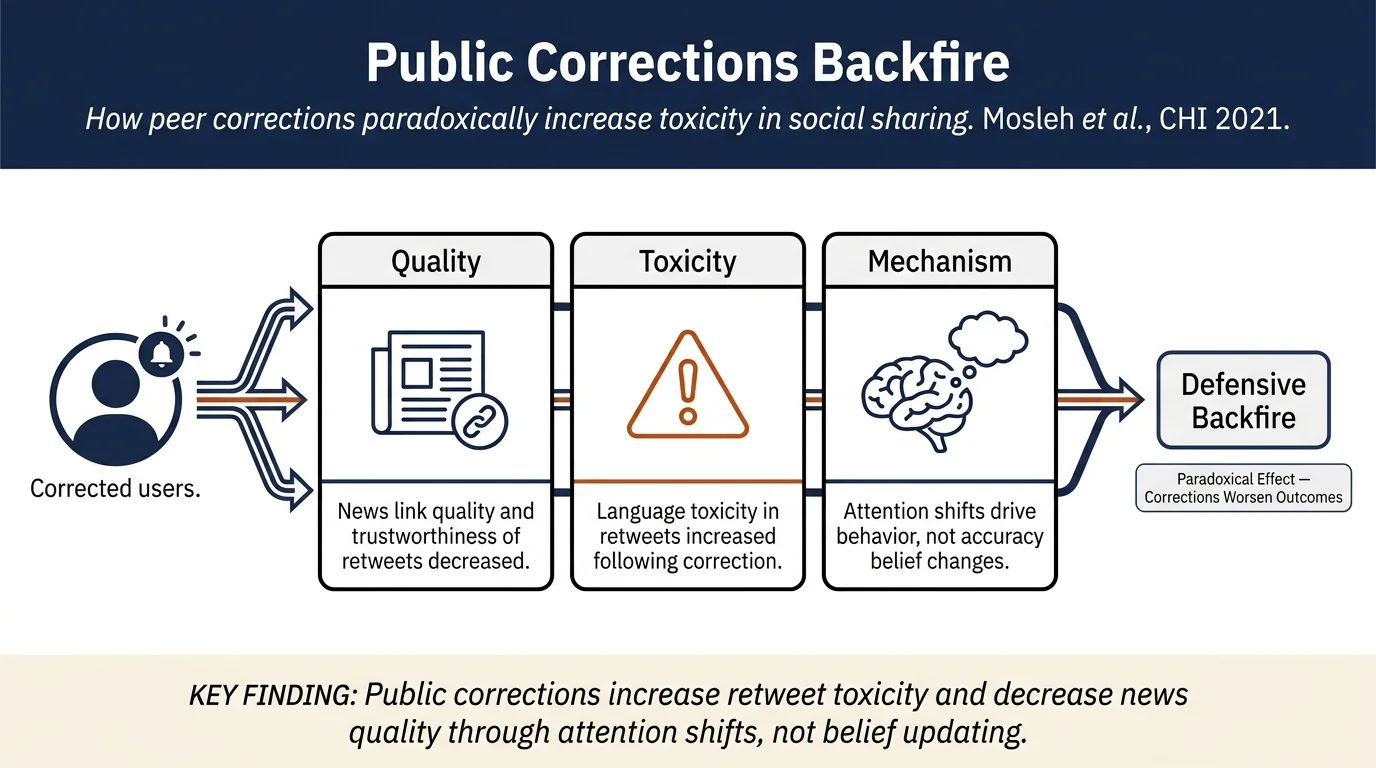
- Documents a significant backfire effect: corrections reduce content quality and increase toxicity of retweets
- Disentangles mechanisms: the effect is not mediated by changes in accuracy beliefs but by attention or preference shifts
- Provides evidence that the correction's public, confrontational nature may matter for downstream effects
Method
Twitter field experiment with stepped-wedge design:
- Participants: 2,000 users identified as having shared recent false political claims on Twitter (targeting users with liberal and conservative leanings in near-equal proportions)
- Intervention: Reply to their false-news tweets with human-generated bot accounts, containing a fact-check link to Snopes.com
- Control: 284 comparable users who did not receive corrections
- Outcome measurement: Content shared by users in the 24 hours before and after correction
- Measures:
- Quality of news links (trustworthiness of shared domains)
- Partisan slant (ideological alignment of linked content)
- Language toxicity (using Google's Jigsaw Perspective API)
- Analysis: User-day level regression with inverse probability weighting and user fixed effects
Results
Quality of shared news:
- Retweets: Being corrected significantly decreased quality (coefficient: −0.006, p<0.05); a 1.05 to 1.4% decrease in average retweet quality
- Primary tweets: No significant effect on primary tweet quality
- Overall: The effect was robust across multiple model specifications
Partisan slant:
- No significant effect on the partisan alignment of subsequently shared content
- Effect emerged only weakly in retweets when using inverse probability weighting
Language toxicity:
- Retweets: Being corrected significantly increased language toxicity (coefficient: +0.008, p<0.001)
- Primary tweets: No significant effect
- Effect was larger for retweets than for primary tweets, suggesting the intervention affects shared content more than original posting
Mechanism: The correction's effect did not extend to primary tweets, suggesting it operates through the channel of attention (users focusing on retweets over original posting) or preference shifts rather than through direct accuracy priming. The public confrontational nature of the correction may trigger defensive reactions.
Notes
Strengths:
- Large-scale field experiment with real Twitter behavior (N=2,000), not a laboratory study
- Direct causal evidence via randomized intervention timing
- Multiple outcome measures (quality, slant, toxicity) with consistent patterns on toxicity
- Thoughtful analysis of mechanisms through attention vs. preference channels
Weaknesses:
- The quality effect is modest in magnitude (1–1.4% decrease) and significant only for retweets, not primary tweets
- Partisan slant shows no significant effects, limiting generalizability of the boomerang phenomenon
- The study recruits from a limited pool of users (recent false-news sharers with known ideologies), so effects may not generalize to other populations
- No direct measurement of users' cognitive or emotional reactions to being corrected
- The 24-hour measurement window may be too short to capture longer-term behavior change
Open questions:
- Do effects persist beyond 24 hours? Does repeated correction change the pattern?
- Does the identity of the corrector (peer, platform, journalist) matter for downstream effects?
- Would private corrections avoid the backfire, or is the mechanism psychological rather than social-performance-driven?
- How do effects vary by baseline political ideology or prior history of sharing misinformation?