Contributions
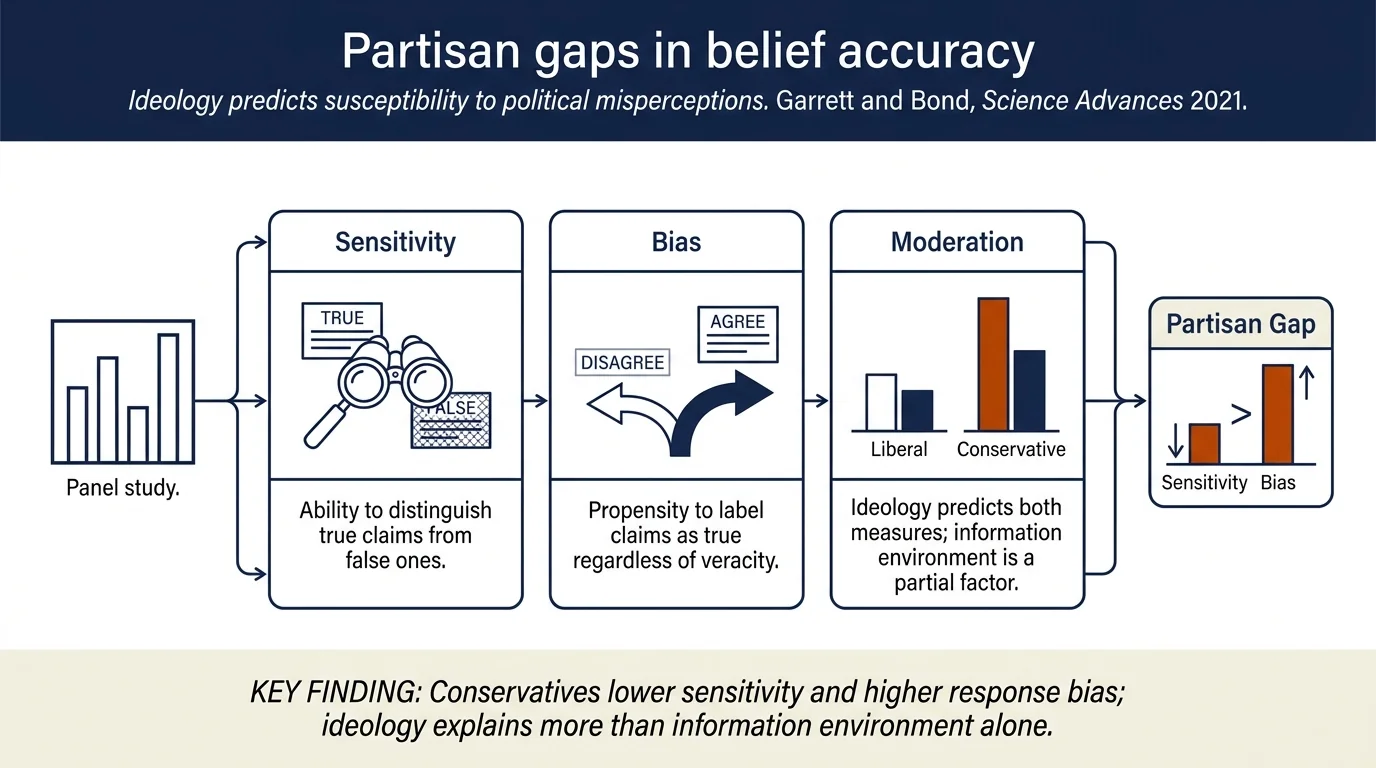
- Demonstrates robust evidence that conservatives exhibit lower sensitivity (ability to discriminate truths from falsehoods) across diverse political topics, using signal detection theory.
- Shows the role of the political information environment: high-profile true claims tend to favor the left, while false claims favor the right.
- Identifies how ideology moderates the effect: conservatives' sensitivity and response bias are contingent on whether claims benefit or harm their ingroup.
- Provides evidence that widespread political misperceptions pose a significant threat to democratic decision-making and informed citizenship.
Method
The authors conducted a longitudinal panel study over six months (January–June 2019) with a nationally representative sample of ~1,200 American adults. Participants rated 20 high-profile political claims as true or false in alternating waves. Claims were selected by engagement data from social media to ensure they reflected real-world salience, and were verified for veracity using fact-checkers and expert assessments.
The team used signal detection theory (SDT) to measure two key dimensions of belief accuracy:
- Sensitivity — an individual's ability to distinguish true claims from false ones (independent of their overall tendency to believe everything).
- Response bias — the propensity to label claims as true (higher values = stronger truth bias).
They estimated random effects regression models to examine the relationship between political ideology and these measures, controlling for age, gender, education, psychological factors (faith in intuition, need for evidence, belief that truth is relative), and time effects.
Results
Strong main effects of ideology on accuracy:
- Conservatives believed significantly more falsehoods (mean ~2 false claims vs. ~1.5 for liberals) and believed slightly fewer truths.
- Conservatives exhibited lower sensitivity (worse at distinguishing true from false) compared to liberals.
- Conservatives showed higher response bias (greater tendency to label all claims as true).
These relationships persist even after controlling for the composition of the information environment. However, the magnitude of the effect is substantially reduced when the researchers account for the fact that:
- True claims disproportionately favor liberal interests.
- False claims disproportionately favor conservative interests.
Crucially, even after this adjustment, ideology remains a highly significant predictor: the political information environment explains part of, but not all of, the conservative-liberal gap. The effect is moderated by claim type—conservatives' sensitivity and bias depend on whether claims benefit or harm their ingroup, suggesting that political motivation influences how they process information.
Notes
A landmark paper providing unusually rigorous evidence for partisan asymmetry in susceptibility to false claims. The use of signal detection theory allows the authors to disentangle perceptual discrimination ability from response tendencies, which is methodologically cleaner than simply counting correct/incorrect ratings. The paper's treatment of the information environment as a partial (not complete) explanation is important — it resists both simple blame-assignment narratives and the symmetric-bias hypothesis, instead showing that ideology and information environment interact. The limitation acknowledged by the authors is the U.S.-focused sample and the possibility that other democratic societies might show different patterns.