Contributions
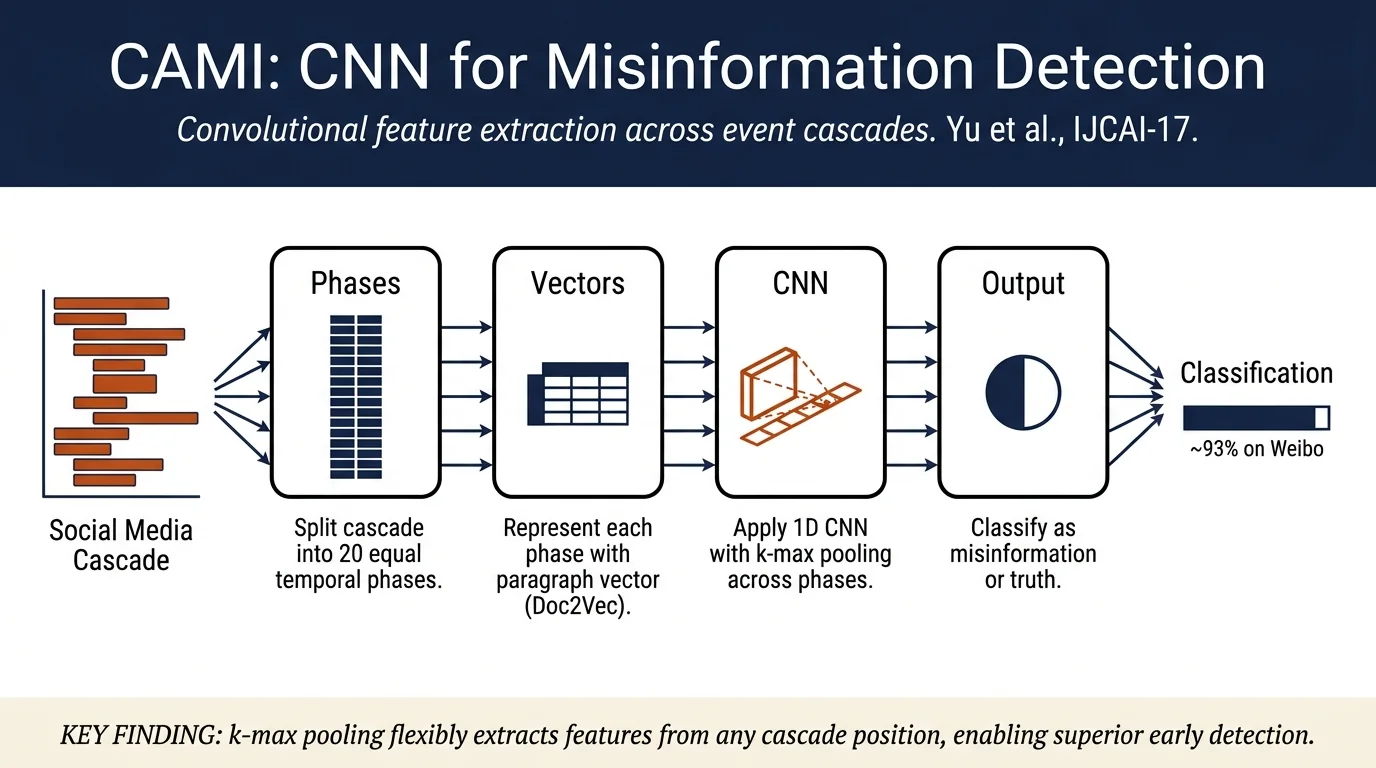
- Proposes CAMI, a CNN-based architecture using paragraph vectors to learn representations of temporal event phases and CNNs with k-max pooling to extract discriminative features for misinformation identification
- Demonstrates that CNN can flexibly extract key features scattered across an event sequence, addressing limitations of RNN methods that have bias toward recent inputs and require long sequences for accurate temporal signal capture
- Provides visualization experiments (kernel response patterns and saliency maps) showing that key misinformation-indicative features appear throughout event cascades, not just at the rear
- Achieves significant performance improvements over GRU-2 (state-of-the-art RNN baseline) and conventional feature engineering methods on both misinformation identification and early detection tasks
Method
CAMI processes social media events in three stages. First, events are split into 20 equal-sized temporal phases based on normalized timestamps (not equal time intervals, which would create imbalanced phases). Each phase groups microblog posts (tweets or Weibo posts) and is represented as a "paragraph" using Doc2Vec (paragraph vector). The resulting 20-dimensional sequence serves as input to the CNN.
The CNN architecture uses two convolutional layers with k-max pooling between them. Each convolutional layer applies 1D convolutions (filter widths 7 and 5) with tanh nonlinearity. K-max pooling captures the k largest values in each feature map while preserving their order in the sequence, enabling the model to extract salient features that may appear at any position. Finally, a fully connected layer produces the misinformation vs. truth classification via softmax.
A key insight is that misinformation cascades exhibit long-tailed distributions (most activity in early hours), and key signals indicating veracity (denial, skepticism, questioning) appear throughout the cascade, not concentrated at any single phase. The architecture exploits this by flexibly pooling across the sequence rather than relying on recurrent transitions.
Results
On Weibo dataset, CAMI achieves 93.3% accuracy, 92.1% precision, 94.5% recall, and 93.3% F1 for misinformation identification — significantly outperforming GRU-2 (91.0% accuracy) and all conventional methods.
On Twitter dataset, CAMI achieves 77.7% accuracy, 74.4% precision, 84.8% recall, and 79.3% F1 — again substantially better than GRU-2 (75.7% accuracy).
For early detection (detecting misinformation within limited time windows), CAMI dramatically outperforms competing methods. At 24 hours from event start, CAMI reaches ~90% accuracy on Weibo vs. ~80% for GRU-2 and ~60% for conventional methods. CAMI achieves high accuracy much earlier than any baseline, making it practical for deployed systems.
Visualization experiments confirm the architecture's strength: convolutional kernels show variable response patterns across early, middle, and late positions, indicating the model learns to detect diverse signals (initial claims + later responses). GRU-2's visualization shows kernel responses weighted toward early positions, confirming the reported RNN bias toward recent inputs.
Notes
Strengths: The paper makes a cogent argument for CNN over RNN in this domain — the constant recurrent matrix and bias toward recent inputs are genuine limitations for early detection. The visualization experiments effectively demonstrate that key discriminative features scatter throughout cascades. Performance gains over strong baselines are substantial and consistent across two large datasets.
Limitations: The method relies on having microblog posts available; it does not model post text content directly (only via paragraph vectors), so linguistic cues are indirect. The 20-phase discretization is somewhat arbitrary and may lose granularity in very early windows. Generalization to other platforms or languages beyond Chinese (Weibo) and English (Twitter) is unstudied.
Follow-ups: Later work might integrate post text more directly (e.g., via attention mechanisms), incorporate user credibility signals, or extend to multimodal cascades (text + images + video).