Contributions
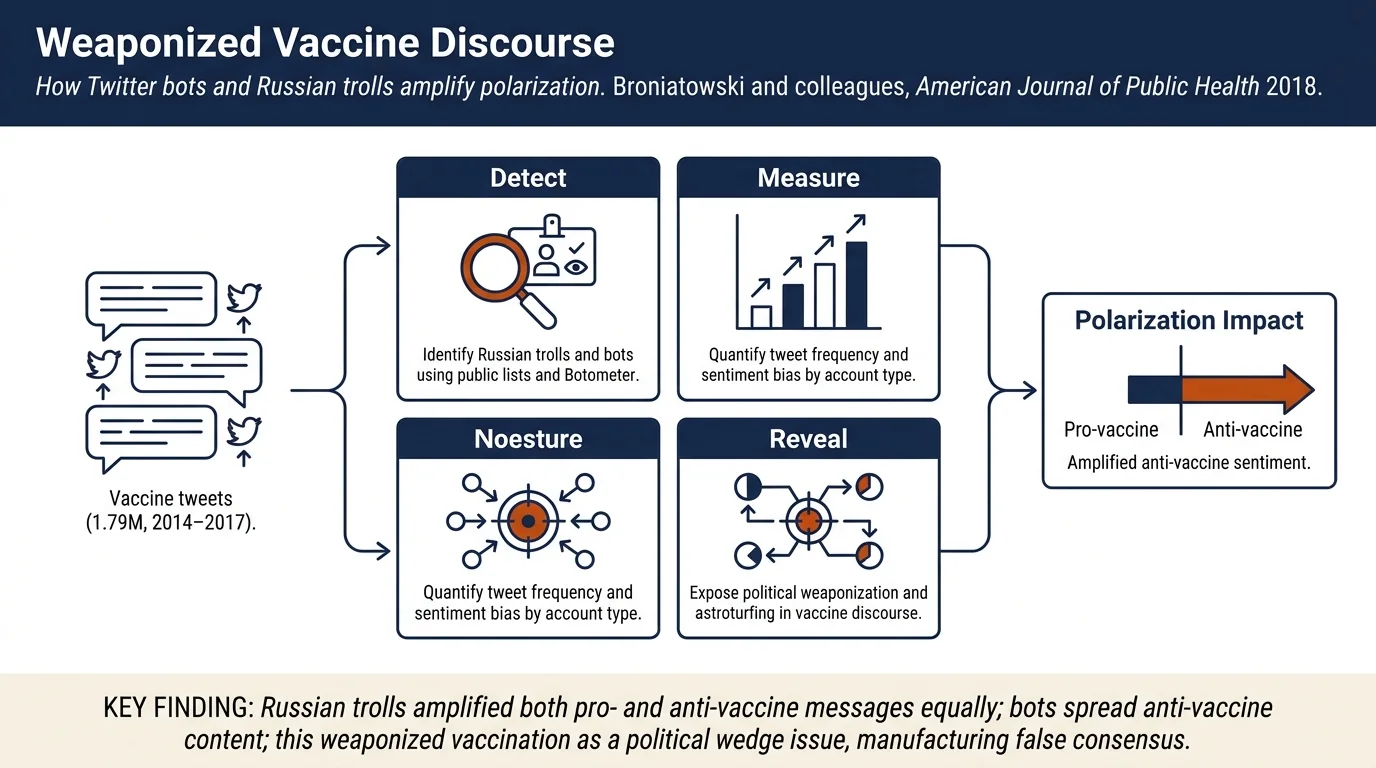
- Quantification of bot/troll impact on health discourse: First large-scale study measuring rates at which known bots and Russian trolls tweet vaccine-related content compared to average users.
- Stratification by account type and strategy: Distinguishes Russian trolls (amplify both sides for discord), commercial/malware bots (promote anti-vaccine clickbait), and sophisticated bots (high-volume amplification).
- Identification of astroturfing tactics: Documents how unidentifiable accounts create false grassroots opposition to vaccination, confounding public perception of scientific consensus.
- Qualitative analysis of #VaccinateUS campaign: Reveals Russian trolls' use of politically polarized, emotionally provocative messaging designed to exploit health policy as a domestic political weapon.
Method
Data collection: Two data sources from the Twitter streaming API (July 2014–September 2017):
- Random 1% sample of all tweets (baseline for average user rates)
- Vaccine stream: tweets containing vaccine-related keywords ("vax", "vacc")
Bot/troll identification: Extracted tweets from 7 publicly available lists of known bot and troll accounts:
- NBC News-identified Russian trolls
- Congressional list of Russian trolls
- Sophisticated bots (Varol et al.)
- Content polluters (Lee et al.)
- Traditional spambots (Cresci et al.)
- Social spambots (Cresci et al.)
- Fake followers (Cresci et al.)
Bot score classification: Applied Botometer API to segment accounts into three categories:
- <20% likelihood: very likely humans
- 20–80% likelihood: uncertain provenance
-
80% likelihood: very likely bots
Sentiment coding: Three annotators manually coded tweets as provaccine, antivaccine, or neutral using an established codebook; disagreements resolved by fourth annotator. Moderate inter-rater reliability (Fleiss κ = 0.48–0.49) achieved full consensus after two additional rounds.
Qualitative analysis: Thematic analysis of 253 tweets containing #VaccinateUS (identified as uniquely linked to Russian trolls), categorized by pro-/anti-vaccine themes and divisive messaging patterns.
Results
Vaccine tweet frequency (bots vs. average users):
- Russian trolls (NBC-identified): 102× more likely to tweet about vaccination (χ² = 102.0, p < 0.001)
- Sophisticated bots: 28.6× more likely (χ² = 28.6, p < 0.001)
- Content polluters: 7× more likely (χ² = 7.0, p < 0.001)
Content polarization and stance:
- Content polluters posted antivaccine messages 75% more frequently than average users (χ² = 11.18, p < 0.001)
- Russian trolls amplified both sides equally, with no significant skew toward antivaccine content
- Accounts with intermediate bot scores (20–80% likelihood) posted significantly more polarized and antivaccine tweets than likely-human accounts (39% polarized vs. 31%, p < 0.001; 60% antivaccine of polarized tweets vs. 35%, p < 0.001)
- Unidentifiable accounts (93% of the sample) were more polarized (χ² = 12.1, p < 0.001) and antivaccine (χ² = 35.9, p < 0.001)
#VaccinateUS qualitative findings:
- 253 total messages identified; 43% provaccine, 38% antivaccine, 19% neutral — notably balanced compared to typical vaccine hashtags
- Tweets contained grammatical errors and unnatural phrasing but fewer spelling/punctuation errors than general vaccine stream
- Distinctive political framing: appeals to "freedom," "democracy," "constitutional rights" and "government overreach" — explicitly tied vaccination to US political divisiveness
- Conspiracy theories singularly focused on US government (vs. diverse culprits in other anti-vaccine tweets)
- Novel divisive themes: racial/ethnic divisions, socioeconomic inequality, appeals to God, animal welfare — topics rarely seen in standard vaccine discourse
- Messages designed to provoke and prolong arguments; often baiting pro-vaccine users into defensive responses
Notes
Strength: Large-scale quantitative study with multiple complementary data sources and manual sentiment annotation. Clear stratification by account type reveals heterogeneous bot/troll strategies — not all automated accounts pursue the same agenda. The #VaccinateUS thematic analysis provides concrete evidence of weaponized political messaging embedded in health discourse.
Limitations: Botometer confidence scores are imperfect; 93% of tweets fall in the uncertain range (20–80%), limiting definitive conclusions about provenance. The study cannot distinguish between true human accounts and sophisticated cyborgs in this middle category. Sentiment coding (moderate initial inter-rater agreement) required consensus rounds, which may introduce coder bias.
Implications: Shows that information warfare operates through health domains, not just overtly political content. Russian interference was not narrowly anti-vaccine; rather, it amplified polarization and manufactured discord. The study highlights the "astroturfing" problem: accounts that blur the line between human and automated create the false impression of grassroots opposition. Public health communicators should avoid "feeding the trolls" with direct confrontation, which amplifies polarizing content through retweets and engagement.
Follow-ups: Mechanisms by which false equivalency erodes consensus despite high baseline public confidence in vaccines. Detection and removal strategies for cyborg and sophisticated bot accounts. Comparison of vaccine discourse with other polarized domains to characterize Russian interference patterns.