 Gordon Pennycook
Contributions
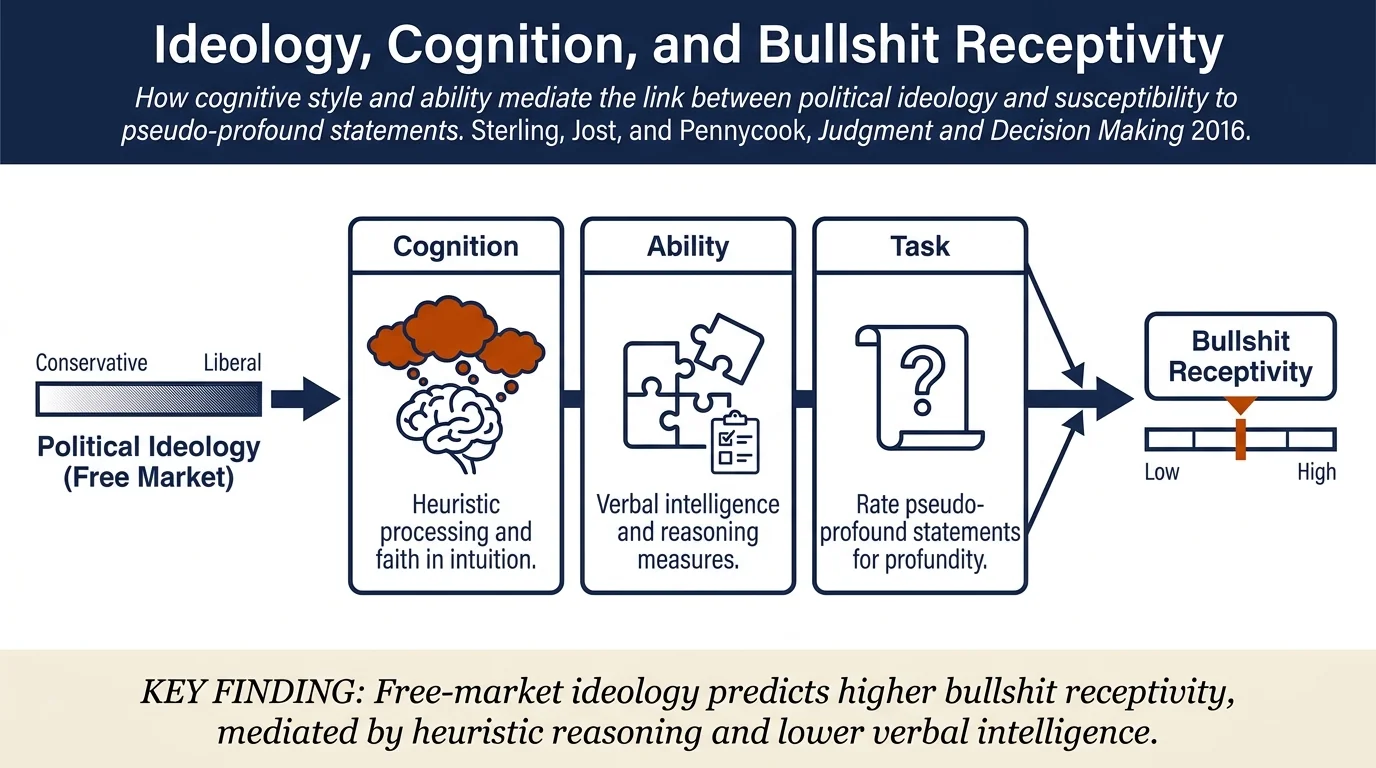
- Demonstrates a linear relationship between neoliberal ideology endorsement and bullshit receptivity ($r = .16$, $p = .046$)
- Identifies cognitive style (heuristic processing, faith in intuition) and cognitive ability (verbal intelligence) as partial mediators of this relationship
- Documents a quadratic effect where ideological moderates show higher bullshit receptivity than ideological extremists
- Tests competing theoretical positions on whether ideological differences exist in cognitive style and reasoning ability
Method
Sample: 198 U.S. residents (98 male, 100 female, $M_{age} = 36$, $SD_{age} = 11.4$) recruited via Amazon's Mechanical Turk. Participants completed the study that assessed individual differences in receptivity to pseudo-profound bullshit alongside political ideology and cognitive measures. Final sample $N = 163$ after exclusion criteria.
Bullshit receptivity measure: Participants rated 30 pseudo-profound statements on a 5-point profundity scale (1 = "Not at all profound" to 5 = "Very profound"). Statements included 20 randomly generated pseudo-profound items using buzzword generators and 10 tweets from Deepak Chopra. Items were highly correlated ($r = .88$), combined into a single bullshit-receptivity scale (mean profundity rating).
Cognitive style measures:
- 20-item Need for Cognition scale ($\alpha = .93$) measuring enjoyment of effortful thinking
- 20-item Faith in Intuition scale ($\alpha = .94$) measuring confidence in intuitive abilities
- Heuristics and Biases battery ($\alpha = .75$) measuring ability to overcome intuitive errors; higher scores indicate better performance
Cognitive ability measures:
- Wordsum task ($\alpha = .60$): 12-item verbal intelligence test
- 9-item numeracy scale ($\alpha = .57$)
- 12-item Raven's Advanced Progressive Matrices ($\alpha = .69$): abstract reasoning
Political ideology measures:
- 5-item Free Market Ideology scale ($\alpha = .81$) assessing endorsement of unregulated markets
- Single-item self-placement on fiscal conservatism (1 = strongly liberal, 5 = strongly conservative)
- Single-item self-placement on social conservatism (1 = strongly liberal, 5 = strongly conservative)
Results
Correlational findings: Free market ideology correlated with worse heuristics-and-biases performance ($r = -.26$, $p = .001$), lower need for cognition ($r = -.23$, $p = .003$), higher faith in intuition ($r = .20$, $p = .011$), lower verbal intelligence ($r = -.32$, $p < .001$), and lower abstract reasoning ($r = -.16$, $p = .04$). Endorsement of free market ideology was associated with higher bullshit receptivity ($r = .16$, $p = .046$).
Linear regression models:
Model 1: Free market ideology alone significantly predicted bullshit receptivity ($b = .006$, $SE = .003$, $t(161) = 2.01$, $p = .046$).
Model 2 (cognitive style): Adjusting for cognitive style (heuristic processing, faith in intuition, need for cognition) reduced the ideology-bullshit relationship to non-significance ($p = .53$). Heuristic processing ($b = -.895$, $p = .002$) and faith in intuition ($b = .009$, $p = .004$) independently predicted bullshit receptivity. Need for cognition did not ($p = .86$).
Model 3 (cognitive ability): Adjusting for cognitive ability measures (verbal intelligence, numeracy, abstract reasoning) also reduced the relationship to non-significance ($p = .40$). Verbal intelligence alone significantly predicted bullshit receptivity ($b = -.837$, $p = .033$), while numeracy ($p = .10$) and abstract reasoning ($p = .20$) did not.
Quadratic effects: A quadratic relationship emerged where moderate supporters of free market ideology showed higher bullshit receptivity than ideological extremists ($b = -.00027$, $SE = .00012$, $t(160) = -2.25$, $p = .026$). This curvilinear effect was reduced to non-significance after adjusting for cognitive style ($p = .17$) or cognitive ability ($p = .35$).
General ideology self-placement: Linear and quadratic effects of fiscal and social conservatism on bullshit receptivity were not statistically significant ($p > .10$), though coefficients were in the same direction as free market ideology effects.
Notes
This secondary analysis complements the original Pennycook et al. (2015) work by isolating ideological differences in bullshit receptivity—a dimension the original authors mentioned collecting but did not analyze. The key finding—that neoliberal, free-market ideology predicts higher bullshit receptivity—contradicts the intuition that liberals might be more susceptible to pseudo-profound statements due to open-mindedness. Instead, the data support classical dual-process theories predicting that simplistic, heuristic reasoning styles and lower analytical ability drive acceptance of meaningless claims.
The quadratic effect (moderates > extremists) aligns with political psychology research on ideological extremism and reasoning complexity, suggesting that both neoliberal and far-left positions entail more complex, motivated reasoning than centrist positions. However, this effect is fully mediated by cognitive style and ability measures, implying ideological differences in bullshit receptivity are reducible to underlying differences in how people process information.
Limitations: The sample is small ($N = 163$), convenience-based (Amazon Mechanical Turk), and limited to one type of bullshit (pseudo-profound statements using abstract buzzwords). The measure of bullshit receptivity may not generalize to other forms of misleading claims, particularly in political contexts where bullshit takes different rhetorical forms. The paper does not distinguish between ideological asymmetries in cognitive ability (conservatives genuinely lower in analytic ability) and ideological asymmetries in cognitive motivation (conservatives use their analytical abilities differently when evaluating politically congruent claims).
The findings are consistent with Pfattheicher and Schindler (2016), who independently found that self-identified conservatism and favorable views of Republican candidates predict acceptance of pseudo-profound bullshit using the same measure, strengthening confidence in the association between conservative ideology and bullshit receptivity.