 Qiaozhu Mei
Contributions
- Novel use of enquiry/question posts as early signals for rumor detection, rather than relying solely on rumor debunking or fact-checking signals
- Algorithm that clusters signal tweets (enquiries and corrections) to identify emerging controversial topics at scale
- Statistical classifier that ranks candidate rumor clusters by likelihood of containing disputed factual claims, achieving 50%+ precision on benchmark data
- Evaluation on real-world events (Boston Marathon bombing) and everyday tweet streams demonstrating scalability
Method
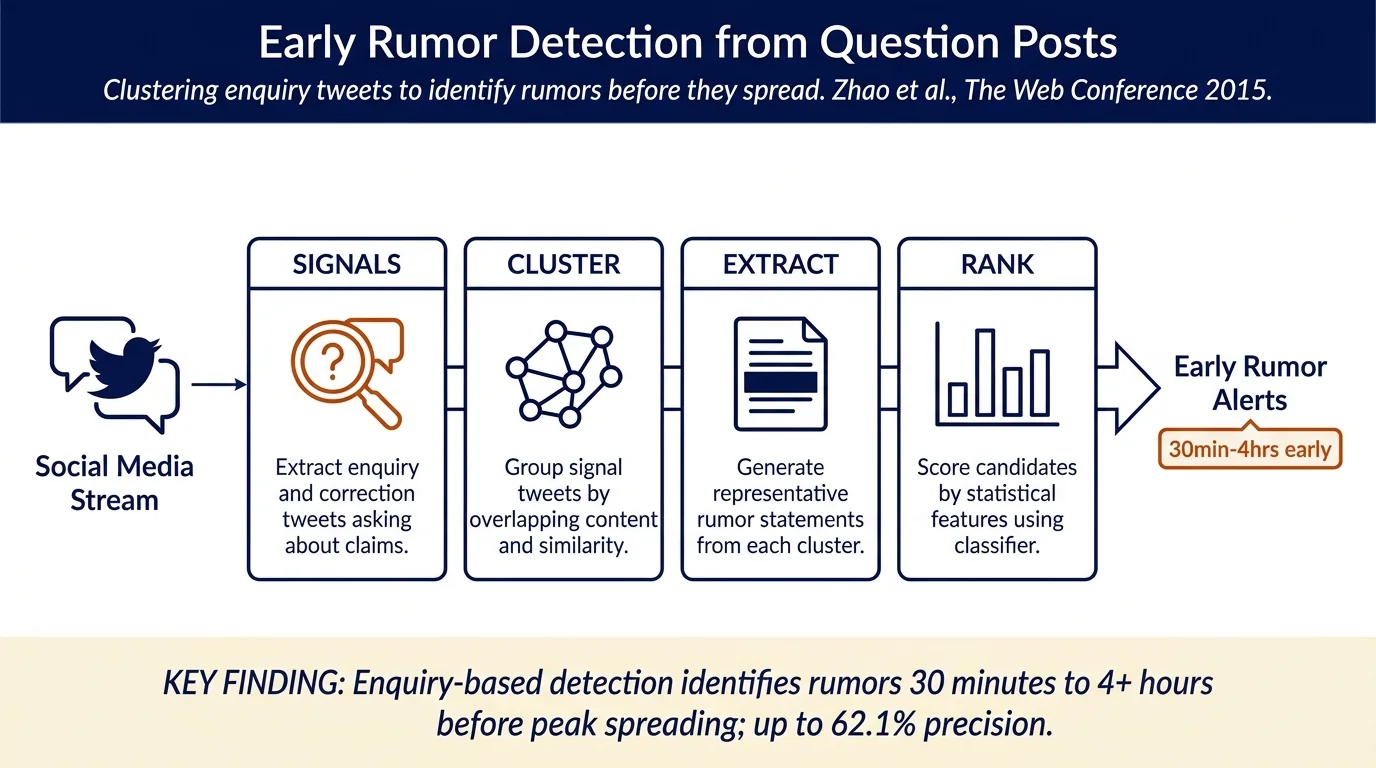
The paper defines a rumor as a controversial and fact-checkable statement that may be true or false, appearing on social media. The core observation is that when rumors emerge, users post questions asking whether claims are true—these enquiry posts are observable early signals.
The algorithm proceeds in five steps:
-
Identify Signal Tweets: Use regular expressions to extract enquiry tweets (asking verification or correction questions) and correction tweets (debunking or expressing skepticism). Examples: "Is this real or hoax?", "Is this true or false?", "RT @AP Breaking: Two Explosions in White House".
-
Identify Signal Clusters: Cluster signal tweets based on overlapping content—grouping all enquiries about the same claim together. Uses connected-component clustering on a graph where edges connect tweets with high similarity.
-
Extract Statements: For each cluster, extract a representative statement defining the common claim. This becomes the rumor candidate's summary statement.
-
Capture Non-signal Tweets: Match all remaining (non-enquiry, non-correction) tweets against the signal cluster summaries to find related discussion tweets that discuss the rumor without explicitly questioning or correcting it.
-
Rank Candidate Rumor Clusters: Extract statistical features (percentage of signal tweets, entropy of word frequency, tweet length statistics, retweet ratios, URLs, hashtags, @mentions) and train a classifier to rank clusters by likelihood of containing a disputed factual claim.
Results
Evaluated on the Boston Marathon bombing event (April 15, 2013) and the Gardenhose everyday tweet stream:
- Boston data: Detected 110 rumors from the stream of tweets related to the bombing; average precision above 50% among top-ranked candidates
- Earliness: Enquiry-based detection identifies rumors 30 minutes to 4+ hours before peak spreading
- Precision/recall: Using correction signals only, achieved 52.1% precision; using both enquiries and corrections, achieved up to 62.1% precision
- Scalability: Processed over 1 billion tweets efficiently; framework scales to massive Twitter streams using Hadoop
Notes
Strong contribution: the use of enquiry posts as early signals is intuitive and novel, providing a detection mechanism that can act before rumors spread widely. The statistical ranking approach is pragmatic but relatively lightweight—later work explores more sophisticated NLP and network-based ranking methods. The paper demonstrates real-world applicability on an impactful event (Boston Marathon bombing) and shows the method generalizes to everyday rumors in diverse tweet streams. Limitation: relies on explicitly formulated question tweets, which may miss rumors that spread primarily through assertions or corrections without questioning.