 Miriam Metzger
Contributions
- Tests the differential persuasive potential of personal versus organizational message sources in motivating social media–facilitated activism
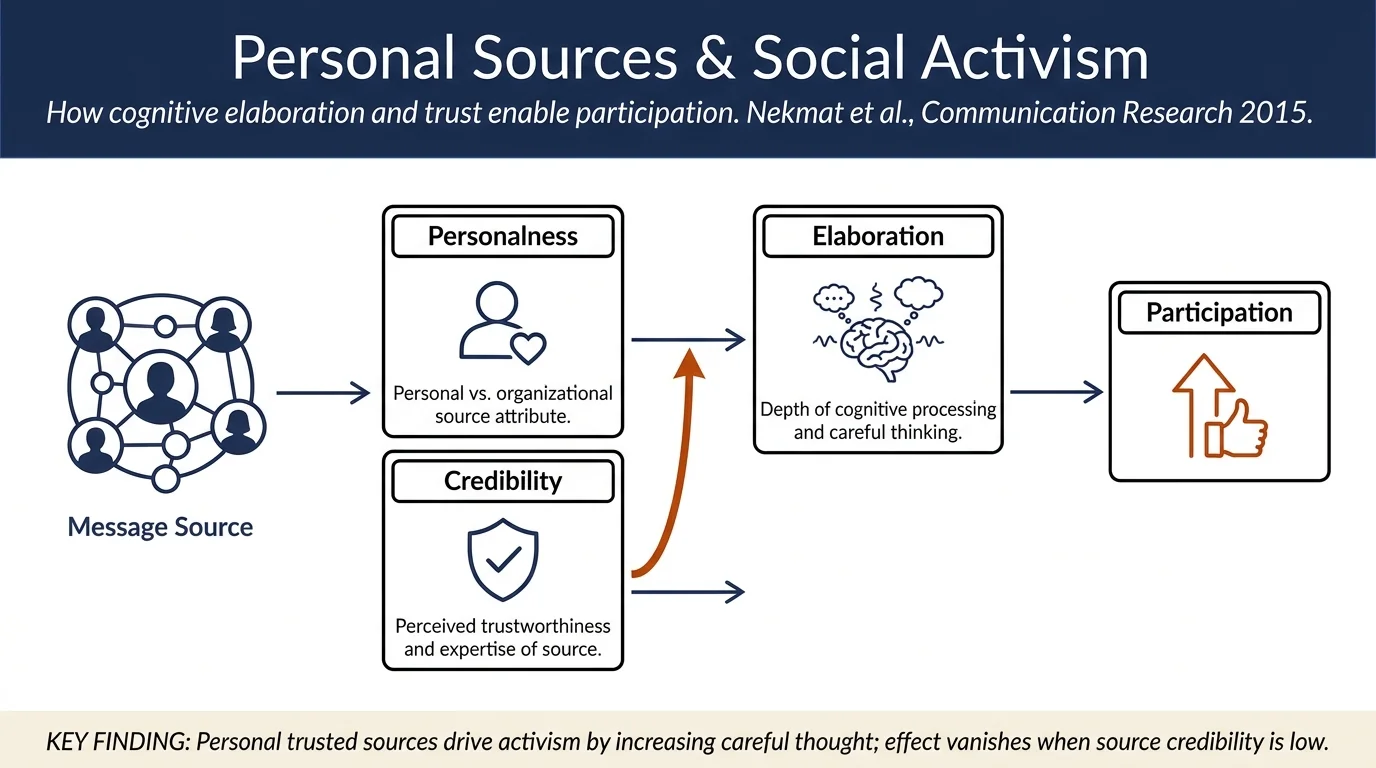
- Demonstrates that cognitive elaboration (the degree to which recipients thoughtfully process a message) mediates the influence of source personalness on collective-action participation
- Shows that perceived source credibility moderates the relationship between personalness and cognitive elaboration, strengthening the indirect effect
- Extends elaboration likelihood model (ELM) theory to the social media activism context by examining how source characteristics interact with cognitive processing
Method
Online experiment with 208 undergraduate participants from a Southeastern U.S. university (mean age 19.2 years, 66% female). Participants received an environmental activist message about campus park removal, manipulated as coming from either a personal source (a friend or family member) or an organizational source (an official student environmental group). The message was identical across conditions; only the attributed source varied. After exposure, participants completed questionnaires assessing: (1) cognitive elaboration on the message (measured via two items on careful reading and amount of thought), (2) perceived source credibility (believability, knowledgeability, trustworthiness), and (3) personal issue involvement and attitudes toward activism (control variables). The dependent variable was willingness to participate in eight specific collective-action activities (ranging from low-effort, like commenting on Facebook, to higher-effort, like joining the activist group).
Results
Direct source effects (H1): Personal sources were significantly more influential ($M = 5.44$, $SD = 1.21$) than organizational sources ($M = 4.02$, $SD = 1.49$; $F(1, 207) = 543.13$, $p < .001$). This translates to a large effect size ($\beta = .44$, $R^2 = .27$, adjusted).
Mediation through cognitive elaboration (H2a–H2b): Cognitive elaboration significantly mediated the influence of source personalness on collective-action participation ($B = .35$, $p < .01$). The indirect effect remained significant after controlling for personal issue involvement and attitudes toward activism ($Sobel Z = 3.35$, $p < .01$, 95% CI: [.046, .171]).
Moderation by perceived source credibility (H3–H5): Perceived source credibility moderated the relationship between personalness and cognitive elaboration ($F(7, 200) = 14.62$, $p < .01$, $R^2 = .44$). Specifically, when perceived source credibility was high ($M + 1 SD = 6.80$), the indirect effect of source personalness through cognitive elaboration on collective-action participation was significant ($B = .495$, $p < .01$); when credibility was at the mean ($M = 5.55$), the effect remained significant ($B = .258$); when credibility was low ($M - 1 SD = 4.29$), the indirect effect was not significant ($B = -.020$).
Activity-level effects (RQ2): Personalness of source was most influential for the low-effort "Like" activity ($M_{\text{personal}} = 5.13$, $M_{\text{organizational}} = 1.75$) and least influential for the high-effort uploading materials activity ($M_{\text{personal}} = 4.11$, $M_{\text{organizational}} = 1.75$).
Notes
The finding that the personalness-elaboration-participation pathway only operates under high credibility has important practical implications: even a trusted personal contact will not motivate elaboration if the receiver perceives the source as not credible (e.g., if the friend is known to have poor judgment on environmental issues). Conversely, organizational sources may face an inherent disadvantage not simply because they lack the personal touch, but because recipients invest less cognitive effort in messages from institutional actors they perceive as distant or potentially self-interested. The mediation pattern suggests that thought is the operative mechanism—people don't simply comply because a trusted friend asked; rather, the trust makes them willing to think carefully about the message, and that careful thinking drives their decision to participate. The activity-level ranking (easy "Likes" most susceptible to source effects, hard-work activities least) is consistent with the idea that personal appeals are most effective for low-barrier actions, which aligns with related research on "clicktivism" and low-commitment activism. Sample limited to undergraduate students (young, relatively homogeneous); effects may differ in older populations or cross-cultural contexts. Measurement of cognitive elaboration relied on self-report (two items) rather than behavioral indices or think-aloud protocols, which could introduce social-desirability bias.