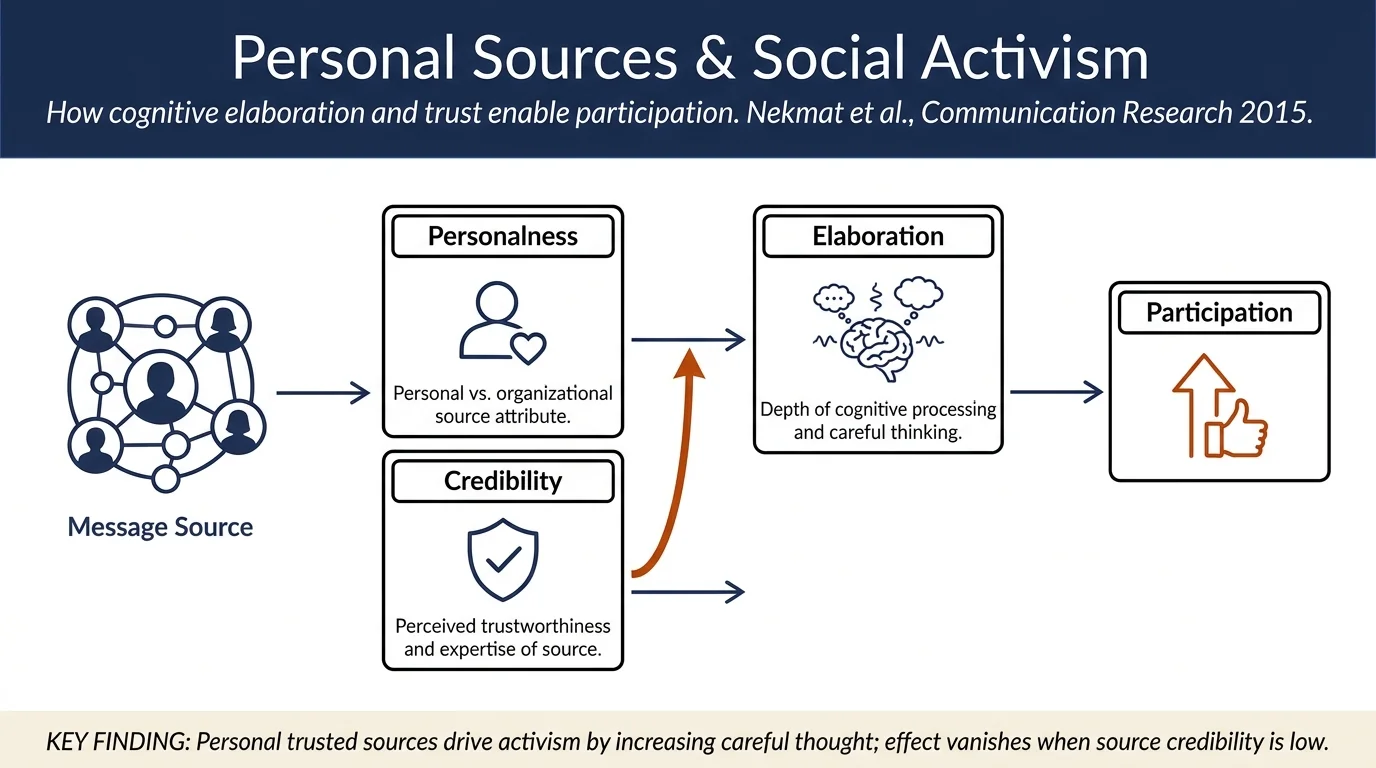
Cognitive processing refers to the mental activities through which individuals encode, interpret, and evaluate information. In the context of misinformation research, cognitive processing encompasses two broad approaches: heuristic (quick, automatic, based on mental shortcuts) and systematic (effortful, deliberative, based on detailed analysis). These processing modes affect how susceptible individuals are to misinformation, how effectively corrections work, and what interventions can build resistance to false claims.
Dual-process models
The Elaboration Likelihood Model (ELM) proposes that message persuasiveness depends on the amount of cognitive effort (elaboration) a recipient invests:
Central route (high elaboration). When people carefully analyze a message—examining arguments, considering evidence, linking claims to their own knowledge—they form attitudes based on substantive evaluation. These attitudes are more stable, resistant to counterargument, and predictive of behavior. Central-route persuasion requires sufficient cognitive resources (attention, motivation, ability) and typically occurs for personally relevant topics.
Peripheral route (low elaboration). When cognitive resources are scarce or the topic seems irrelevant, people rely on peripheral cues: source attractiveness, credibility, emotional appeals, sheer repetition. Peripheral-route attitudes change more easily and are less predictive of behavior, but peripheral persuasion is faster and requires less effort from both source and recipient.
Implications for misinformation: False claims using peripheral cues (emotional language, impersonation of trusted sources, repetition) can achieve high persuasiveness without substantive scrutiny. Corrections that assume people will engage in detailed analysis often fail because targets never invest the cognitive effort to evaluate the corrective information.
Individual differences in cognitive processing
Need for cognition. Individual differences in the tendency to engage in effortful thinking correlate with resistance to misinformation. People with high need for cognition think more carefully about messages, verify claims more rigorously, and are less susceptible to peripheral persuasion tactics. High need-for-cognition individuals also show less comparative optimism about their own credibility assessment abilities—they're more aware of their own fallibility.
Cognitive style and flexibility. Flexible thinkers (those who can hold multiple perspectives, challenge their own assumptions, integrate new evidence) are better at evaluating messages from diverse sources and updating beliefs appropriately. Rigid, closed-minded cognitive styles are associated with greater belief polarization and resistance to corrective information.
Cognitive aging. Older adults show declining effortful processing capacity, particularly under time pressure or high cognitive load. This correlates with higher fake news sharing rates in some studies and greater susceptibility to peripheral persuasion. However, older adults' domain knowledge and experience can partially compensate for processing limitations.
Source credibility and elaboration
Cognitive elaboration is not independent of source characteristics. People invest more mental effort in messages from personally close, trustworthy sources than from impersonal or low-credibility sources. This can be beneficial (trusted sources motivate protective scrutiny) or risky (people may uncritically accept information from trusted sources without verification).
The reverse also holds: high cognitive elaboration on a low-credibility source's message does not guarantee resistance to persuasion—if the message is well-argued or emotionally resonant, careful thinking may actually increase acceptance of falsehood.
Interventions targeting cognitive processing
Prebunking (inoculation). Teaching people to recognize persuasion techniques—loaded language, false appeals to authority, emotional manipulation—builds cognitive resistance by training pattern recognition before misinformation is encountered. This operates by reducing peripheral processing; techniques become salient, triggering central-route skepticism.
Accuracy salience. Making accuracy a focal concern (e.g., asking people to rate the accuracy of multiple claims before exposure) increases effortful processing and reduces susceptibility to false headlines. Effects are stronger than making people feel silly for falling for misinformation (shame is less effective than accountability).
Slowing down. Encouraging deliberative processing—asking for reasons or additional consideration—increases attention to claim veracity and reduces susceptibility to false headlines. This effect operates at scale in social media: a brief delay or prompt for reflection reduces sharing of misinformation without reducing sharing of accurate content.
Fact-checking under elaboration. Corrections work better when recipients invest cognitive effort in evaluating the corrective information. Corrections presented with supporting evidence and reasoning are more persuasive than bare denials, particularly for high-need-for-cognition individuals. However, corrections often fail because targets don't engage in sufficient elaboration.
Related topics
- Persuasion — how cognitive processing mode shapes message effectiveness
- Source Credibility — how source characteristics affect effort level
- Psychology of misinformation — cognitive biases and belief formation
- fact checking effectiveness — when corrections succeed or fail
Key papers
- Connective-Collective Action on Social Media: Moderated Mediation of Cognitive Elaboration and Perceived Source Credibility on Personalness of Source — Demonstrates empirically that cognitive elaboration mediates the influence of source personalness on collective-action participation; shows this indirect pathway operates only under high perceived credibility, illustrating the interaction between processing depth and source characteristics in persuasion.