Collective action refers to joint activities undertaken by groups of individuals to pursue shared objectives or causes. In the context of misinformation research, collective action encompasses both grassroots activism, social movements, and organized campaigns—phenomena where individuals' willingness to participate is shaped by information received, sources they trust, and how they process persuasive messages about collective goals.
Forms of collective action
Connective-collective activities. Lower-barrier, digitally native forms of activism enabled by social media: commenting on posts, "liking" content, sharing campaign materials, following activist pages, signing online petitions. These activities require minimal time investment and no formal organizational membership, yet they aggregate into visible expressions of support and can mobilize larger movements.
Organizational collective action. Higher-barrier activities: joining activist organizations, attending physical protests, donating money, enrolling in campaigns that require ongoing commitment. These typically involve formal institutions and require more sustained individual involvement.
Networked movements. Large-scale coordination across networks where individuals are loosely connected through personal relationships (friends, family) and social media rather than formal organizational structures. Examples: Arab Spring, Occupy Wall Street, Black Lives Matter.
Determinants of participation
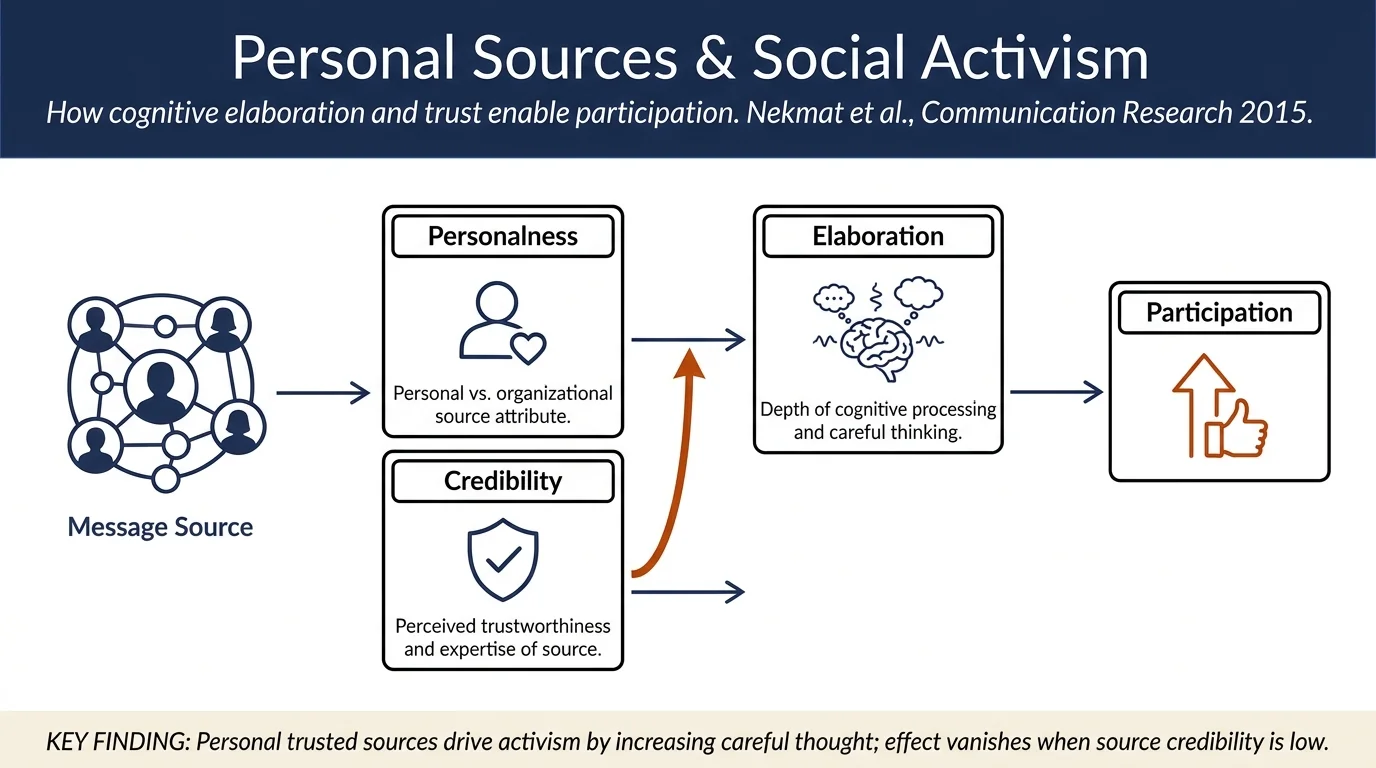
Message source characteristics. People are significantly more willing to participate when messages come from personally trusted sources (friends, family) versus institutional or organizational sources. This personalness advantage operates through increased cognitive elaboration—individuals think more carefully about messages from trusted sources, and this deeper processing drives action.
Credibility and trust. The persuasive advantage of personal networks is moderated by perceived source credibility; messages from trusted personal contacts are only influential if the receiver also perceives them as credible on the issue at hand. High-credibility sources can motivate participation even without organizational backing; low-credibility sources fail even when personally close.
Cognitive processing. The amount of cognitive effort individuals invest in evaluating a persuasive message—thinking carefully about its content, connecting it to their own beliefs, considering implications—predicts participation. This "cognitive elaboration" can be triggered by both the importance of the issue to the individual and the characteristics of the message source.
Network effects. Individuals' decision to participate is influenced by observation of others' behavior and visibility of support within their social networks. Visible participation by friends or high-status network members increases participation rates.
Low-barrier versus high-barrier activities. Online activism follows a gradient from minimal-effort acts (liking, sharing) to substantial commitments (organizing, donating, protesting). Social media's affordances make low-effort activities more accessible, and participation in easy activities can lead to escalation toward more substantial commitment.
Misinformation implications
Collective action amplifies both legitimate information and misinformation. Coordination and mobilization around false claims—whether through organic movement or deliberate disinformation campaigns—can scale falsehood into apparent consensus or mass behavior. The same psychological and social mechanisms that enable grassroots activism can amplify conspiracy theories, political propaganda, and health misinformation.
Conversely, correcting misinformation at the collective-action level (before mobilization) requires understanding how source trust and cognitive elaboration operate in distributed networks, rather than relying solely on claim-level fact-checking.
Related topics
- Social media and misinformation — platform affordances enabling coordinated action
- Persuasion — psychological mechanisms of message influence
- Source Credibility — how trust in sources shapes action
- Social networks and online communities — structural properties of networks affecting diffusion
Key papers
- Connective-Collective Action on Social Media: Moderated Mediation of Cognitive Elaboration and Perceived Source Credibility on Personalness of Source — Experiment (N=208) testing how personalness of message source, cognitive elaboration, and perceived credibility interact to influence willingness to participate in connective-collective activities on social media; demonstrates moderated mediation: personalness → elaboration → participation, conditional on high credibility.