 Stephan Lewandowsky
Contributions
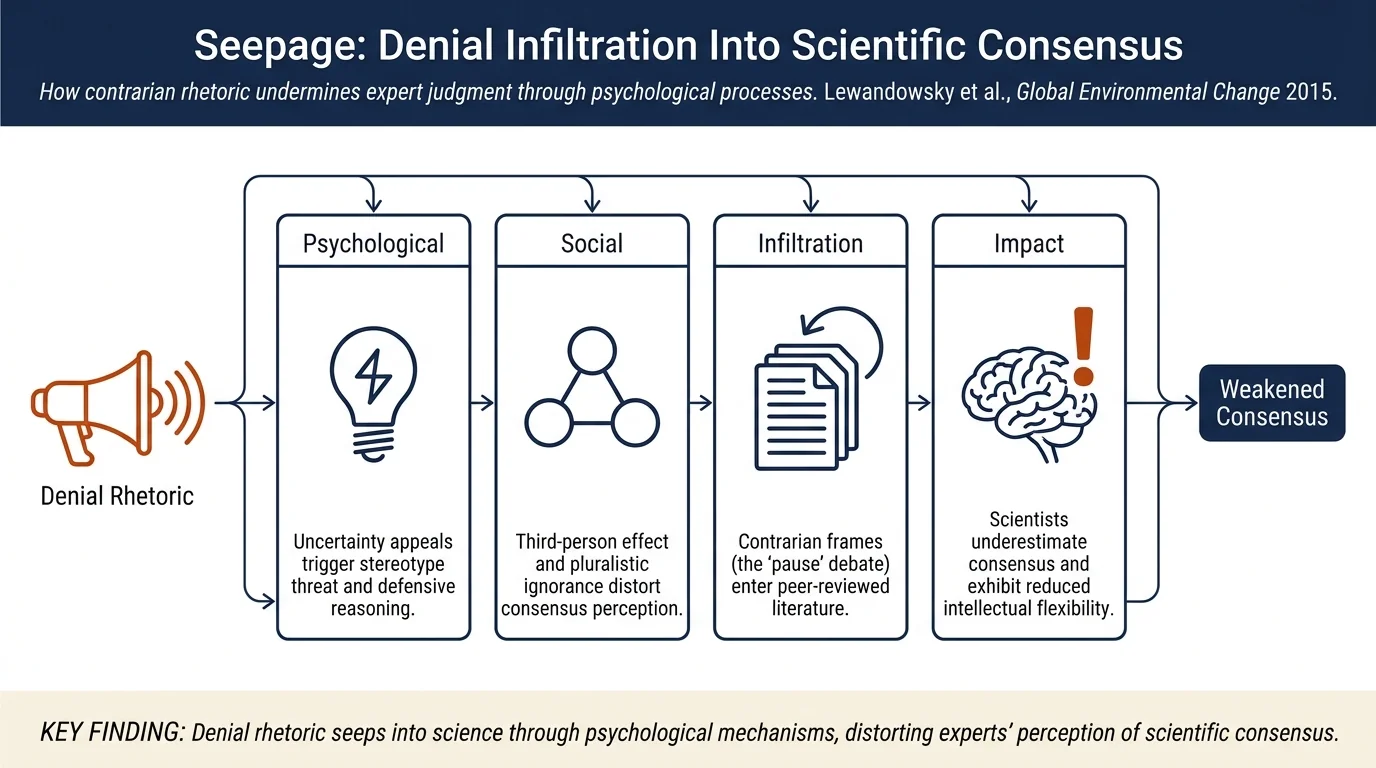
- Identifies "seepage" as the infiltration of contrarian claims into the scientific literature and scientific debate, affecting even expert judgment.
- Analyzes psychological mechanisms that make scientists susceptible to denial rhetoric: stereotype threat, third-person effect, pluralistic ignorance, and conflicting expertise.
- Uses the "global warming pause" debate as a case study showing how uncertainty appeals are weaponized rhetorically to create doubt and delay consensus-based policy action.
- Demonstrates that scientists, despite domain expertise, can underestimate consensus among peers and are vulnerable to false balance and perceived dissent within their own field.
Method
The paper synthesizes research from psychology, climate science, and organizational science to examine how denial rhetoric affects scientific discourse. Key analyses include:
-
Psychological allure of uncertainty: Reviews literature on how conflicting expert estimates, apparent disagreement among experts, and ambiguity in scientific communication create conditions for contrarian influence.
-
Social processes underlying seepage: Examines stereotype threat (scientists under threat from stereotypes about denialists perceive threat from peers), third-person effect (belief that others are more persuadable than oneself), and pluralistic ignorance (misperception of peers' actual views).
-
The "pause" case study: Analyzes how the debate over a temporary slowdown in warming rate (1998–2013) became a linguistic and rhetorical frame used to challenge climate consensus. Shows how this framing exploited legitimate scientific uncertainty and created perception of ongoing debate where strong consensus existed.
-
Expert cognition under pressure: Examines how scientists, when exposed to reminders of adverse stereotypes or competing claims, exhibit reduced openness to consensus, increased adoption of alternative explanations, and susceptibility to motivated reasoning.
Results
- The perceived "pause" in global warming between 1998–2013 was used as a rhetorical frame to undermine climate consensus, despite scientific consensus that warming resumed and the long-term trend remained unchanged.
- Scientists who are reminded of adverse stereotypes or threatened with contradictory claims exhibit reduced intellectual flexibility and greater openness to alternative, less credible explanations.
- Climate scientists systematically underestimate the level of consensus among their peers, making them vulnerable to the perception that ongoing legitimate debate exists about fundamental questions (e.g., "is the Earth warming?") already settled in the literature.
- Even in peer-reviewed literature, the frequency of papers devoted to alleged "pause" or "hiatus" claims increased sharply after 2007, showing that seepage of contrarian frames into scientific discourse can occur at the publication level.
Notes
This paper is distinctive in analyzing denial not as a public discourse phenomenon but as a process affecting expert judgment itself. It demonstrates that propaganda and denial tactics do not merely mislead the public—they can undermine the confidence and reasoning of domain experts through well-understood psychological processes (social pressure, stereotype threat, conflicting cues). The case study of the "pause" is a paradigmatic example of how uncertainty—a cornerstone of legitimate science—can be weaponized rhetorically to create manufactured doubt.
The paper's framing of "seepage" is important: it's not that individual contrarian papers are wrong or fraudulent, but that the aggregation of borderline claims into the literature creates a linguistic landscape that affects perception of consensus and distorts what even careful scientists believe about the state of knowledge in their field.