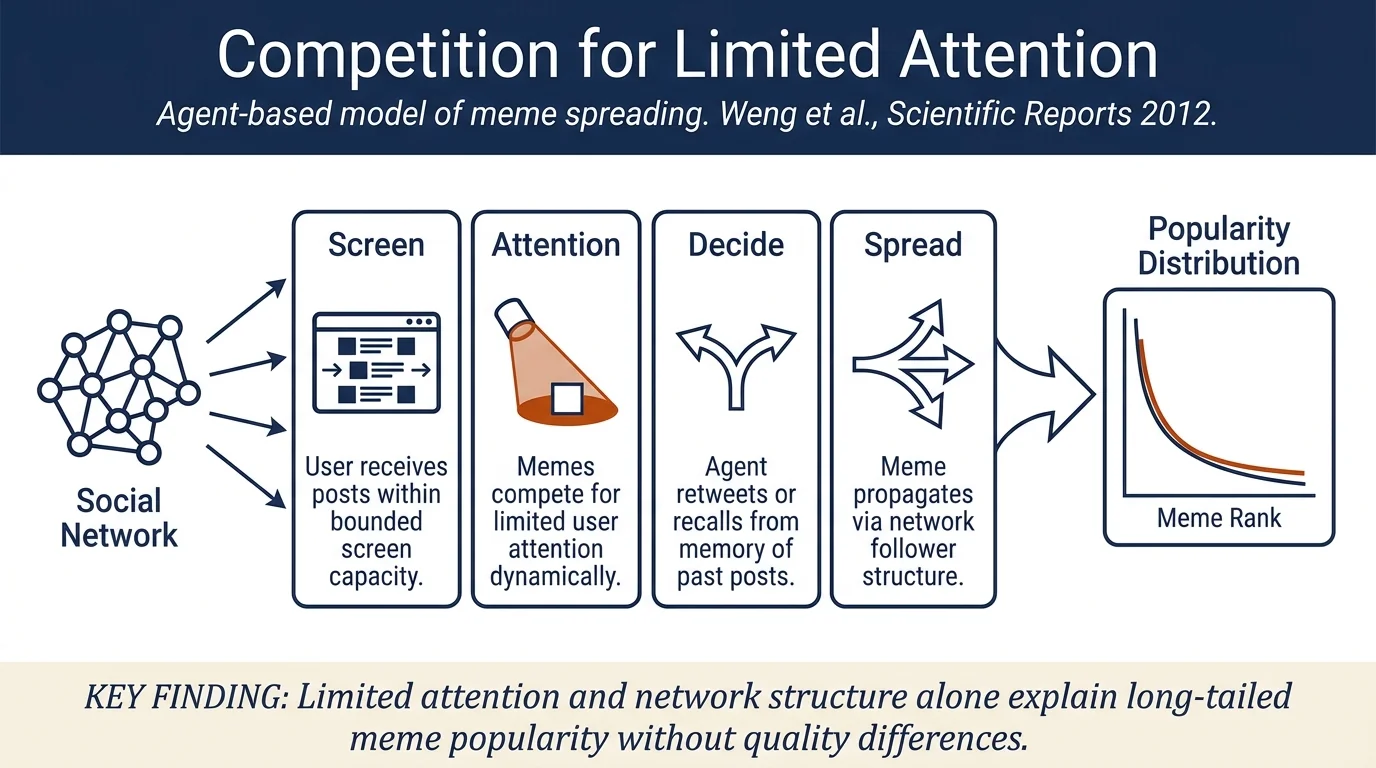
The attention economy framework (Simon 1971) models information systems where the primary constraint is not the supply of information but users' finite capacity to consume it. In social media, each user can only read, like, retweet, or engage with a small fraction of the content broadcast to them. This scarcity of attention creates competition: ideas, memes, and claims must outcompete thousands of alternatives to be seen and shared.
Core insight: What becomes popular depends not just on message quality or user influence, but on the interaction between message properties, network structure, and the sheer volume of competing content. Under information overload, a few items go viral while most fade regardless of merit.
Key mechanisms
Bounded attention: User engagement (time per day, posts read, accounts followed) follows remarkably stable patterns despite vast changes in available content volume. This means with each new meme injected into the system, older memes get pushed out—not because users dislike them, but because attention is zero-sum.
Power-law distributions emerge: When competition for limited attention is the only mechanism (no assumptions about intrinsic quality differences), meme popularity and lifetime distributions are heavy-tailed (power-law). A few items dominate; most disappear quickly.
Network amplification: Social network structure determines how attention constraints play out. Hub users (with many followers) amplify content disproportionately; clustered networks create echo chambers where the same ideas recirculate; weak ties between communities filter what crosses group boundaries.
Implication for misinformation: False claims can propagate as widely as true ones under attention competition, because network structure and cognitive factors (novelty, emotional content, in-group reinforcement) often outweigh accuracy in determining viral success.
Key papers
- 2012-weng-meme-competition — Agent-based model showing limited attention + social network structure alone (without quality differences) explain observed meme popularity heterogeneity; validates against 120M Twitter retweets
- 2007-wu-huberman-novelty-collective-attention — Shows news popularity decays via multiplicative process; competition for attention explains temporal patterns of collective interest fading
- 2008-crane-sornette-robust-dynamic-classes — Models exogenous and endogenous bursts of attention in single-item dynamics; combines epidemic spreading with forgetting mechanisms
- 2010-goetz-lerman-characterizing-popularity — Empirical study of blog and social media popularity; argues competition is central to virality, independent of post quality
- 2019-menczer-misinfocon-four-reasons — Video lecture on structural vulnerabilities: finite attention + information overload make false claims inevitable; power-law virality patterns under attention scarcity
Related topics
- information-diffusion — how content spreads through networks, driven in part by attention competition
- social-networks — network topology shapes how attention flows and competition plays out
- polarization — attention competition can amplify in-group reinforcement and out-group dismissal, contributing to echo chambers
- cascade-prediction — predicting cascade size from early signals, under constraints of limited attention
- information-overload — the condition that necessitates attention economy models