Key findings
-
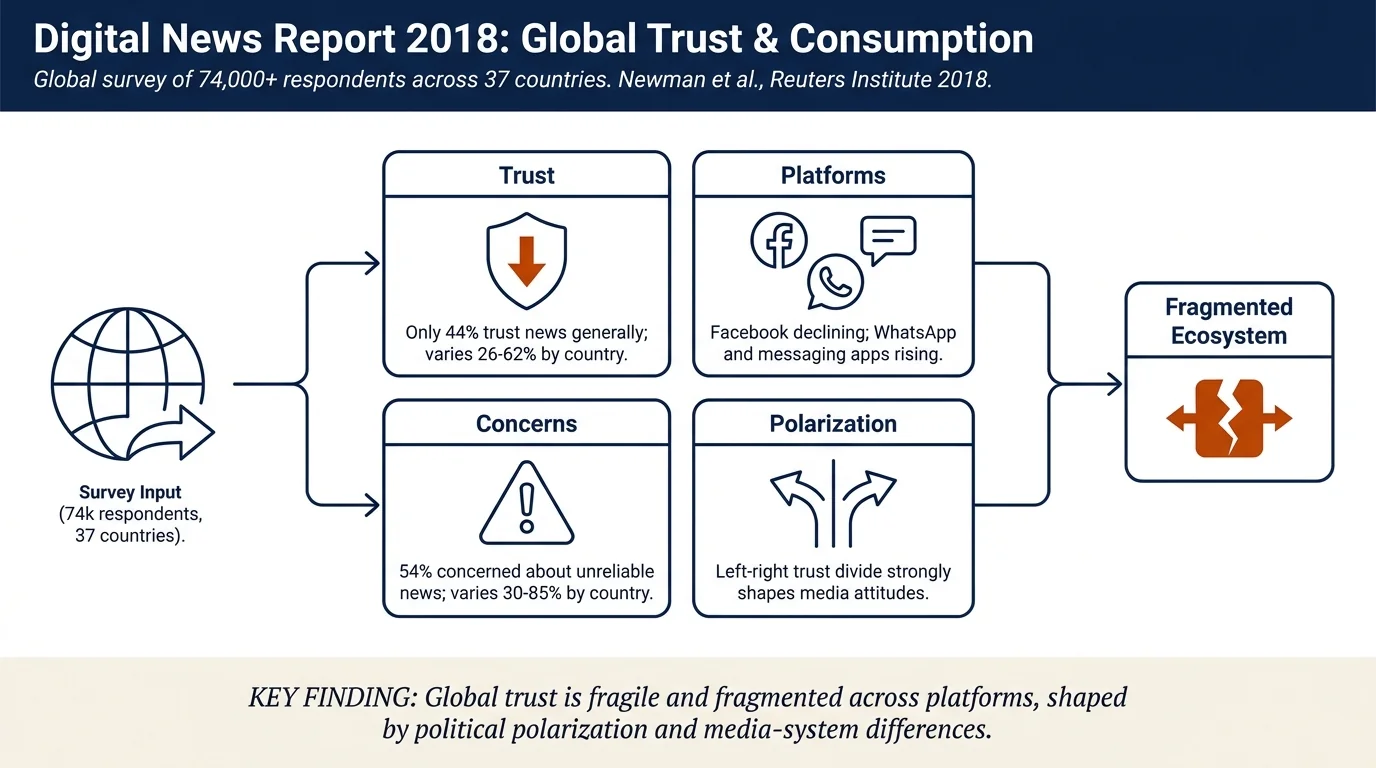
Social media reversal: Facebook use for news has declined significantly in several key markets (down 17 points in US since 2016, down to 45% from 51%). Other platforms (WhatsApp, Instagram, Snapchat) are growing as news sources, particularly in Latin America and Asia.
-
Trust under pressure: Only 44% of respondents trust news in general; just 51% trust news from search engines, 34% from social media, 23% from social media only. Trust is unevenly distributed, with significant country variation (Finland 62%, Greece 26%, South Korea 25%).
-
Misinformation concerns: 54% of respondents express concern about unreliable news on the internet. This concern varies significantly by country: Brazil 85%, Spain 69%, US 64%, France 63%, with lower concern in Germany 37% and Netherlands 30%.
-
Political polarization & trust: In the US, those identifying as left report three times higher trust in mainstream media (51%) than right-leaning respondents (17%). Trust in news media correlates strongly with perceived political bias.
-
Fake news definition gaps: When prompted, 58% worry about fabricated/made-up news, but only 26% can cite specific recent examples. Audiences conflate poor journalism, clickbait, biased spin, and outright fabrication under the umbrella term "fake news."
-
Brand-level trust variation: TV news brands (local television, national broadcasters) score 6-9/10 trust; newspaper brands and digital-native brands vary 3-7/10. Trust in brands like Fox News, Breitbart, CNN, and HuffPost shows strong partisan splits.
-
Government regulation mixed: 61% in Europe (Spain, UK, France, Germany) support government action to combat misinformation; only 41% in the US support intervention. Government regulation of platforms scores stronger support than platform self-regulation in most countries.
-
News literacy high in Nordic countries, lower elsewhere: Finland 62%, Norway 65% trust most news most of the time. Greece 26%, South Korea 25% lag significantly. Trust and news literacy are highest where media systems are independent and competitive.
News consumption patterns
-
Gateway preferences by country: Direct access dominates in Nordic countries (Finland 65%, Norway 62% go directly to news websites). Social media gateway is highest in Malaysia 64%, Brazil 52%, Turkey 51%. Search is top gateway in South Korea 47%, Poland 39%.
-
Age differences: Younger users (18-24) rely more on social media and search; older users (55+) prefer direct access and email newsletters. Mobile is now the primary device for news access in most countries.
-
Messaging apps rising: WhatsApp use for news tripled since 2014 (now surpasses Twitter in importance in many countries). Encrypted messaging offers "safer" space for political discussion in countries with censorship concerns (Turkey 80%, Malaysia 54%, Hong Kong 56%).
-
Notifications fatigue: Mobile news alerts are the fastest-growing gateway (doubled since 2016 in some markets). However, 37% say nothing would encourage them to use alerts, and 71% feel they receive too many alerts.
Implications
The 2018 report shows a news ecosystem under significant strain: declining trust, rising misinformation concerns, political polarization, and fragmentation across platforms and gateways. Variation across countries is extreme, suggesting structural differences in media systems, regulation, and political context shape audience behavior and trust.
Notes
This is the 7th annual report in the Reuters Digital News series (since 2012); the 2018 edition marks significant methodological maturation and represents the most comprehensive global survey of news consumption habits available. The detailed country-by-country breakdowns (Section 3) are particularly valuable for understanding region-specific patterns in media consumption and trust. The emergence of encrypted messaging as a primary news-discussion platform in some countries signals important shifts in information ecosystems that deserve continued monitoring.