Misinformation sharing encompasses the processes, behaviors, and individual factors that influence how people spread false or misleading information online. This includes both intentional dissemination and cases where people unknowingly propagate false claims they believe to be true.
Key distinctions
Belief vs. sharing: Research reveals a substantial disconnect between what people believe and what they choose to share on social media. People may share false claims they don't necessarily believe, driven by factors like emotional engagement, tribal signaling, or inattention to accuracy.
Individual differences: Analytical reasoning, prior beliefs, exposure to corrections, and cognitive reflection predict susceptibility to sharing misinformation. Political ideology and social context also shape sharing behavior.
Behavioral asymmetries: Empirical evidence documents asymmetries in misinformation sharing across political groups in some contexts, though the magnitude and consistency of these asymmetries varies by time period, platform, and issue.
Key papers
- Renault, Mosleh & Rand (2025) — Republicans are flagged more often than Democrats for sharing misinformation on X's Community Notes — Empirical quantification of partisan asymmetries in misinformation sharing using crowdsourced ratings; finds 2.3× more Republican posts flagged as misleading; rules out base-rate and rater-composition confounds.
- Mosleh et al. (2024) — Differences in misinformation sharing can lead to politically asymmetric sanctions — Demonstrates that conservatives shared significantly more low-quality news and false claims than liberals on Twitter during the 2020 election, explaining observed asymmetries in platform suspensions.
- Pennycook & Rand (2021) — The Psychology of Fake News — Comprehensive review showing that susceptibility to misinformation reflects poor truth discernment and lack of analytical reasoning rather than partisan bias, and that belief and sharing are substantially disconnected.
- Pennycook et al. (2020) — Fighting COVID-19 Misinformation on Social Media — Demonstrates that simple accuracy nudges (reminders to focus on accuracy) nearly triple truth discernment when deciding whether to share content.
- Pennycook et al. (2021) — Shifting attention to accuracy can reduce misinformation online — Shows that subtle reminders to focus on accuracy increase sharing of accurate news and reduce sharing of low-quality content in both survey and Twitter field experiments.
- Pennycook et al. (2019) — Fighting misinformation on social media using crowdsourced judgments of news source quality — Demonstrates that politically balanced crowds can match professional fact-checkers in evaluating news outlet trustworthiness, providing a scalable approach to identifying low-quality sources.
- Mosleh et al. (2021) — Perverse Downstream Consequences of Debunking — Field experiment showing that corrections to false claims can paradoxically increase users' subsequent sharing of low-quality and toxic content.
See also
Papers on this topic
 Psychology & interventionsDetection methods
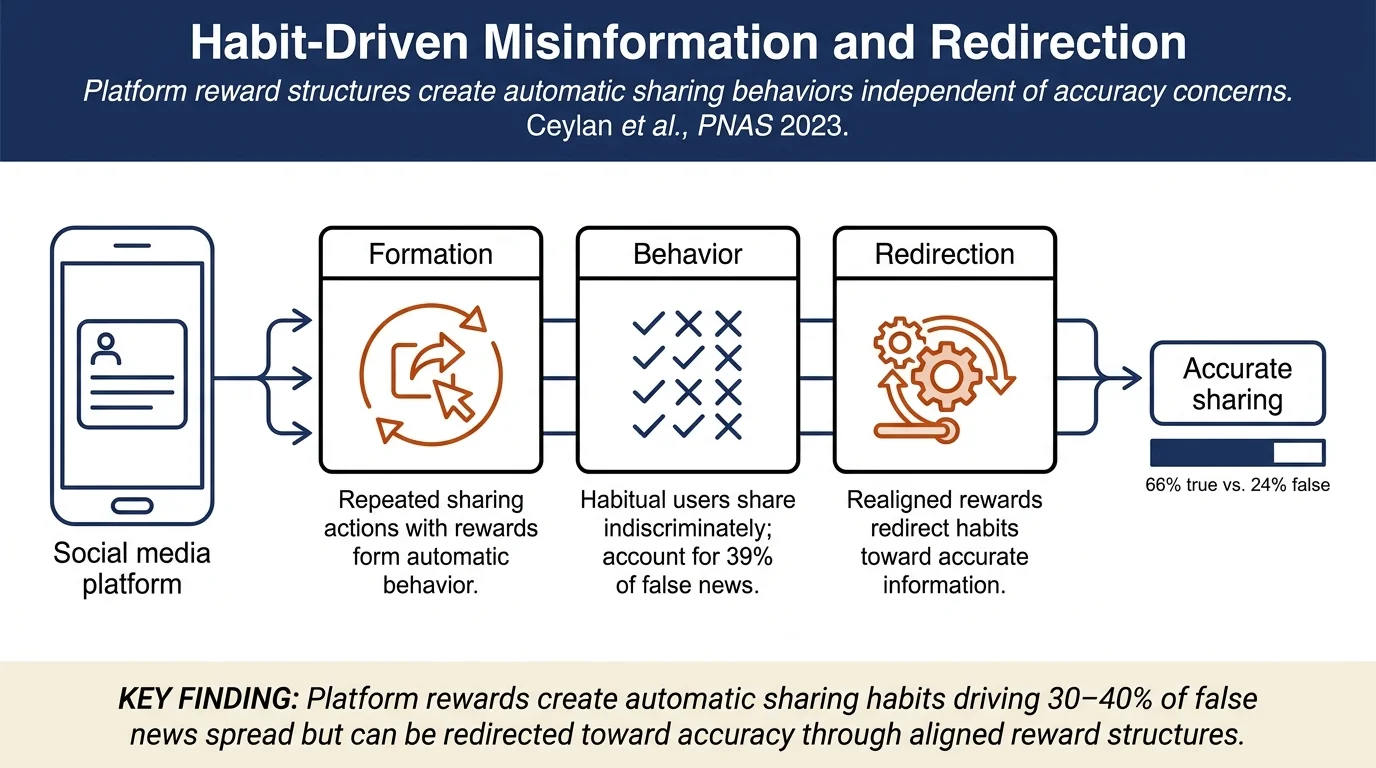
Sharing of misinformation is habitual, not just lazy or biased