Explore papers
Filter by research area, year and venue. Every filter is in the address bar, so you can share a view as a link.
 Datasets & evaluationFact-checking & verification
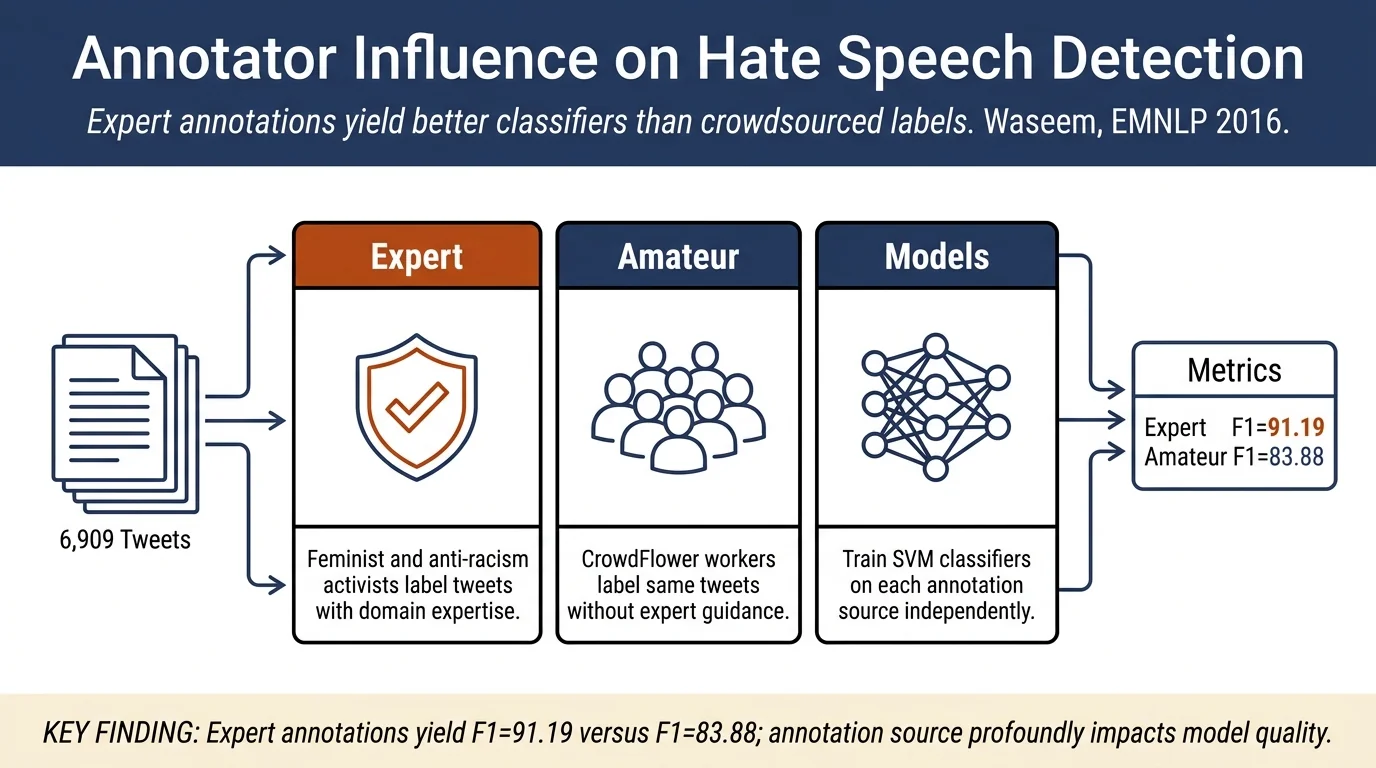
Are You a Racist or Am I Seeing Things? Annotator Influence on Hate Speech Detection on TwitterThis paper compares hate speech detection systems trained on expert annotations (from feminist and anti-racism activists) versus amateur annotations (crowdsourced via CrowdFlower) on 6,909 tweets. Systems trained on expert annotations significantly outperform those trained on amateur data, and amateur annotators systematically label more…
 Spread & networksDetection methods
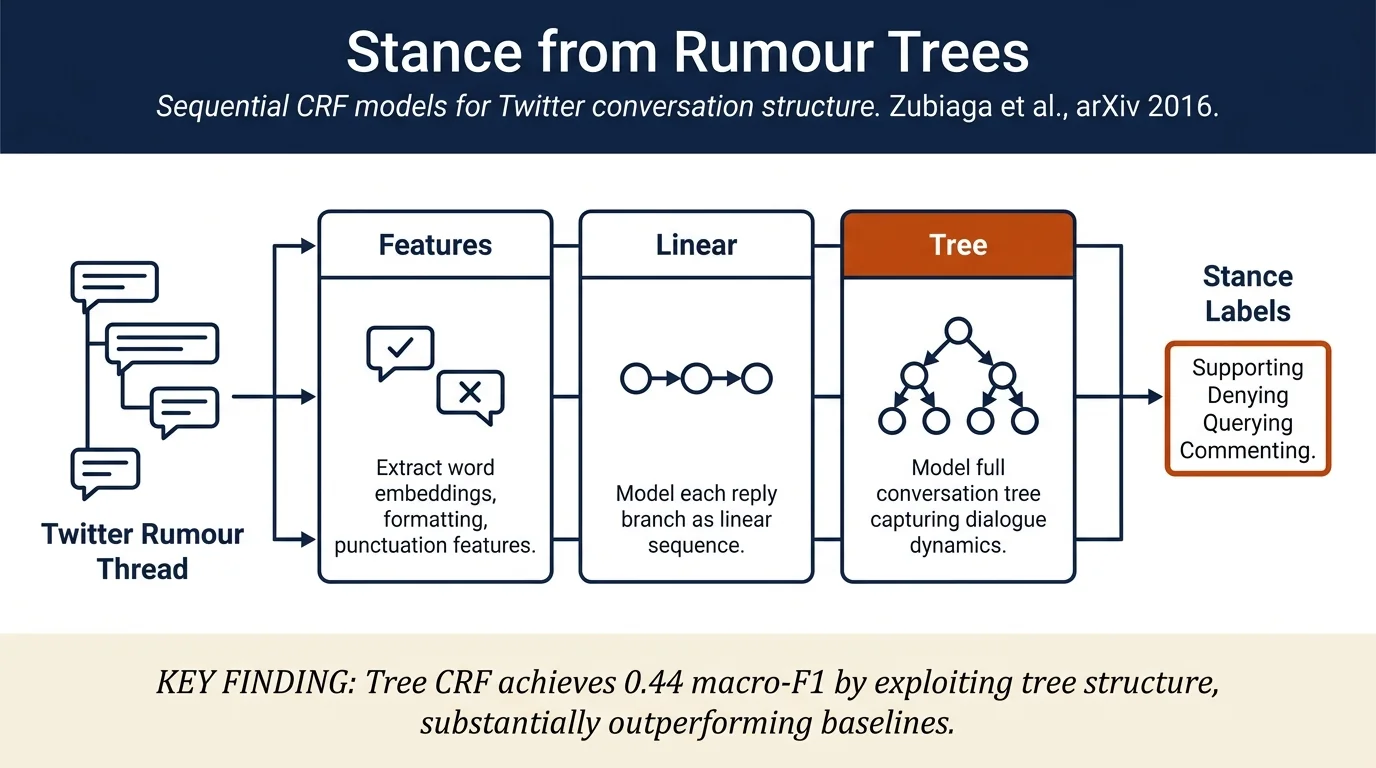
Stance Classification in Rumours as a Sequential Task Exploiting the Tree Structure of Social Media ConversationsProposes that modelling Twitter conversations as tree-structured sequences improves rumour stance classification. Introduces Linear and Tree Conditional Random Fields (CRF) to exploit the sequential structure of replies within rumour threads, showing that Tree CRF significantly outperforms non-sequential baselines on 4,519 annotated…
 Bots & coordinated campaignsDatasets & evaluation
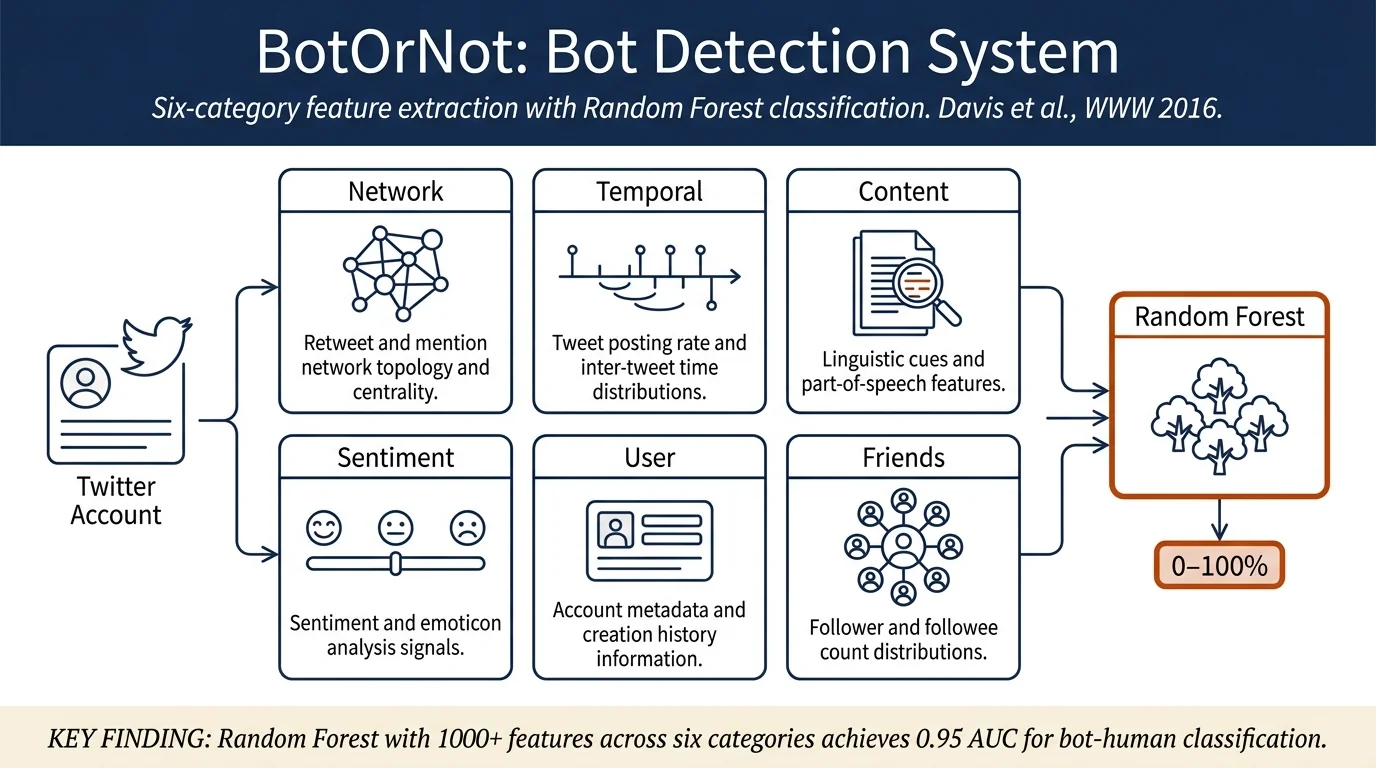
BotOrNot: A System to Evaluate Social BotsBotOrNot is a publicly available service and API that evaluates whether a Twitter account is controlled by a human or automated bot. Using 1,000+ features across six categories (network, user, friends, temporal, content, sentiment), the system applies Random Forest classification to achieve 0.95 AUC on a labeled dataset of 15k bots and…
 Bots & coordinated campaignsDetection methods
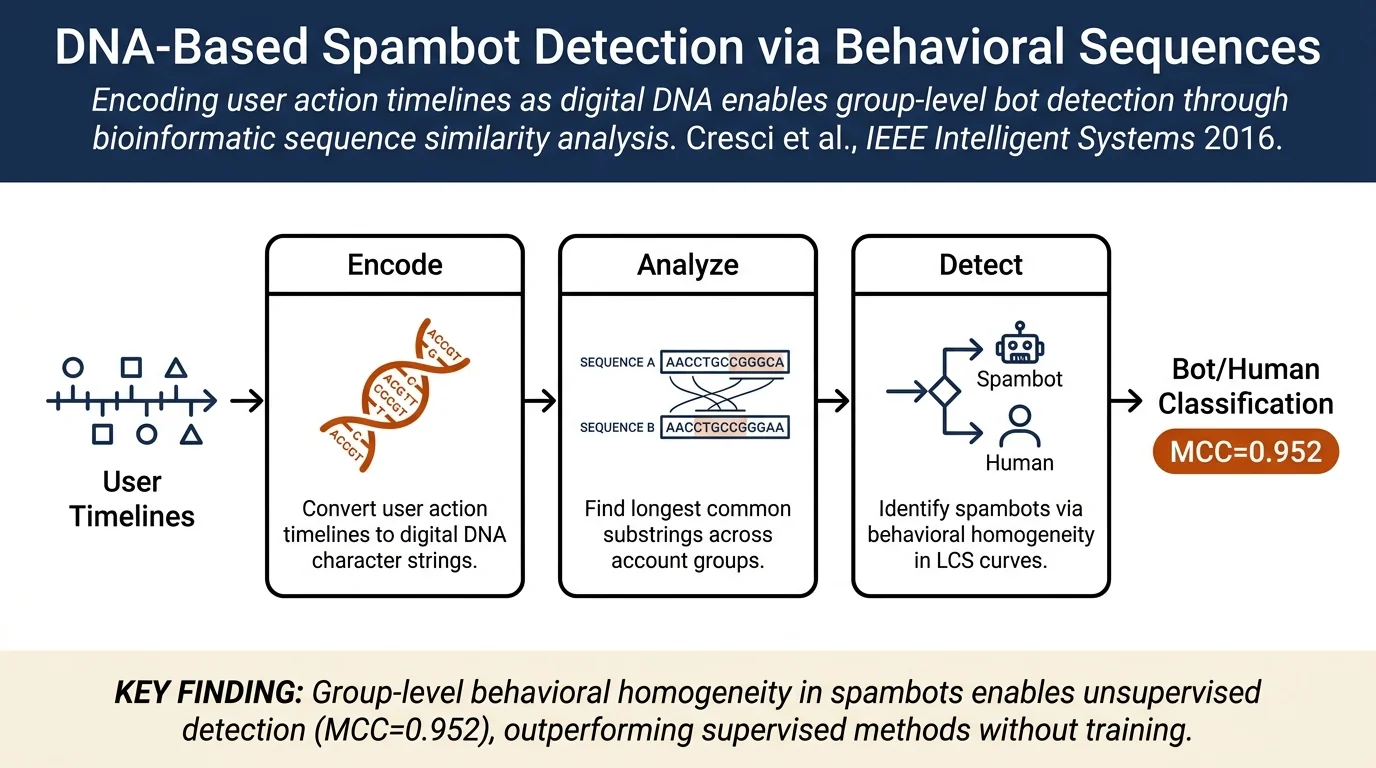
DNA-Inspired Online Behavioral Modeling and Its Application to Spambot DetectionProposes a novel methodology to characterize online user behavior using DNA-inspired digital sequences, where each user action (tweet type, content features) is encoded as a character in a string. Applies standard bioinformatic DNA analysis techniques—specifically longest common substring (LCS) analysis—to detect spambots on Twitter by…