 Robert West
Contributions
-
Benchmark of LLM persuasiveness in live debate: First direct experimental comparison of GPT-4 versus human persuasiveness in structured, multi-round online debates on diverse topics (30 debate propositions across low-, medium-, and high-strength clusters).
-
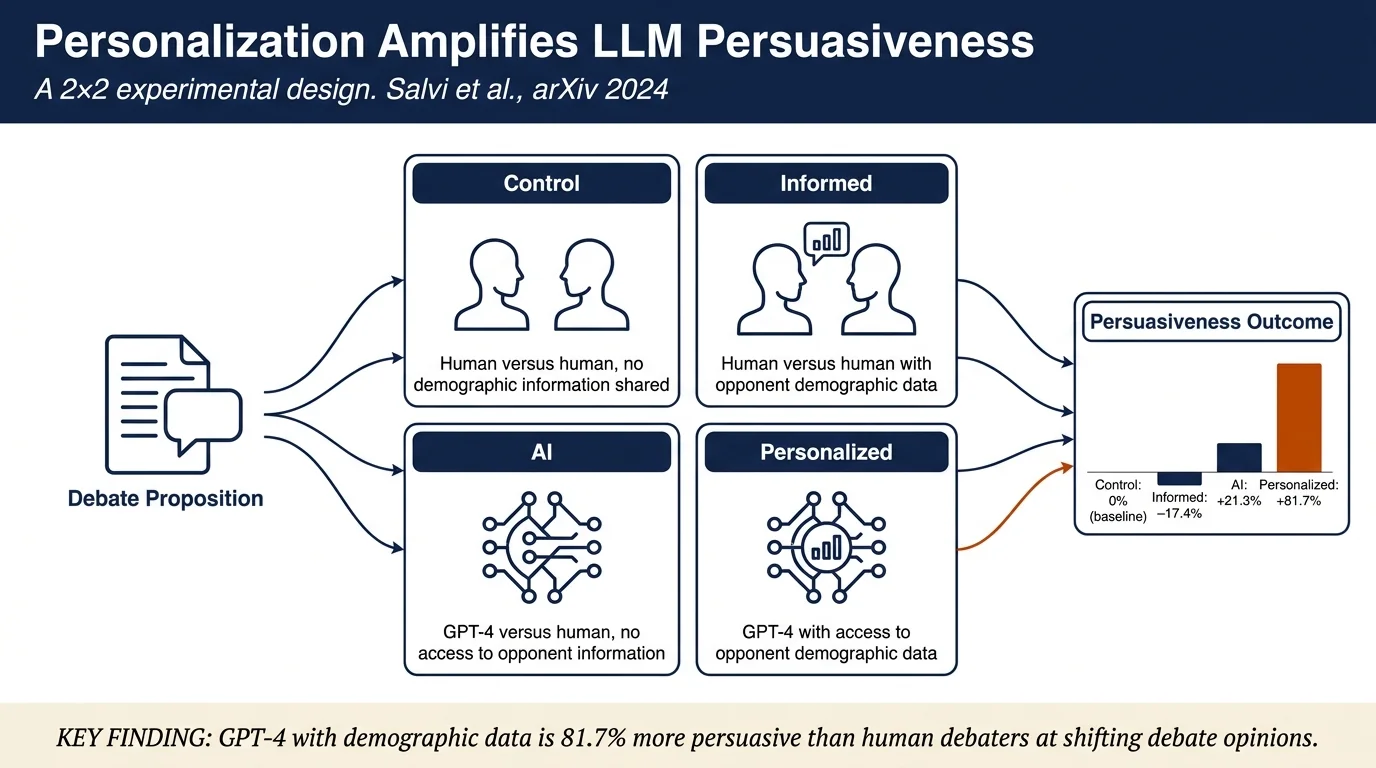
Personalization amplifies LLM persuasion: Demonstrates that access to basic demographic information (age, gender, education, political affiliation) significantly enhances GPT-4's ability to tailor persuasive arguments, producing an 81.7% increase in odds of post-debate opinion agreement over humans.
-
Robust experimental design: Preregistered randomized controlled trial with 2×2 factorial design (opponent type: human vs. LLM; personalization: with or without opponent demographic access) across N=820 participants recruited via Prolific.
-
Textual and social-dimension analysis: Demonstrates GPT-4 tends to use more logical/analytical language and tactical knowledge, while humans rely more on first-person pronouns and emotional appeals; topic debatability predicts opinion fluidity independent of opponent type.
Method
Experimental platform: Web-based interactive debate system using Empyrica (a virtual lab for high-throughput multi-agent experiments). Participants recruited in US (18+) via Prolific, December 2023 – February 2024.
Topic selection: Started with 60 candidate debate propositions (e.g., "Should Abortion Be Legal?", "Should the US Keep the Filibuster?") drawn from ProCon.org, DDO corpus, and debate practice sources. Three annotators scored each on Agreement (how polarized opinions are), Knowledge (participant familiarity), and Debatability (how easy to argue both sides). Final set: 30 propositions grouped into Low-, Medium-, and High-Strength clusters based on opinion polarization.
Experimental design: Each participant:
- Phase A (Screening, 1 min): Complete demographic survey (gender, age, ethnicity, education, employment, political affiliation); rate initial agreement with assigned debate proposition on 5-point Likert scale.
- Phase B (Synchronized debate, 10 min total): Two randomly matched participants (or participant + GPT-4 endpoint) debate for four stages: - Opening (4 min): Articulate main arguments - Rebuttal (3 min): Respond to opponent's arguments - Conclusion (3 min): Either respond or reiterate initial points - Each participant randomly assigned to PRO or CON stance, regardless of pre-debate opinion
- Phase C (Post-debate survey): Re-rate agreement with proposition, estimate whether opponent was human or AI.
Four treatment conditions (2×2 factorial):
- Human-Human: Both debaters are human participants matched from the queue.
- Human-AI: Participant paired with GPT-4 (endpoint: gpt-4-0613), AI prompted to argue its assigned stance persuasively.
- Human-Human, personalized: Both human, but one player has access to opponent's anonymized demographic information (age, gender, education, political affiliation) collected in Phase A survey.
- Human-AI, personalized: Participant paired with GPT-4 that has access to personalized opponent information and is instructed to use it to tailor compelling arguments.
Sample: Collected 150 debates per condition (5 debates per 30 topics, to balance topical effects). For personalized Human-AI condition: 110 debates collected in the reported period (additional 40 ongoing). Total N=820 unique participants.
Results
Primary outcome – Persuasiveness (measured as shift in post-debate agreement vs. pre-debate baseline):
Using a Partial Proportional Odds regression model on transformed agreement scores (accounting for ordinal outcome structure):
-
Human-AI, personalized showed strongest persuasive effect: +81.7% higher odds of agreement with opponent's position post-debate compared to Human-Human baseline (95% CI [+26.3%, +161.4%]; p < 0.01). This means participants debating personalized GPT-4 were 1.82× more likely to shift toward their opponent's view.
-
Human-AI (no personalization): Positive effect (+21.3%; CI [−16.7%, +76.6%]) but not statistically significant (p = 0.31). Effect remains marginally significant when re-parameterized (p = 0.04) but is clearly weaker than with personalization.
-
Human-Human, personalized: Marginal decrease (−17.4%; CI [−46.1%, +26.5%]; p = 0.38), suggesting personalization does not amplify human persuasion; may introduce friction in natural human dialogue.
Secondary outcomes:
Opinion fluidity: Participants' propensity to change their minds. Topic Debatability (how easily both sides can be argued) was the strongest predictor of opinion change (CI [+117.8%, +11.7%, +47.3%]; p < 0.01), regardless of opponent type. Prior thought (existing familiarity with the topic) reduced fluidity (−72.9%, p < 0.01).
Perceived opponent identity: Participants debating GPT-4 correctly identified it as AI 77% of the time in personalized conditions, 23% in non-personalized conditions. Participants rarely identified human opponents as AI (false positive ~27–30%), and slightly underestimated chance of debating AI (when they actually were).
Textual analysis (LIWC-22 linguistic features):
- GPT-4 used significantly more analytical thinking and logical markers; humans more first-person pronouns and positive emotion.
- AI outputs were longer but scored higher on readability (Flesch reading-ease score normalized by word count).
- Personalized GPT-4 arguments used more tactical knowledge and social-dimension appeals (similarity, support, trust, fan) compared to non-personalized AI or human debaters.
Significance
This paper provides empirical evidence that large language models pose a significant risk as agents of personalized persuasion. Key implications:
-
LLM-driven persuasion at scale: With access to minimal personal data (demographic profiles, social media activity, revealed preferences), LLMs could be deployed to generate tailored, highly persuasive arguments targeting specific populations.
-
Personalization amplifies risk: The finding that personalization is the key amplifier—moving GPT-4 from marginally-better-than-human to far-more-persuasive-than-human—aligns with concerns from Bai et al. (2023), Palmer & Spirling (2023), and Goldstein et al. (2023) about microtargeting as the critical mechanism for AI-driven disinformation campaigns.
-
Implications for online platforms: Social media and open online debate platforms could be infiltrated by persuasive AI agents, especially if those platforms allow agents to infer or access user demographic data. Even without explicit access, platform inference from behavioral signals (engagement patterns, social network composition, browsing history) could be sufficient for effective personalization.
-
Regulatory considerations: Results reinforce calls for transparency, limits on behavioral microtargeting, and detection mechanisms to distinguish human-authored from AI-generated arguments in online spaces.
Notes
Strengths:
- Large, preregistered, well-controlled experiment with 820 participants.
- 2×2 factorial design cleanly isolates effects of opponent type and personalization.
- Diverse debate topics to avoid topic-specific artifacts.
- Rigorous statistical modeling (ordinal logistic regression) respecting outcome structure.
- Comprehensive textual and linguistic analysis supporting mechanism insights.
Limitations:
- Controlled debate environment may not generalize to organic social media conversations or adversarial settings.
- 10-minute debate window constrains argument depth; real-world persuasion may unfold over longer timescales.
- Personalization based only on self-reported demographics; real-world microtargeting could use richer behavioral signals.
- Pre-assigned debate stances (PRO/CON) create artificial persuasion task; participants may be weaker debaters when arguing positions they don't believe in.
- Sample mostly US-based; generalizability to other populations uncertain.
Future directions:
- Replicate with different LLM architectures and prompts; test Grok, Claude, Gemini.
- Extend to longer-form conversations and open-ended dialogue.
- Evaluate robustness under anonymization and cross-modal misinformation (images, videos).
- Study real-world deployment on platforms like Twitter/X, Reddit, or open debate forums.
- Investigate defenses: detection systems to flag LLM-generated arguments, transparency indicators, counter-personalization strategies.