 Briony Swire-Thompson
 David Lazer
Contributions
- Demonstrates no backfire effects at group or item level in a large, carefully designed study with two independent experiments and 920 total participants.
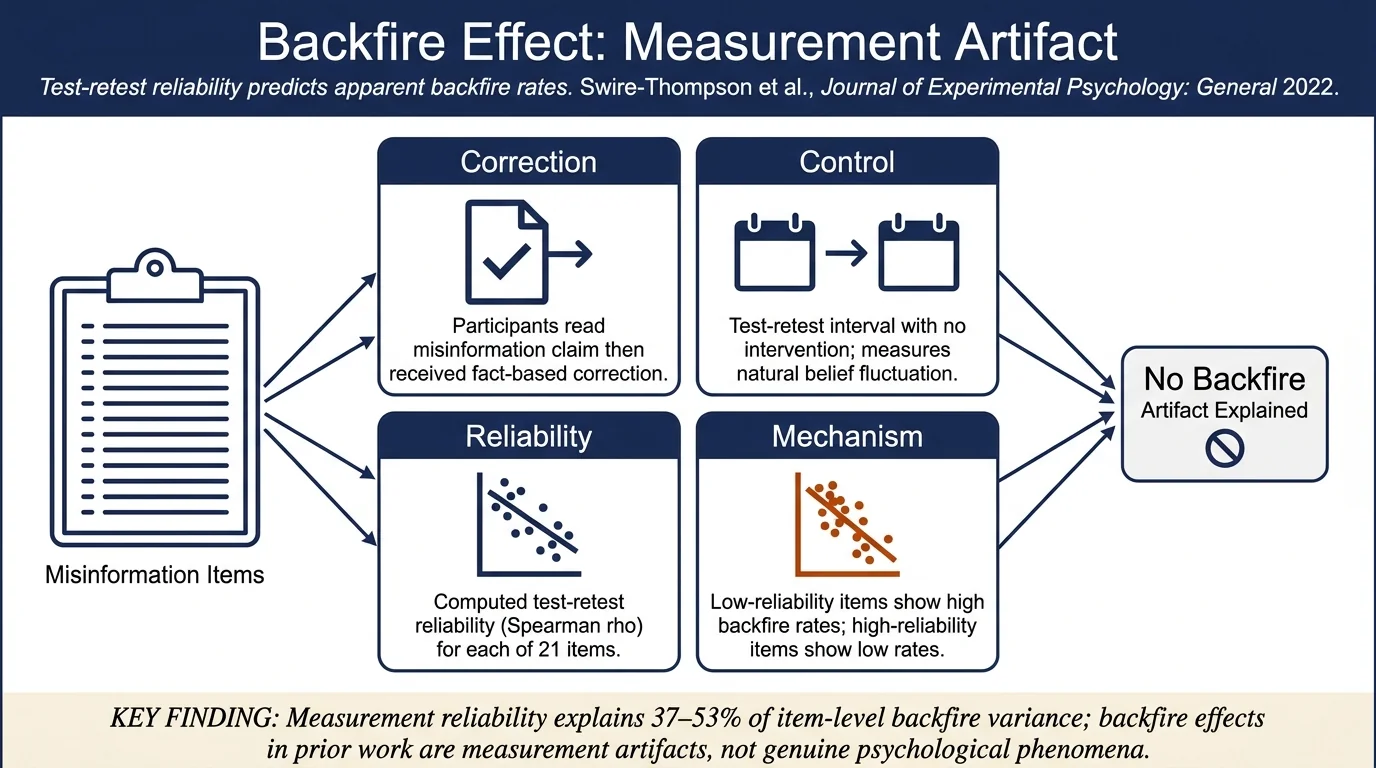
- Quantifies the relationship between measurement reliability and backfire rate: 37–53% of variance in backfire rate is explained by test–retest reliability.
- Shows that unreliable measures (single-item scales, noisy instruments) artificially inflate backfire effects through regression to the mean, not genuine belief entrenchment.
- Tests competing theoretical mechanisms: worldview-defense factors (importance, prior belief strength) show no predictive power, while familiarity-related factors (novelty, illusory truth effect) are significantly correlated with backfire rate.
- Provides methodological guidance: reliably measured items do not backfire; fact-checkers and communicators should not avoid corrections due to unfounded backfire concerns.
Method
Two pre-registered, nearly identical longitudinal experiments compared a correction condition (participants read a misinformation claim, then received a correction) to a test–retest control condition (participants rated beliefs at pre-test and post-test, 3 weeks apart, with no intervention). The design allows backfire to be measured as belief increase in the correction condition vs. the control condition.
Participants: Experiment 1 had 388 crowdworkers (recruited via Prolific Academic; 92% retention from pre-test to post-test); Experiment 2 had 532 (88% retention). Both recruited from the USA, ages 18–84.
Stimuli: 21 misinformation items + 21 corresponding facts, pre-selected to vary across novelty, personal importance, societal importance, and prior belief strength. Items were adapted from prior backfire-effect studies (Swire et al. 2017; Wood & Porter 2019) and newly generated items. Each item had a 2–3 sentence correction citing a reputable source.
Procedure:
- Pre-test: Participants rated belief in 21 misinformation and 21 fact items (0–10 scale). They also rated whether they'd heard each item before, its personal importance, its societal importance, and (for misinformation only) how much they believed the claim initially.
- Correction/Control: Correction-condition participants read a correction (highlighted, labeled false, with 2–3 sentences explaining why and citing a source). Control-condition participants answered demographic questions.
- Post-test (3 weeks later): All participants re-rated belief in all 42 items on a 0–10 scale.
Measurement of backfire and belief-boost rates: Defined as the percentage of participants showing a ≥2-point increase in belief on the 11-point scale. The 2-point threshold was chosen to avoid rounding artifacts (e.g., 7.5 rounding to 7 or 8).
Reliability calculation: Test–retest reliability for each item was computed by correlating pre- and post-test belief ratings in the control group (Spearman's $\rho$, used because data were not normally distributed).
Results
Group-level analysis (overall belief changes): Participants in the correction condition updated their beliefs significantly in the intended direction (downward, toward the truth) compared to the control condition. No backfire at the group level: Experiment 1, $F(1,386) = 325.01$, $p < .001$, $\eta_p^2 = 0.46$; Experiment 2, $F(1,530) = 329.93$, $p < .001$, $\eta_p^2 = 0.46$. A small illusory truth effect in the control condition (belief increase due to repetition) was observed, but correcting misinformation did not increase belief compared to initial ratings.
Item-level analysis — the central finding: When comparing post-correction beliefs to pre-test control beliefs for each item, no item showed a backfire rate significantly greater than the control belief-boost rate. Backfire rates ranged from 2.99% to 33.96% across items and experiments; belief-boost rates in the control condition ranged from 4.62% to 32.31%. The critical finding: item reliability strongly predicted backfire rate:
- Experiment 1: $\rho = -0.61$, $p = 0.004$ (Spearman correlation between test–retest reliability and backfire rate)
- Experiment 2: $\rho = -0.73$, $p < 0.001$
In other words, items with low test–retest reliability showed higher rates of apparent backfire. Items with higher reliability showed lower backfire rates. This held across both experiments despite minor methodological differences between them.
Variance explained: Test–retest reliability explained 37% of variance in backfire rate (Experiment 1) and 53% (Experiment 2). Familiarity-related attributes (novelty, illusory truth effect) also correlated significantly with backfire rate ($\rho_{\text{Exp 2}} = -0.82$ for novelty, $\rho = 0.59$ for illusory truth effect), though these effects did not explain unique variance beyond reliability.
Worldview factors: Perceived societal importance and personal importance showed no significant correlation with backfire rate ($p > 0.3$ for both experiments). Prior belief strength was weakly negatively correlated in Experiment 2 ($\rho = -0.53$, $p = 0.013$) but not Experiment 1, and did not account for unique variance beyond reliability.
Notes
Significance for the field: This work addresses a methodological blind spot in backfire-effect research. Prior meta-analyses and reviews (e.g., Swire-Thompson et al. 2020) suggested that backfire effects are most often reported in studies using single-item or unreliable measures. This study provides direct evidence that the association is causal in mechanism: measurement error inflates backfire rates through regression to the mean and noise. The finding does not invalidate backfire as a psychological phenomenon entirely — it may occur under specific, rare conditions — but it explains why backfire is so rarely replicated in well-designed studies and why the consensus has shifted to skepticism. The implication is that fact-checkers and communicators should not avoid corrections due to backfire concerns; the evidence for large-scale, generalizable backfire effects does not hold under scrutiny.
Strengths:
- Large sample sizes, pre-registration, two independent experiments with identical designs (minor exceptions noted in methods).
- Careful measurement of both group-level and item-level effects, with explicit quantification of reliability.
- Broad range of items (N = 21) designed to vary in importance, novelty, and prior belief, improving generalizability.
- Use of Bayesian hypothesis tests (Bayes factors) to quantify support for the null hypothesis (no backfire).
- Transparent reporting of all measures, conditions, and data exclusions.
Limitations:
- Participants recruited via Prolific Academic, which may not represent politically extreme or highly conspiratorial populations (though the authors note most backfire studies use similarly broad convenience samples).
- Three-week retention interval may not capture longer-term belief entrenching; some theorists argue backfire is a delayed effect.
- Items are diverse in content (gender pay gap, Marmite composition, testosterone and memory) but may not span all domains where backfire has been claimed (e.g., deeply partisan political claims).
Future work: The authors recommend that future backfire research prioritize reporting measurement reliability and that meta-analyses re-examine prior studies in light of this measurement-error mechanism. The finding also motivates investigation into which specific conditions (if any) produce genuine, reproducible backfire above measurement artifact.