Belief updating is the cognitive process by which people revise existing beliefs in response to new information. Despite assumptions that people are rational Bayesian reasoners, empirical research shows belief updating is frequently imperfect: people exhibit selective exposure, disconfirmation bias, identity-protective cognition, and backfire effects when corrected.
Key mechanisms
Disconfirmation bias: People process information confirming existing beliefs more favorably than disconfirming information; they scrutinize refutations more heavily and accept supportive evidence less critically.
Identity-protective cognition: When beliefs are entangled with group identity (e.g., political affiliation, in-group membership), correction attempts may trigger identity threat, causing people to reject evidence more strongly.
Prior conviction: Highly conviction beliefs (especially those thought resistant to evidence) show greater persistence; however, recent evidence suggests even conspiracy beliefs can update with sufficiently diagnostic evidence.
Elaboration and engagement: When people elaborately encode new information—through dialogue, explanation, or prompting themselves to articulate their reasoning—belief updates are more durable.
Effective interventions
- Diagnostic counterevidence: Facts and evidence directly addressing the focal belief (rather than general corrections or narrative appeals) drive larger belief reductions.
- Source credibility: Evidence attributed to expert, neutral, or trusted sources is more persuasive.
- Personalized dialogue: Tailored responses to an individual's specific reasons for believing reduce defensiveness compared to generic corrections.
- Inoculation and prebunking: Pre-exposing people to refuted arguments (before they encounter them) reduces susceptibility to subsequent misinformation.
Boundary conditions and limitations
- High-conviction believers: Belief updating is harder for those deeply committed to a belief, particularly when the belief is identity-protective or part of a monological belief system.
- Polarization: In politically polarized contexts, correction can backfire if it triggers partisan identity defense.
- Temporal decay: Belief reductions achieved through interventions sometimes fade over time (decay effects), though recent work suggests durable updating is achievable with sufficient evidence.
Key papers in this wiki
- Tappin, Pennycook & Rand (2020) — Bayesian or biased? Analytic thinking and political belief updating — Tests whether cognitive sophistication magnifies political bias in belief updating; finds that greater analytic thinking correlates with posterior beliefs closer to an unbiased Bayesian benchmark, contradicting the hypothesis that sophistication magnifies bias
- 2025-hackenburg-levers-political-persuasion — Large-scale study documenting how conversational AI causes belief change on political issues (76,977 participants, 707 issues); shows conversational interaction more effective at inducing change than static messages, and identifies rhetorical and informational levers (model scale, post-training, information density) that amplify belief change; critically finds that models optimized for persuasiveness generate less accurate information, documenting a tension between persuasive effectiveness and epistemic quality.
- Boissin et al. (2026) — Dialogues with Large Language Models Reduce Conspiracy Beliefs Even When the AI Is Perceived as Human — Preregistered experiment (N=955) testing whether messenger identity (AI vs. human expert) affects debunking effectiveness; finds no significant differences, indicating belief updates are driven by message quality rather than source characteristics
- Costello, Pennycook & Rand (2026) — Just the Facts: How Dialogues with AI Reduce Conspiracy Beliefs — Demonstrates that conspiracy beliefs durably update in response to AI dialogue providing diagnostic counterevidence and factual argumentation; mechanism studies show facts and evidence are load-bearing while rapport and non-adversarial framing are negligible.
- Guay, Berinsky, Pennycook & Rand (2023) — How to Think About Whether Misinformation Interventions Work — Methodological framework clarifying that intervention success should be measured by discernment (true − false content discrimination) rather than overall belief reduction, since all-reducing interventions can appear effective while harming judgment quality.
- Pennycook & Rand (2021) — The Psychology of Fake News — Comprehensive review of why people believe and share misinformation, synthesizing research on reasoning, heuristics, and the belief-sharing disconnect; evaluates interventions from fact-checking to accuracy prompts.
- Lewandowsky & van der Linden (2021) — Countering Misinformation and Fake News Through Inoculation and Prebunking — Comprehensive review demonstrating inoculation is effective against conspiracy theories; cites empirical evidence that forewarning combined with refuted conspiracy arguments builds resistance to novel conspiratorial rhetoric.
Related topics
- conspiracy-theories — Belief types particularly resistant to updating
- psychological-inoculation — Prebunking and resistance-building approaches
- misinformation-interventions — Broader category of efforts to correct false beliefs
Papers on this topic
 Detection methodsPlatforms, policy & society
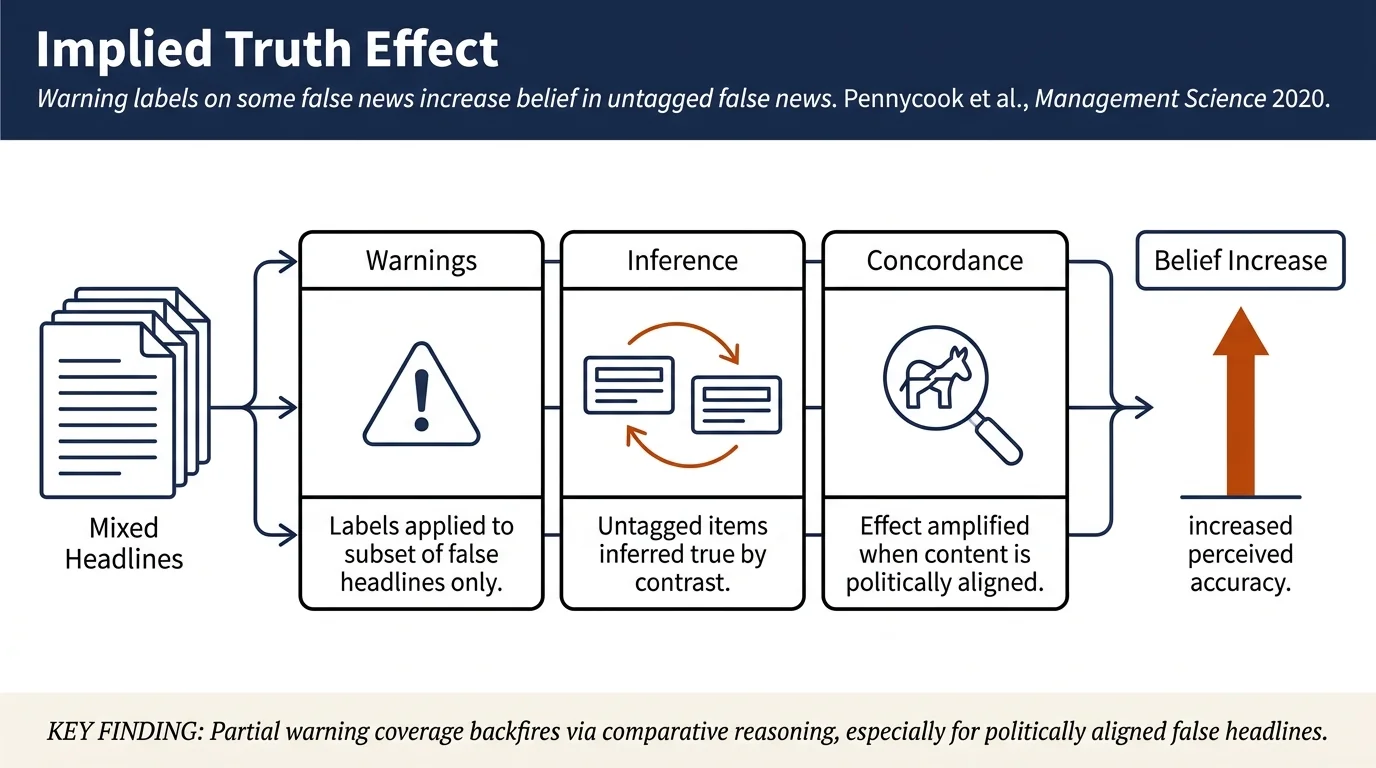
The Implied Truth Effect: Attaching Warnings to a Subset of Fake News Headlines Increases Perceived Accuracy of Headlines Without Warnings
Psychology & interventionsDetection methods
Bayesian or biased? Analytic thinking and political belief updating