 Gordon Pennycook
Contributions
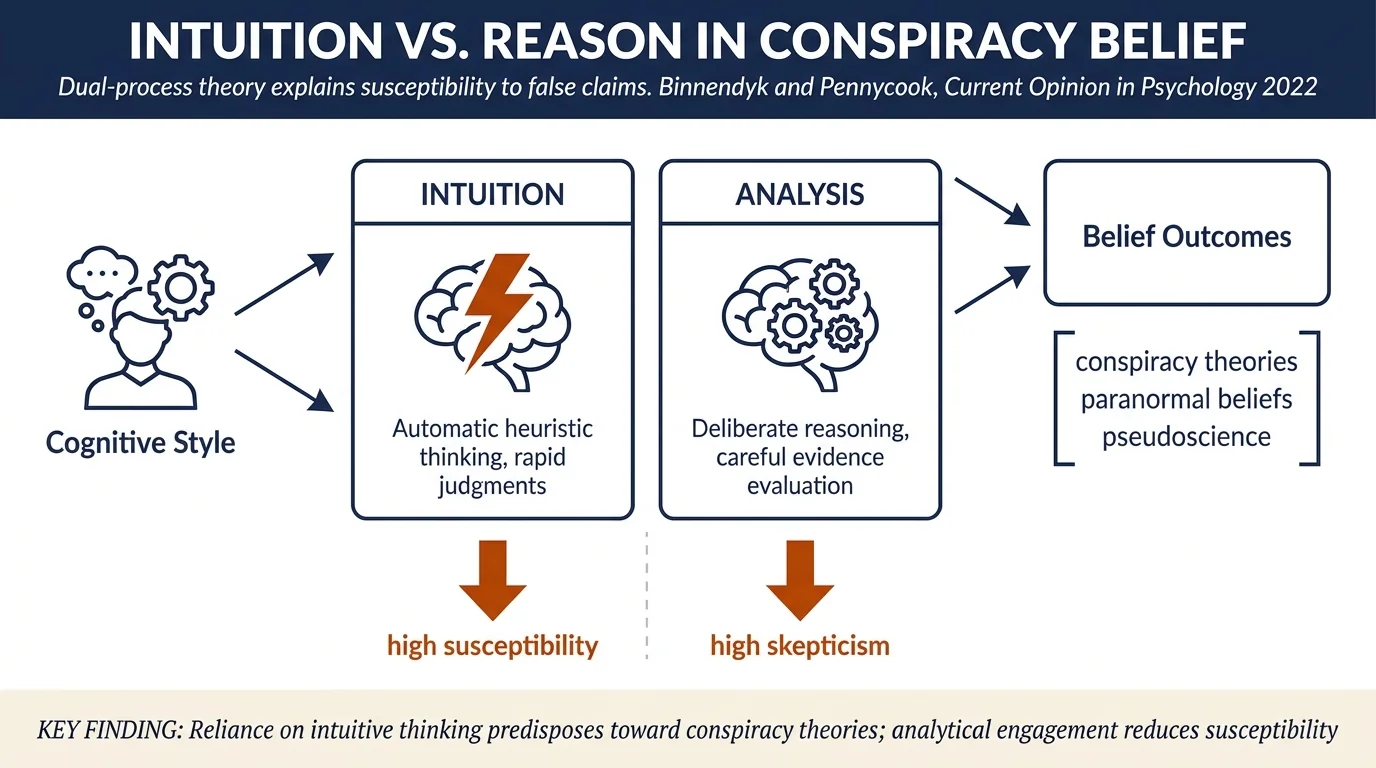
- Synthesizes evidence from dual-process psychology showing conspiracy belief correlates with intuitive thinking and low analytic engagement (measured via Cognitive Reflection Test and similar measures)
- Documents that this relationship replicates across diverse conspiracy types, participant samples, and measurement approaches
- Extends the dual-process framework to related phenomena: conjunction fallacy errors, confirmation bias, pattern perception, and bullshit receptivity all predict conspiracy belief
- Identifies gaps in existing research: most work is correlational, few experimental studies manipulate deliberation, mechanism remains unclear
- Proposes that actively open-minded thinking and epistemically suspect beliefs may operate through similar intuitive-analytic pathways
Method
The paper is a narrative review synthesizing existing empirical work on the relationship between cognitive style and conspiracy belief. The authors organize evidence around dual-process theory (System 1: automatic, intuitive; System 2: deliberative, analytical) and examine how the disposition to engage in analytic thinking predicts skepticism toward conspiracy claims.
Evidence comes from studies using: (1) trait measures of analytic thinking (Cognitive Reflection Test, need for cognition, actively open-minded thinking scales); (2) cognitive-bias measures (conjunction fallacy susceptibility, confirmation-bias tasks); (3) direct experimental manipulation of deliberation (time pressure, explicit encouragement to reflect); and (4) diverse conspiracy samples (paranormal, political, religious, COVID-related).
Results
Correlational evidence: Most studies find a small-to-moderate negative relationship between measures of analytic thinking (CRT scores, high need for cognition) and conspiracy belief. This relationship holds across different conspiracy types, participant samples, and measurement approaches, though effect sizes vary.
Cognitive biases: Conjunction fallacy errors, overestimation of coincidence, and confirmation bias (seeking out biased evidence) are all associated with conspiracy belief, suggesting shared underlying mechanisms related to probabilistic reasoning and evidence evaluation.
Related beliefs: Conspiracy belief is correlated with belief in paranormal phenomena, pseudoscience, bullshit receptivity (tendency to find meaningless statements profound), and low willingness to change beliefs based on evidence.
Ambiguity about reflexive vs. reflective thinking: Some evidence suggests a small proportion of conspiracy theorists may be highly deliberative but use their reasoning to construct elaborate conspiracy narratives. The authors note this "reflexive" open-mindedness (openness to alternative claims) is distinct from genuine analytic thinking and remains understudied.
Notes
Strengths: The review clearly synthesizes a large body of correlational evidence supporting dual-process theory; the findings replicate across diverse contexts. The authors are careful to note the small-to-moderate effect sizes and acknowledge that analytic thinking is not an invincible shield against conspiracy belief.
Limitations and open questions: The paper identifies critical gaps in the literature. Most evidence is correlational; few experimental studies directly manipulate deliberation and measure downstream effects on conspiracy belief. The mechanism by which low analytic thinking increases conspiracy susceptibility remains unclear—is it reduced evidence scrutiny, increased reliance on pattern recognition, or something else? The paper also notes that some intentional conspiracy theorists may engage in elaborate reasoning and that reflexive vs. reflective thinking deserves more attention. Finally, the authors emphasize that work in this domain lacks sufficient experimental studies and that understanding underlying cognitive mechanisms is essential for designing interventions.
The paper is part of a growing literature arguing that individual differences in reasoning style are fundamental to misinformation susceptibility, with implications for designing digital literacy, inoculation, and platform interventions.