 Gordon Pennycook
Contributions
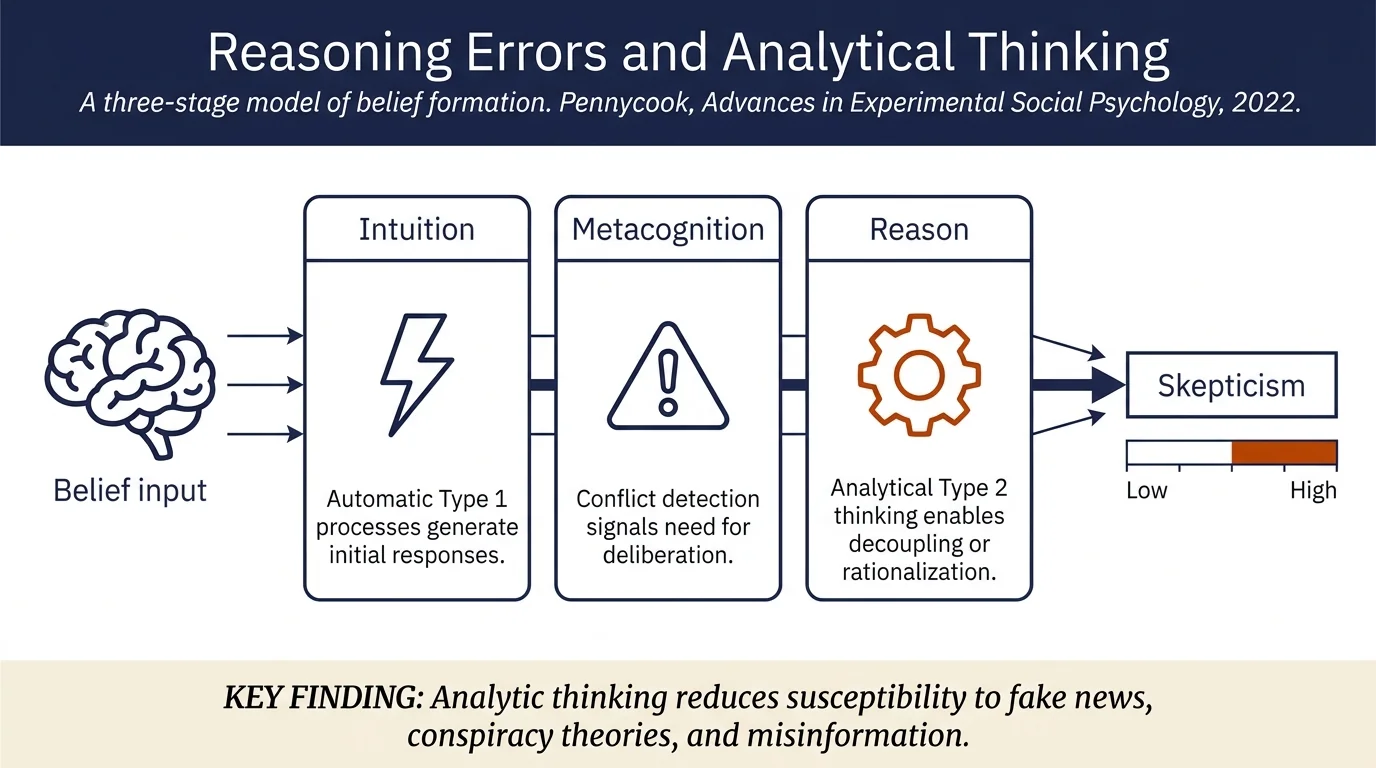
- Formalizes a three-stage model of reasoning that distinguishes errors arising from faulty initial intuitions (Stage 1), failures to detect conflict (Stage 2), and inadequate deliberation (Stage 3).
- Demonstrates that analytic thinking predicts skepticism about a range of epistemically suspect beliefs: fake news, conspiracy theories, paranormal beliefs, COVID-19 misinformation, pseudoscience, and climate-change denial.
- Bridges the heuristics-and-biases tradition with dual-process theories, clarifying the mechanisms by which metacognitive conflict monitoring triggers analytical engagement.
- Applies the framework to explain reasoning errors across diverse domains beyond misinformation, unifying disparate literatures.
Method
The chapter synthesizes decades of dual-process theory and reasoning research. The three-stage model structures the time-course of a single decision-making event:
Stage 1 (Intuition): When presented with a problem or cue, automatic ("Type 1") cognitive processes generate one or more initial responses (IR). These emerge autonomously from stored associations and learned stimulus-response pairings; no deliberation is required.
Stage 2 (Metacognition): A conflict-monitoring system detects whether these intuitive responses contradict each other or violate prior knowledge. If conflict is detected, it signals the need for deliberation; if not, reasoning ends.
Stage 3 (Reason): When conflict is detected, effortful ("Type 2") analytical thinking may be initiated. Pennycook distinguishes two paths: decoupling (inhibiting and replacing the initial intuition) and rationalization (bolstering it). The model predicts that true analytic engagement yields decoupling, while motivated reasoning yields rationalization.
The model emphasizes that people vary in both their tendency to generate competing intuitions and their sensitivity to conflict signals. Analytical cognitive style—indexed by measures like the Cognitive Reflection Test—correlates with better conflict detection and more consistent engagement in decoupling.
Results
Empirical evidence across numerous experiments and domains supports the framework:
- Analytic thinking predicts skepticism across a broad range of epistemically suspect beliefs: paranormal beliefs, conspiracy theories (JFK assassination, 9/11, flat earth), COVID-19 misinformation, pseudoscience, alternative medicine, and climate-change denial.
- Individual differences in analytic cognitive style (even beyond explicit reasoning errors) predict reduced susceptibility to bullshit, fake news, and misinformation; these effects hold even after controlling for prior factual knowledge.
- Conflict detection matters: Manipulations that increase the salience of conflict (e.g., via reasoning questions or perspective-taking) increase the time people spend deliberating and can reduce belief in misinformation.
- Moral judgments and values show patterns consistent with the framework: analytic thinking correlates with less polarized moral judgments and weaker religious fundamentalism.
- Experimental evidence for causal effects: Some paradigms (e.g., verbal protocol studies, deliberation manipulations) support a causal role for analytic thinking in improving judgment quality and reducing false-belief adoption.
Notes
Strengths: The three-stage model provides a unifying framework for disparate empirical phenomena and clarifies the roles of intuition, conflict monitoring, and deliberation. The synthesis integrates heuristics-and-biases research with modern dual-process theory in a way that explains both why people fall prey to reasoning errors and how individual differences (via analytic thinking) modulate this susceptibility. The breadth of empirical coverage—from fake news to climate change to moral judgment—demonstrates the generality of the framework.
Limitations and open questions: The model assumes that at least one intuitive response is generated for most problems; some scenarios (e.g., truly novel questions) may not fit this assumption. The relative contribution of Stage 1 errors (faulty intuitions) versus Stage 2 errors (conflict detection failures) versus Stage 3 errors (inadequate deliberation) varies across domains, but the chapter does not always disambiguate which is most important for a given belief. There remains debate over whether conflict monitoring is the primary trigger for deliberation, or whether it is one of several possible triggers. The causal evidence for analytic thinking improving judgment (versus merely correlating with better prior beliefs or domain knowledge) is mixed and domain-dependent; some studies show causal effects while others find effects are largely explained by prior factual knowledge rather than reasoning ability per se.