 Filippo Menczer
Contributions
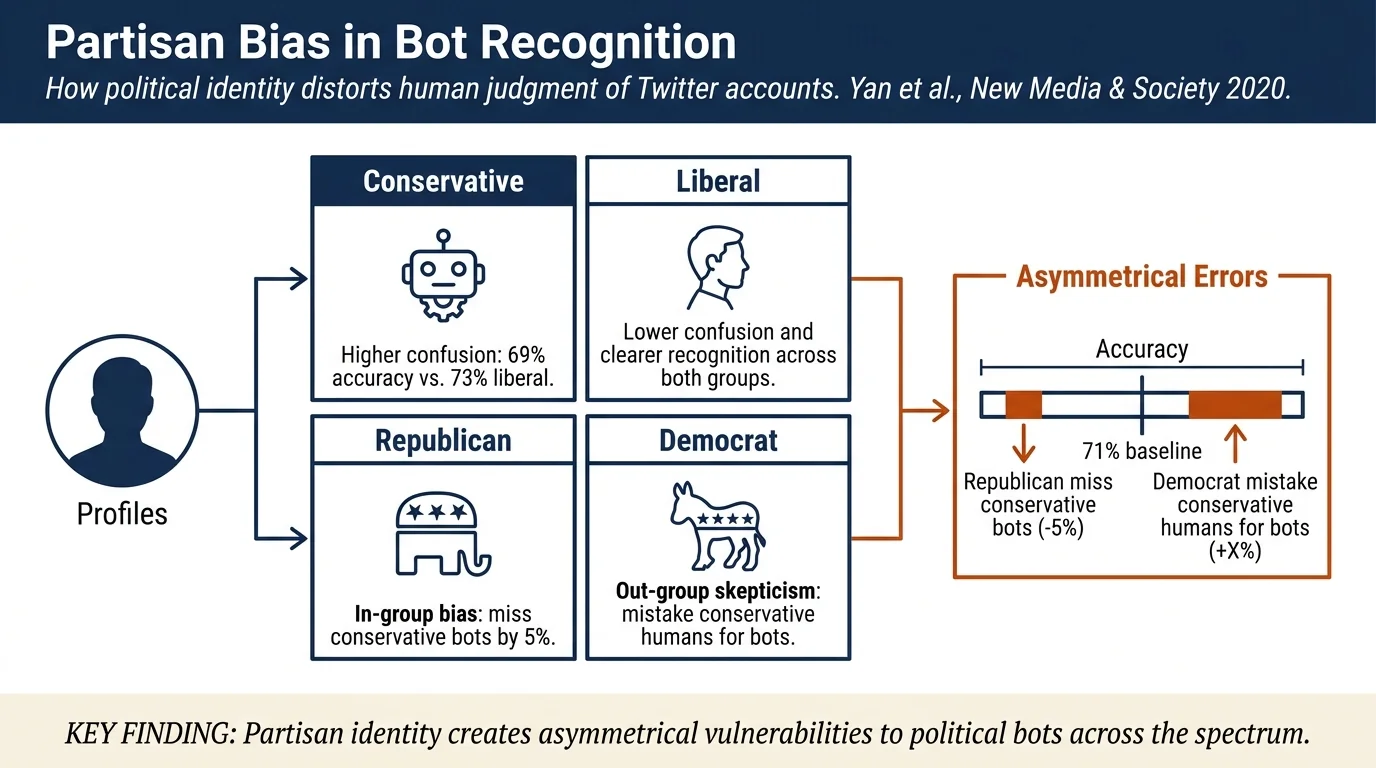
- Experimentally demonstrates that partisan identity influences political bot recognition accuracy, with asymmetrical effects across the political spectrum.
- Shows conservative bot profiles are significantly harder to distinguish from humans ($69\%$ accuracy) compared to liberal profiles ($73\%$).
- Identifies two distinct failure modes: Republicans miss conservative bots (in-group favoritism); Democrats mistake conservative humans for bots (out-group skepticism).
- Provides evidence that deliberation time and perceived uncertainty negatively predict recognition accuracy, suggesting cognitive limits under ambiguity.
- Demonstrates that prior bot knowledge and self-efficacy do not reliably predict recognition performance.
Method
The study used a $2 \times 2$ within-subjects online experiment manipulating (1) ambiguity level (low vs. high, determined by Botometer scores) and (2) political persona (liberal vs. conservative, manually coded from profile content). Participants ($N = 656$ from MTurk, filtered to $n = 656$ completers) evaluated $20$ Twitter accounts sampled from followers of U.S. politicians. For each profile, participants answered: "Do you think the account you just saw is a bot or a human?" with four response options (definitely/likely bot or human). Recognition accuracy was determined via hybrid validation: Botometer scores, expert coding, and crowdsourced majority judgment ($n = 444$ for low-ambiguity cases). The analysis used two-level mixed-effects logistic regression to account for unobserved individual differences.
Results
Baseline recognition: Participants achieved $71\%$ accuracy ($SD = 12\%$) on average, significantly above chance ($t = 43.22$, $p < .001$). High-ambiguity profiles yielded $69\%$ accuracy vs. $73\%$ for low-ambiguity ($\beta = -.13$, $p < .01$).
Conservative profiles are more confusing: Regardless of participant party, accuracy dropped significantly on conservative profiles ($M = 69\%, SD = 15\%$) versus liberal profiles ($M = 73\%, SD = 16\%$; $t = -4.58$, $p < .01$). Conservative bots were misidentified as human $9\%$ more often than liberal bots ($MD = 9\%, p < .01$). Conversely, conservative humans were mislabeled as bots $5\%$ more often than liberal humans ($MD = -5\%, p < .01$).
Asymmetrical partisan bias: When examining congruent vs. incongruent party-profile pairs:
- Democrats show out-group skepticism: significantly more likely than Republicans to mislabel conservative humans as bots ($MD = 2\%, t = 2.04$, $p < .05$).
- Republicans show in-group favoritism: significantly more likely than Democrats to miss conservative bots ($MD = 5\%, t = 3.15$, $p < .01$).
- No analogous asymmetry was found for liberal profiles ($p > .05$).
Cognitive factors: Longer deliberation time predicted lower accuracy ($\beta = -.08$ per minute, $p < .05$); perceived uncertainty predicted an accuracy drop of $14\%$ ($\beta = -.92$, $p < .01$). Neither prior bot knowledge nor self-efficacy were significant predictors ($p > .05$).
Notes
Strengths: The study directly addresses a gap in the literature—how humans perceive political bots—rather than relying solely on automated detection. The asymmetrical finding is striking and policy-relevant: it suggests Republicans face greater vulnerability to bot manipulation despite comparable bot-awareness to Democrats. The hybrid accuracy-determination method (Botometer + expert + crowd) is robust. The two-level mixed-effects model properly accounts for repeated measures and individual heterogeneity.
Limitations: Convenience sample from MTurk; generalizability to non-US, non-English, or less tech-savvy populations is unclear. Participants knew they were in a bot-detection study, which may suppress natural susceptibility. The paper focuses only on profiles with explicit partisan personas; bots with more subtle or non-political personas were not tested. Cross-partisan pairs (e.g., Republican-liberal) were excluded from main analysis; asymmetry might be even larger if studied. No longitudinal follow-up to test whether participants' confidence in judgments predicts real-world bot-interaction patterns.
Implications: The findings underscore that automated bot detection, while effective in aggregate, cannot substitute for human judgment when bots adopt sophisticated partisan personas. Interventions targeting Republican audiences may need to emphasize the deceptiveness of in-group-branded bots; interventions for Democrats should address false positives and the risk of dismissing legitimate out-group voices. The negative relationship between deliberation and accuracy suggests that slowing users down or asking them to explain their reasoning may backfire when profiles are genuinely ambiguous.