 Huan Liu
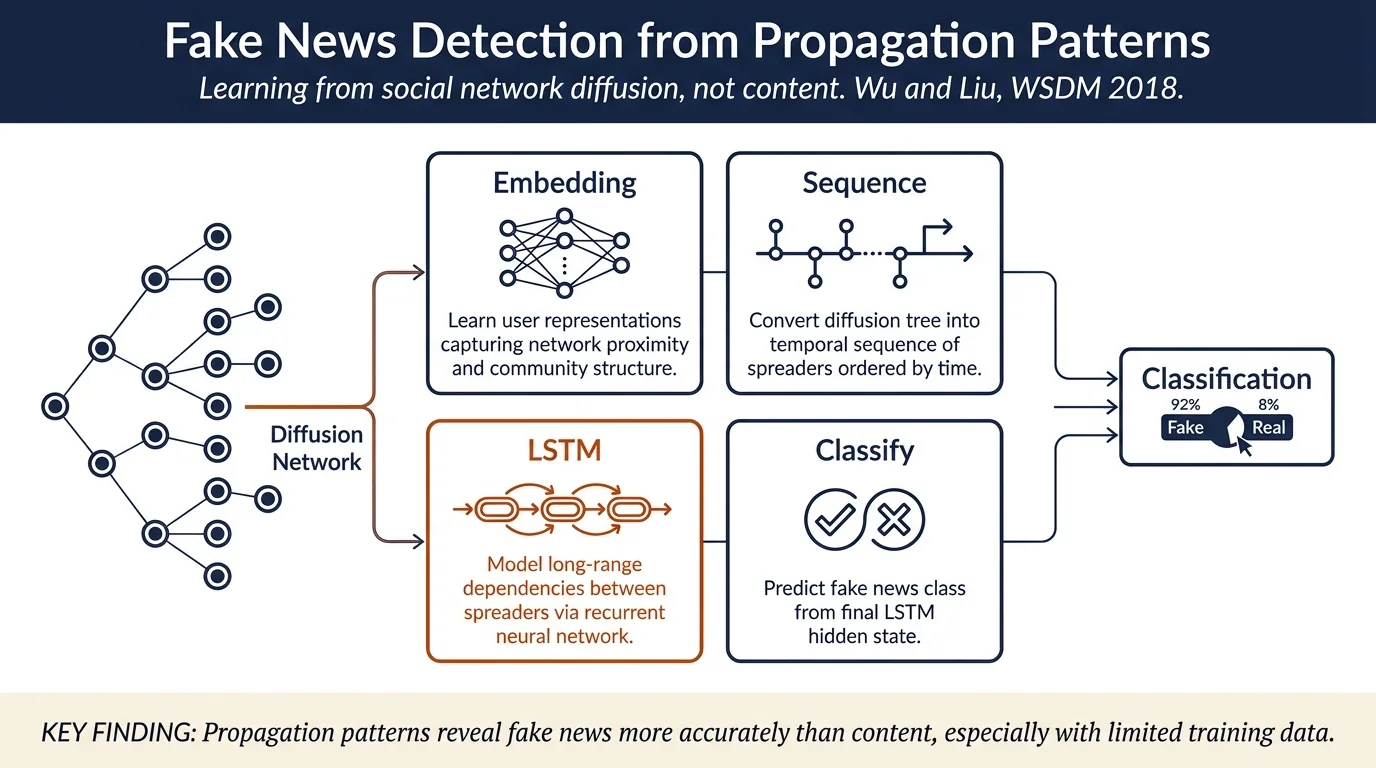
Contributions
- A novel approach to classify social media messages using diffusion network information rather than content, addressing challenges when content is sparse, noisy, or intentionally manipulated.
- A principled embedding method that jointly models both microscopic (first/second-degree proximity) and mesoscopic (community structure) network characteristics.
- An end-to-end LSTM-RNN classifier that converts diffusion trees into temporal sequences and models spreader dependencies for message categorization.
- Experimental validation on two tasks (news categorization and fake news detection) showing TraceMiner outperforms content-based approaches, especially with scarce training data.
Method
TraceMiner operates in two stages: user embedding and sequence classification.
User Embedding: The method learns latent user representations from a social network graph that capture both local proximity (connected nodes or common neighbors should have similar embeddings) and global community structure. Existing methods like DeepWalk or LINE capture only one of these aspects. TraceMiner formulates an optimization problem that jointly models both by decomposing the transformation matrix into a global component (capturing community structure via modularity maximization) and node-specific local components (capturing microscopic proximity via network lasso regularization). The objective function combines: (1) reconstruction loss enforcing embeddings match community representations, (2) modularity maximization to preserve community structure, and (3) network lasso regularization to preserve first/second-degree proximity.
Sequence Modeling: A message's diffusion is represented as a temporal sequence of its spreaders (users who posted or shared it), ordered by timestamp. This converts the intractable problem of comparing tree structures (nn² possible trees for n spreaders, by Cayley's formula) into comparing sequences (n! orderings). To capture long-range dependencies between distant spreaders that may be separated temporally, the method uses LSTM-RNNs. The sequence is fed in reverse order (most recent spreader last) so the initial spreader directly influences the prediction output. After processing the entire sequence, the final hidden state is passed through a softmax layer to produce the predicted class label.
Results
On Twitter news categorization (68,892 messages across 4 categories: business, science/tech, entertainment, medical):
- TraceMiner achieves Micro-F1 of 82.75% with 10% training data vs. 70.21% for XGBoost
- Micro-F1 reaches 93.80% at 90% training data vs. 90.47% for XGBoost
- The gap is largest with scarce data, showing TraceMiner's advantage when content is limited
On fake news detection (3,600 balanced messages):
- TraceMiner achieves F1 of 78.67% with 10% training data vs. 65.58% for XGBoost
- At 90% training data: 91.24% vs. 82.26%
- Larger improvements for fake news than news categorization, suggesting intentional content manipulation by fake news spreaders makes network information particularly valuable
Variants TM(DeepWalk) and TM(LINE) using standard embeddings underperform the joint embedding approach, validating that capturing both proximity types matters.
Notes
Strengths: The insight that propagation patterns are robust to content manipulation is well-motivated and practically valuable for emerging fake news tasks. The technical contribution of jointly modeling multiple network levels is sound. The experimental design with varying training ratios effectively demonstrates the value in low-data regimes.
Limitations: Evaluation is on Twitter only; generalization to other platforms or languages unclear. The method requires complete historical diffusion traces at prediction time, which may not always be available in real deployment. Comparison with other network-based methods (beyond DeepWalk/LINE variants) would strengthen the paper. The paper doesn't explore temporal evolution of diffusion patterns.
Open questions: How does performance degrade when diffusion is incomplete or truncated? Can the method detect early whether news will eventually spread broadly? How sensitive is the embedding to network sampling or missing edges?