Contributions
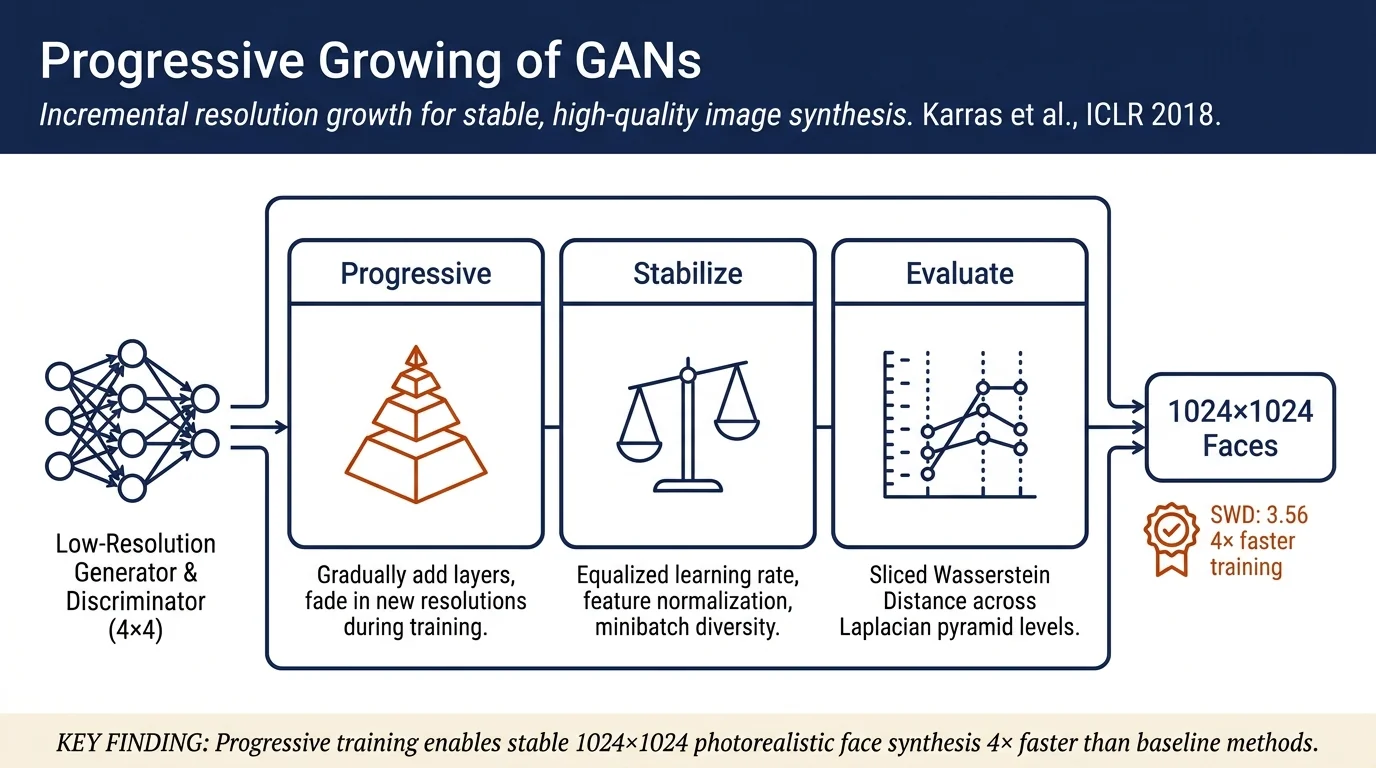
- Progressive growing training methodology: Both generator and discriminator start with low-resolution architectures (4×4 pixels) and gradually increase resolution by adding layers during training, allowing the network to first learn large-scale structure before fine-grained details.
- Stabilized training at high resolution: Progressive growing dramatically stabilizes GAN training and enables synthesis at 1024×1024 resolution, compared to prior work limited to ~256×256.
- Minibatch standard deviation: Reduces GAN mode collapse by computing standard deviation of features across the minibatch and adding it as a feature to the discriminator, encouraging diversity in generated images.
- Normalization techniques: Introduces equalized learning rate (weight normalization at runtime) and pixelwise feature vector normalization to prevent unhealthy competition between generator and discriminator.
- Multi-scale statistical similarity metric: Proposes Sliced Wasserstein Distance (SWD) computed across multiple Laplacian pyramid levels to evaluate both quality and variation of generated images, more robust than prior metrics.
- CELEBA-HQ dataset: Curates a high-quality version of CELEBA with 30,000 images at 1024×1024 resolution by upsampling, aligning faces, and applying quality filtering; removes artifacts and low-resolution images.
Method
The key innovation is progressive growth: training begins with very small networks operating on 4×4-pixel images. The discriminator $D$ and generator $G$ share the same architecture in terms of layer progression. As training converges at a given resolution, new layers are inserted on both sides (generator and discriminator), smoothly fading them in via learned blending parameters (alpha) over thousands of iterations. This allows:
- Coarse structure learning first: Early layers learn high-level patterns (face shape, hair, orientation).
- Fine-detail specialization later: Later layers added during progression focus on texture, eyes, skin detail without disrupting already-learned features.
- Smooth transition: The fade-in mechanism prevents sudden training instability when adding layers.
Training normalization:
- Equalized learning rate: Instead of careful weight initialization, all layers use unit Gaussian initialization and weights are scaled at runtime by $w'_i = c \cdot w_i / \sqrt{\sum_j w_j^2}$, ensuring similar gradient magnitudes across layers regardless of fan-in.
- Pixelwise feature normalization: After each convolution in the generator, feature vectors are normalized to unit length across the feature-map dimension, preventing magnitude escalation.
Variation encouragement:
- Minibatch standard deviation: Adds a layer that computes per-pixel standard deviation of features across the minibatch and broadcasts this as an additional feature channel to the discriminator input. This makes the discriminator sensitive to global feature statistics, forcing the generator to maintain diversity.
Loss function: Uses WGAN-GP loss (Wasserstein GAN with gradient penalty) by default, but also experiments with LSGAN. A fourth term penalizes discriminator output magnitude to prevent extreme gradients.
Results
Inception Score and Multi-Scale Structural Similarity (MS-SSIM):
- CIFAR10 unsupervised setting: 8.80 inception score (best published result at the time for unsupervised setting)
- Progressive growth with all contributions achieves significantly better SWD (Sliced Wasserstein Distance) than baselines
- Configuration (a) baseline (Gulrajani et al. 2017): SWD = 13.9 on CELEBA
- Configuration (g) with progressive growing + proposed contributions: SWD = 3.56 on CELEBA
Training speed: Progressive growing accelerates training by ~4× at full 1024× resolution. Non-progressive training takes ~520 hours to reach full resolution; progressive variant reaches same quality in ~96 hours.
High-resolution face generation: Figure 5 demonstrates 1024×1024 face synthesis from the CELEBA-HQ dataset with high perceptual quality. Figure 10 shows nearest neighbors in feature space, confirming generated faces are novel and not memorized.
Convergence: Progressive growing reaches optimal SWD metric quality much faster and more stably than baseline configurations. The improvement is sustained across all resolution levels.
Notes
Strengths: This is a seminal work that solved a critical practical problem in GAN training—instability and poor quality at high resolution. The progressive growing insight is elegant: instead of learning a mapping from latent space to 1024×1024 all at once, learning coarse-to-fine matches how human perception works. The minibatch standard deviation is a simple but effective solution to mode collapse. The CELEBA-HQ dataset (released publicly) has become a standard benchmark.
Significance for misinformation: While the paper makes no claims about deepfakes (published 2018, before the term was ubiquitous), the progressive GAN architecture has become fundamental to high-quality deepfake pipelines. The ability to generate 1024×1024 photorealistic faces is a direct enabling technology for non-consensual intimate imagery and political deepfakes. The paper's techniques are directly cited in deepfake generation research and tools.
Limitations: The paper focuses on face synthesis and does not directly address deepfake or misinformation applications. However, the architecture's impact on synthetic media capability is enormous.