Contributions
- Systematic analysis of Russian Internet Research Agency participation in U.S. social-movement discourse, specifically #BlackLivesMatter in 2016
- Network-analysis methodology for detecting RU-IRA accounts based on their structural positioning in retweet networks
- Typology of coordinated inauthentic behavior: persona construction, identity performativity, cross-community embedding, and trust cultivation
- Empirical evidence that information operators coordinate content strategically to amplify both sides of polarized discourse
- Mixed-methods approach integrating network graph analysis with qualitative account archaeology and content analysis
Method
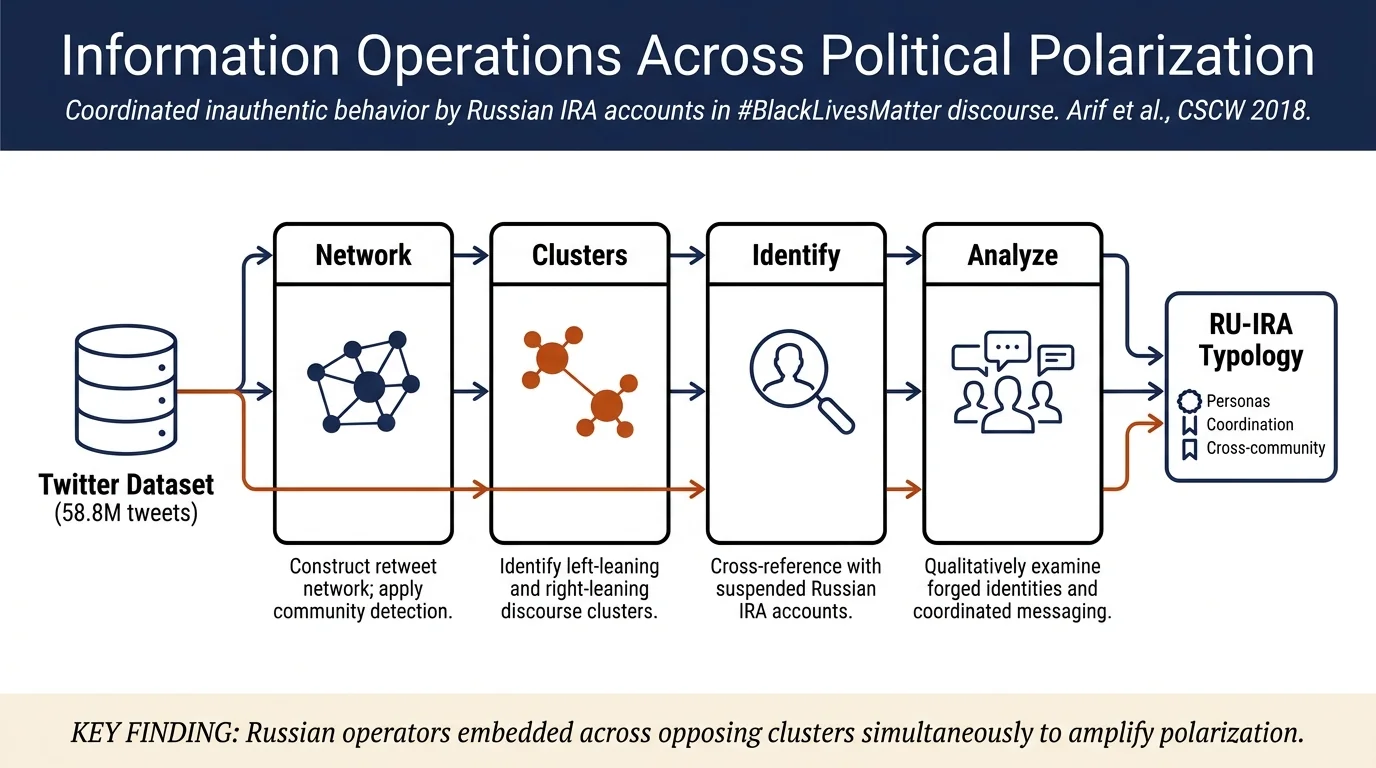
The research employs a mixed-methods approach grounded in constructivist theory. The researchers began with a dataset of 58.8M tweets containing shooting-related keywords collected between December 2014 and October 2016. They filtered this to 248,719 tweets using #BlackLivesMatter, #BlueLivesMatter, or #AllLivesMatter hashtags.
For structural analysis, the team constructed a network graph of retweet flows among 22,020 accounts, where each node is a Twitter account and edges represent retweets. Using Force Atlas 2 visualization and the Infomap community-detection algorithm, they identified two structurally distinct clusters divided along political lines—one left-leaning (pro-BLM) with 10,681 accounts and one right-leaning (pro-Trump, anti-BLM) with 9,509 accounts. The two clusters showed strong homophily: 91.7% of nodes were concentrated in the respective clusters, with roughly 43.2% of nodes in the center contentious to both clusters.
For identifying RU-IRA accounts, the researchers cross-referenced Twitter's November 2017 list of 2,752 suspended RU-IRA accounts against their dataset. This reduced the subset to 96 RU-IRA accounts in the dataset overall; after filtering for network integration (at least two retweets within the clusters), 29 RU-IRA accounts remained for qualitative analysis.
Qualitative analysis examined three units: profile data (hashtag descriptions, profile images, biographies); tweet content (texts, embedded media, memes); and external websites and social-platform links. The researchers used open coding followed by analytical memoing to identify patterns. They supplemented this with Internet Archive snapshots to retrieve historical content.
Results
The network analysis revealed that RU-IRA accounts were deeply embedded in both clusters: 22 of the 29 identified RU-IRA accounts were in the left (pro-BLM) cluster, and 7 were in the right (anti-BLM) cluster. Most striking was that these accounts did not cluster together—they were dispersed and integrated into the surrounding organic networks, suggesting deliberate placement and coordination to appear authentic.
The qualitative analysis identified four systematic patterns in RU-IRA account behavior:
-
Forged identities. RU-IRA accounts constructed personas representing African Americans and conservative Americans. Left-leaning accounts used cultural imagery (Pan-African colors, Black history references), African-American personal narratives, and engagement with BLM hashtags. Right-leaning accounts used American patriotic imagery, gun-rights language, and Trump support.
-
Content adaptation. Accounts in the left cluster tweeted support for Black Lives Matter, shared accomplishments of African Americans, and engaged with celebratory content (e.g., Black History Month, African American hairstyles, film reviews). Accounts in the right cluster emphasized traditional American holidays, military service, and gun ownership. This code-switching suggested a "brand identity" approach where a central script governed persona consistency while allowing topic flexibility.
-
Cross-network coordination. RU-IRA accounts retweeted each other across clusters, creating the illusion of organic dialogue. In one example, three RU-IRA accounts (@TrayneshaColе, @BleepThePolice, @CrystallJohnson) coordinated to retweet each other on a "Girl Power" meme, amplifying a discussion about women's engagement in activism.
-
Trust cultivation. Accounts engaged in seemingly casual, organic interactions: retweeting and discussing topics with other accounts, sharing personal stories, and participating in trending conversations. This sustained engagement created the appearance of authentic activist participation and community membership.
Overall, the 29 RU-IRA accounts accounted for 89,437 tweets in the broader "LM" dataset. Although their direct numerical impact was limited, the strategic placement and coordinated messaging across opposing communities suggest their primary goal was exacerbating division rather than amplifying a single side.
Notes
Strengths: The paper makes a strong empirical contribution by combining network positioning analysis with qualitative deep-dive into persona construction and content strategy. The finding that RU-IRA accounts coordinated across opposing clusters—rather than promoting one side—is a novel insight into information-operation strategy: the goal is amplifying existing societal division, not necessarily winning a particular "side." The media-archaeology approach (using Internet Archive snapshots to reconstruct deleted profiles) is methodologically rigorous.
Limitations: The authors acknowledge that their dataset may be incomplete due to Twitter's rate limits and keyword-filtering bias. Not all RU-IRA accounts may have been active in their collection window. The study is focused on a specific discourse and moment (2016); generalization to other information-operation contexts requires caution. Some identified accounts were not retweeted enough to include in network analysis, limiting the sample size for qualitative study.
Impact: This work has been influential in shifting how researchers understand computational propaganda—not as unidirectional messaging, but as deliberate amplification of existing polarization. It has informed platform responses and policy discussions around coordinated inauthentic behavior detection.