Statistical Detectability of Coordination
Authors: Letizia Iannucci, Antonis Matakos, Mikko Kivelä Venue: arXiv cs.SI, 2026 — arXiv:2610.37970
TL;DR
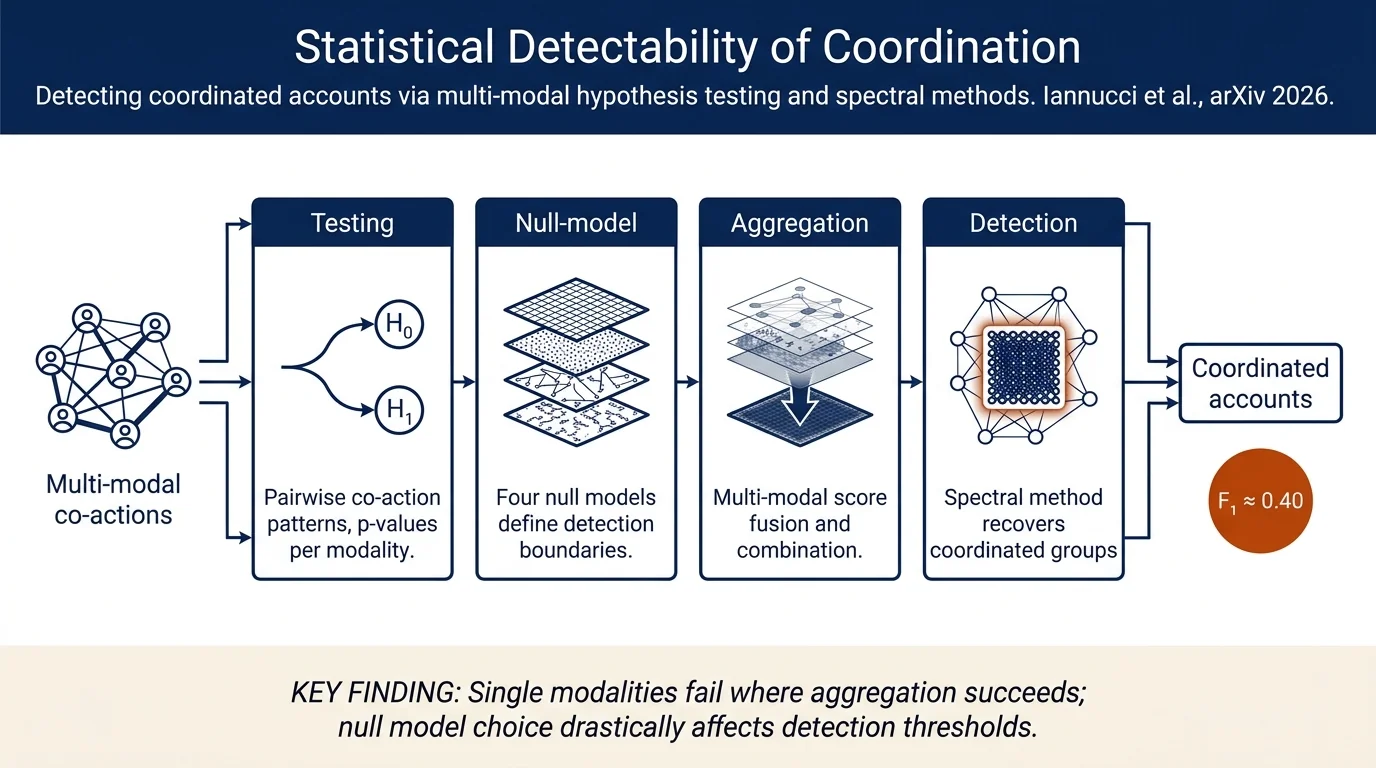
This paper formulates coordination detection as a hypothesis-testing problem on account pairs, modeling coordination as a planted submatrix. The authors derive statistical and computational detection limits, test four different null models on 26 information-operation datasets across 7 modalities, and show that multi-modal aggregation is essential—density alone is insufficient to reliably detect coordinated behavior.
Contributions
- Formulates coordination detection as pairwise hypothesis testing of co-action patterns, reducing the problem to planted submatrix detection
- Derives information-theoretic and computational lower bounds (in terms of signal strength, group size, population scale, and modality count)
- Proposes a spectral method that recovers coordinated groups with agreement higher than previously reported methods on labeled data
- Demonstrates empirically that the choice of null model drastically affects detection thresholds, contradicting prior work's assumption that density-only clustering suffices
- Shows that a single modality can fail to detect coordination detectable across multiple modalities, validating multi-modal analysis
Method
The paper models coordination detection at two levels. Pairwise level: For each pair of accounts (i, j) and each modality (e.g., hashtags, mentions), the authors test whether the pair co-acts more frequently than would be expected under a null model. Each modality contributes a p-value; a threshold test scores co-acting pairs and aggregates scores across modalities. Group level: The coordinate group is inferred via a planted submatrix search—finding a dense block of high-scoring pairs in a matrix. Four null models are evaluated:
- Uniform-modality: Randomizes action times uniformly within each modality.
- Uniform-account: Spreads each account's actions uniformly over its active period.
- Account-activity: Preserves each account's activity profile and hourly patterns but randomizes items.
- Item-virality: Redraws action times of each account's actions from empirical item adoption curves.
For each null model, the authors compute confidence intervals on p-values, derive detection boundaries using scan and spectral tests, and measure how the predicted regime (impossible/hard/easy) aligns with labeled ground-truth recovery.
Results
The predicted regime of the 26 labeled information operations depends strongly on the null model chosen, with wide variance: easy regime (36%), account-activity (54%), uniform-account (81%), item-virality (84%). Multi-modal aggregation shifts operations toward easier detection; the spectral method recovers groups with F₁ of 0.40 under the uniform-account null model, exceeding most prior work evaluated on the same data. Permutation tests on density alone prove insufficient—coordinated groups detectable via spectral methods on aggregated scores can fail pairwise density tests. Recovery heuristics (size-agnostic peeling, fixed-size greedy search) find denser sets than chance but often miss or under-detect true coordination; the spectral method's median F₁ of 0.40 exceeds all top-3 prior methods evaluated in prior work.
Connections
- Related to Community Detection via shared graph-structure foundations, but applies hypothesis testing to account pairs rather than clustering edges.
- Builds on planted submatrix detection (classical signal detection problem) adapted for multi-modal account co-action layers.
- Addresses limitations flagged by prior work on temporal window effects in coordination detection.
- Methods apply to Computational Propaganda, Information operations, and Bot detection workflows.
Notes
The paper's key insight—that a single modality can render coordination undetectable while multiple modalities make it easy—has direct implications for platform detection strategies. Most practical coordination campaigns exploit multiple action channels; a single-layer method risks false negatives. The choice of null model is non-obvious and consequential; the paper validates all four against labeled data, showing no universally dominant null. The spectral approach is practical and outperforms clustering and density-based heuristics, though the authors note that real-world campaigns may be more complex (multiple disjoint subgroups, varying signal strength) than their single-block model assumes.