Contributions
- Temporal analysis of feature importance: Demonstrates that rumor characteristics evolve over time, with different feature sets becoming salient at different propagation stages
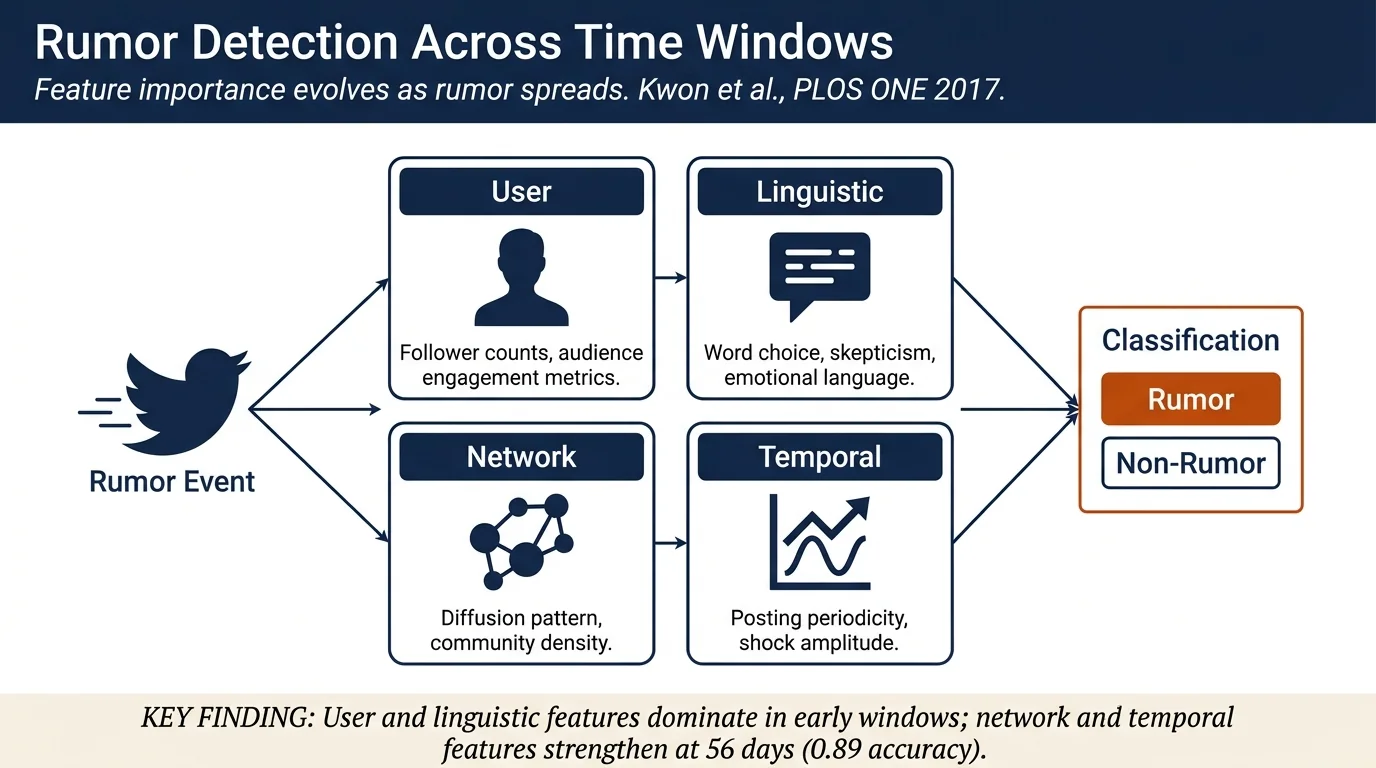
- Comprehensive feature framework: Examines 90+ features across four domains (user, linguistic, network, temporal) grounded in social psychology and information diffusion theory
- Periodic External Shock (PES) model: Proposes a temporal model capturing cyclical patterns in rumor spreading by extending the SIkεM epidemic model
- Practical algorithms: Introduces two rumor classification algorithms—one for early detection (user + linguistic features) and one for long-term analysis (all features)—each with different computational and data requirements
- Large-scale empirical validation: Uses 111 events (60 rumors, 51 non-rumors) from Twitter's near-complete archive covering 2006–2009
Method
Data
The authors extracted rumor and non-rumor events from Twitter's historical data:
- Rumors: Two rumor archives (snopes.com, urbanlegends.about.com) were used to identify rumorous events and their occurrence dates on Twitter
- Non-rumors: News events from times.com, nytimes.com, cnn.com were used to identify notable non-rumorous events
- Dataset: 111 total events (60 rumors, 51 non-rumors) with high inter-annotator agreement (ICC > 0.99)
- Time scope: 2006–2009 tweets and network information
Features
User features (27 variables): Followers, friends, tweets, percentiles (25th, 50th, 75th, 100th) of these counts, means, standard deviations, skewness, kurtosis. Hypothesis: rumor spreaders have distinctive audience sizes and engagement patterns.
Linguistic features (21 variables): Word counts from the Linguistic Inquiry and Word Count (LIWC) tool capturing cognitive styles (skepticism, negation), emotional dimensions (tentative, certain), and social processes (hearing, family, social relationships). Theory: rumors trigger different linguistic patterns than factual news.
Network features (43 variables): Three network types—
- Extended network (all users touching an event)
- Friendship network (followers/following relationships)
- Diffusion network (inferred information flow based on posting order and follow relationships)
Measures: density, clustering coefficient, degree distribution, connected component size, and direction of information flow. Theory: rumors create denser, smaller communities with weaker external connections than news.
Temporal features (5 variables): Periodic External Shock (PES) model parameters capturing periodicity, amplitude, and phase of rumor cycles, plus a baseline shock strength.
Classification
- Machine learning: Random forest classifiers with 10-fold cross-validation
- Feature selection: Ran stepwise variable selection 10 times, selecting features that appeared ≥8 times to ensure robustness
- Comparison: Evaluated each feature domain independently and in combination across the five observation windows
Results
Feature importance by observation window
User features:
- Highly predictive in 3-day window (F1: 0.76)
- Decline over time; by 56 days, F1 drops to 0.64
- Interpretation: early rumor spreaders have distinctive profiles, but these characteristics converge as more diverse users engage
Linguistic features:
- Remarkably stable predictors (F1: 0.80–0.86 across all windows)
- Key indicators: skepticism, negation, tentative language, and words related to cognition and social relationships
- Most useful alone for early detection; combined with others, they maintain predictive power
- F1 score of 0.80 using linguistic features alone; 0.8–0.86 when combined with others
Network features:
- Poor performance in short windows (3–7 days: F1 ≈ 0.56–0.65)
- Dramatically improve with longer observation (56 days: F1 = 0.77)
- Interpretation: rumor diffusion networks take time to develop distinctive structure; early network is too sparse
Temporal features:
- No predictive power in short windows (3–7 days)
- Become significant at 14+ days (F1 > 0.70)
- Most predictive at 56 days (F1 = 0.87) when periodic cycles are apparent
- Encoding: rumor events show repeating peaks; non-rumor events show single prominent spike
Overall classification performance
Across all features combined:
- 3 days: 0.74 accuracy
- 7 days: 0.73 accuracy
- 14 days: 0.75 accuracy
- 28 days: 0.70 accuracy
- 56 days: 0.89 accuracy (F1 = 0.90)
Proposed algorithms
Algorithm 1 (early rumor detection): Uses user and linguistic features only
- F1 score: 0.77–0.80 at 28 days (best: 0.80)
- Advantage: detectable without full network history; practical for real-time systems
Algorithm 2 (long-term classification): Uses all features
- F1 score: 0.80–0.90 (best: 0.90 at 56 days)
- More accurate but requires complete network data and extended observation periods
Notes
Strengths:
- Comprehensive feature analysis with strong theoretical grounding in psychology and network science
- Large-scale study using near-complete Twitter archive; findings are statistically robust
- Practical insight: early detection requires different tools than long-term analysis—informs system design
- Reproducible methodology; authors describe feature extraction and model fitting in detail
- Stable linguistic features offer practical advantage for real-time systems with incomplete network data
Limitations:
- Limited to Twitter; generalization to other platforms or languages unclear
- Rumor/non-rumor ground truth relies on manual archives (snopes.com, urbanlegends); some events may be misclassified or miss borderline cases
- Feature sets derived from common case studies; may not generalize to novel types of rumors
- Network completeness assumption: the authors use the public Twitter API snapshot from 2009, which may be incomplete for users who deleted tweets or accounts
- Machine learning features are observational; causation between spreading patterns and veracity cannot be claimed
- Limited to single language (English) and cultural context
Impact and follow-up:
This paper established temporal variation in rumor detection features as a core research direction. Subsequent work has extended this to: real-time early detection (building on the 3–7 day insights), multimodal rumor detection, and cross-platform rumor tracking. The finding that linguistic features remain stable predictors has been validated in later work on fact-checking and claim verification.