Contributions
- Frames clickbait as a form of deceptive "false news" distinct from but related to outright falsehood and sensationalism
- Surveys linguistic and computational methods for detecting clickbait at multiple levels of analysis
- Proposes that curiosity-gap theory (from information-seeking research) explains why clickbait headlines work psychologically
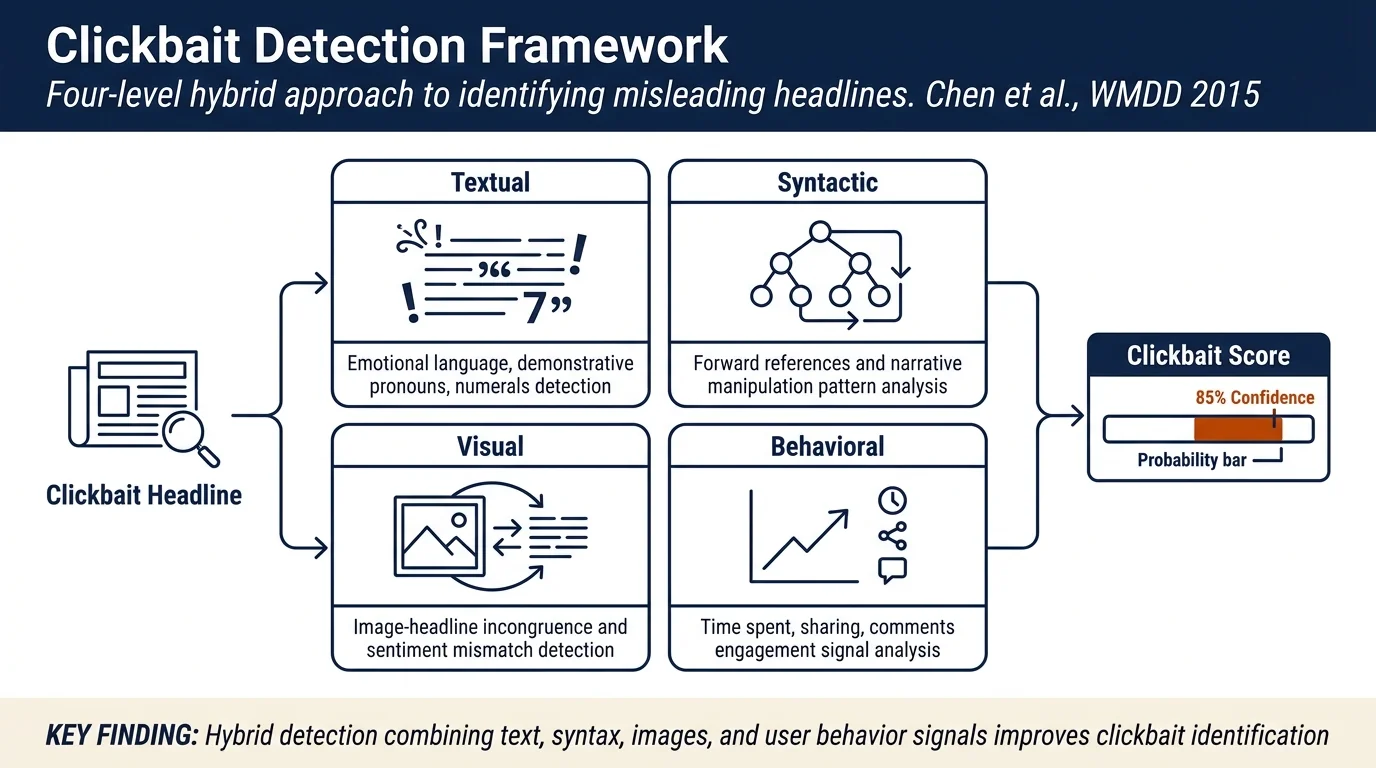
- Identifies four families of detection cues: lexical/semantic, syntactic/pragmatic, image-based, and user-behavior-based
- Suggests concrete machine-learning approaches (SVM, Naive Bayes, PCFG) applicable to each cue family
Method
The paper conducts a comprehensive literature review of clickbait characteristics and proposes a taxonomy of detection approaches:
Lexical and semantic cues exploit the observation that clickbait uses distinctive vocabulary patterns — demonstrative pronouns ("this"), action verbs, emotional language, numerals — captured via stylometric features and word-frequency analysis. Methods include SVM and Naive Bayes classifiers trained on keyword probabilities, and lexicon-based approaches (e.g., LIWC) to quantify affective and action-oriented language.
Syntactic and pragmatic features leverage the notion that clickbait uses forward-referencing (resolving pronouns only after reading the article) and manipulative narrative structure. Probability Context-Free Grammars (PCFG) can extract constituent syntax; neural network analysis can detect narrative patterns and reverse-narrative effects on curiosity.
Non-textual cues include images (via emotional ratings and sentiment analysis to detect headline-image incongruence) and user behavior signals (time spent reading, sharing, commenting) as indirect indicators of whether the headline delivered on its promise — a low "choice gap" suggests low clickbait probability.
Results
The paper does not report quantitative results on a single dataset; instead, it surveys existing work showing that:
- Stylometric features distinguish yellow journalism from high-quality journalism with 77% accuracy (Lex et al., 2010)
- Forward-referencing headlines are prominent on engagement-optimized sites like UpWorthy
- User engagement metrics (time-on-page, sharing behavior) correlate with headline-content match quality
The paper argues that a hybrid approach combining all four cue families would yield the best detection performance, though does not implement or evaluate such a system.
Notes
Strengths: Clear positioning of clickbait as a distinct but related problem to fake news; grounded in sensemaking theory from information science; pragmatic identification of multiple complementary detection signals. Proposes concrete linguistic features and machine-learning methods that influenced subsequent clickbait-detection work.
Limitations: No implemented system or empirical evaluation on a clickbait corpus. The paper is a position and survey, not an empirical study. Subsequent work (e.g., Chakraborty et al. 2016, Blom & Hansen 2015) built concrete datasets and classifiers based on these ideas, achieving much higher detection accuracy.
Historical significance: Early framing of clickbait as false news and as a target for automatic detection; helped motivate the clickbait-detection shared task (Potthast et al., 2017) and datasets like Webis Clickbait Corpus.