Contributions
- Systematizes deception research across interpersonal psychology, law enforcement, computer-mediated communication, and NLP to establish a foundation for fake news detection.
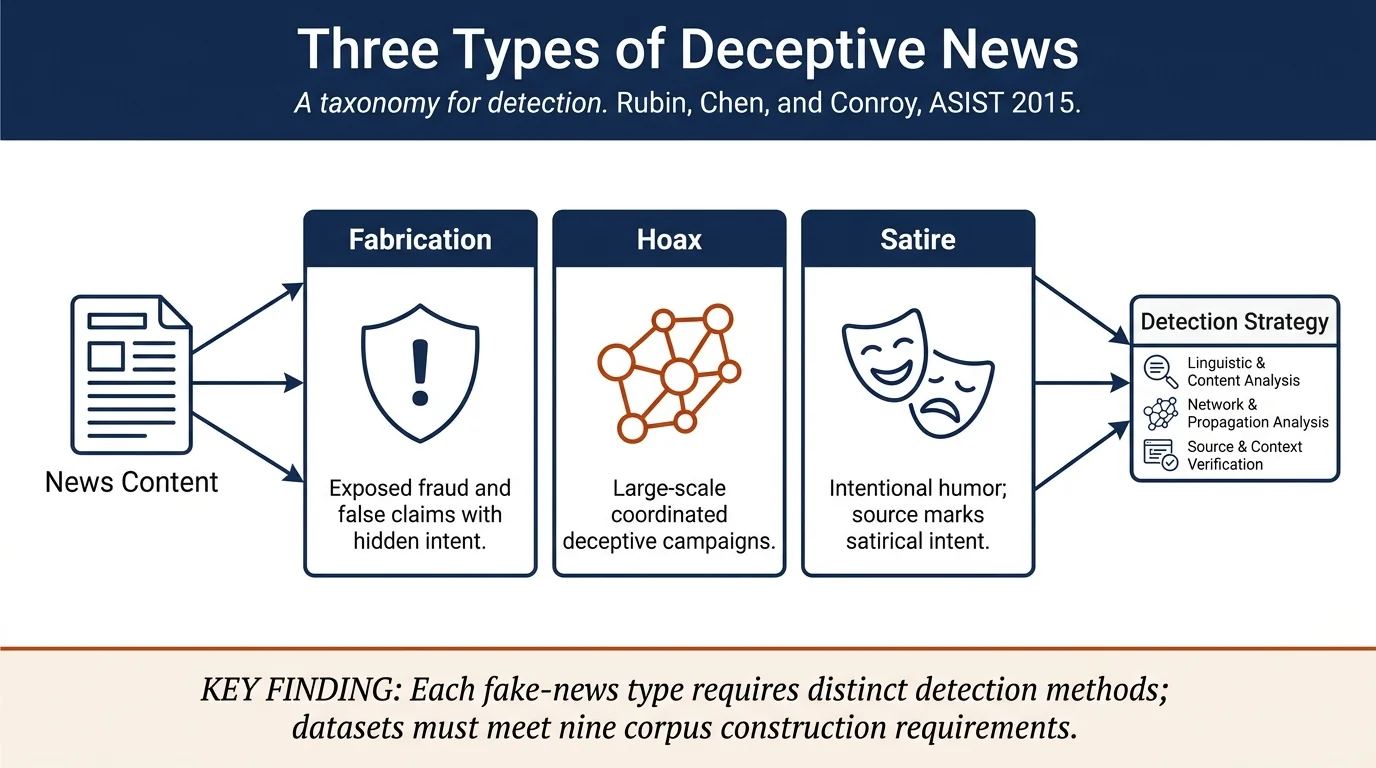
- Proposes a taxonomy of three fake news types, each requiring distinct detection strategies: Type A (serious fabrications including exposed fraud and yellow press), Type B (large-scale hoaxes like the #ColumbianChemicals attack), Type C (humorous fakes including satire sites and news game shows).
- Articulates nine corpus construction requirements for predictive modeling of fake news, addressing technical, pragmatic, and cultural dimensions.
- Reviews deception detection practices across disciplines to extract requirements for building labeled datasets suitable for NLP and text analytics.
Method
The paper conducts a systematic literature review of deception detection across five disciplines: interpersonal psychology, law enforcement, computer-mediated communication (CMC), and natural language processing. The authors identify how each discipline collects deceptive data and what data formats it produces. Based on this review and prior research, they specify nine requirements for fake news detection corpora:
- Availability of both truthful and deceptive instances — Predictive methods require balanced positive and negative examples.
- Digital textual format accessibility — Text is the preferred medium for NLP.
- Verifiability of ground truth — Credible sources with established reputation (e.g., legacy journalism outlets) serve as positive instances; exposed frauds and deliberate hoaxes provide negatives.
- Homogeneity in lengths — Comparable article lengths prevent length bias.
- Homogeneity in writing matter — Corpus should align on genres (breaking news, editorials, op-eds) and topics (politics, business, science).
- Predefined timeframe — Snapshot collection reduces temporal variation.
- Manner of news delivery — Context for humor, sensationalism, absurdity, and believability shifts interpretation.
- Pragmatic concerns — Copyright costs, public availability, disclosure degrees, and privacy protection.
- Language and culture — English dominates deception research; cultural and linguistic differences are overlooked.
Results
The paper does not report empirical results but rather provides a typology and framework. It demonstrates through examples (e.g., the Jack Warner / Onion spoof case, the #ColumbianChemicals hoax) how each fake news type presents distinct challenges for detection. The three-type taxonomy implies that:
- Serious fabrications (Type A) exhibit linguistic cues akin to deception in other contexts, since fabricators may leak verbal indicators.
- Hoaxes (Type B) are creative, unique, and multi-platform, requiring methods beyond text analytics (e.g., network analysis).
- Humorous fakes (Type C) provide steady corpora (e.g., The Onion, CBC's This Is That) but may confuse text classifiers that pick up cues of believability, sensationalism, or humor rather than deception.
Notes
This paper's systematic framework was highly influential in establishing fake news detection as a distinct research area within NLP and information science. The three-type taxonomy reflects real distinctions in the phenomenon and in detection difficulty, distinguishing satire (where the source typically marks intent) from deliberate hoaxes and fraud (where intent is hidden). The corpus requirements remain relevant for dataset construction today. A notable limitation is the paper's emphasis on ground-truth verifiability: while legacy media sources can serve as positive instances, the distinction between genuine reporting and subtle propaganda or partisan framing remains contested. The requirement for homogeneous writing matter and predefined timeframes, while sound, reflects practical trade-offs in data collection that limit the ecological validity of resulting models.