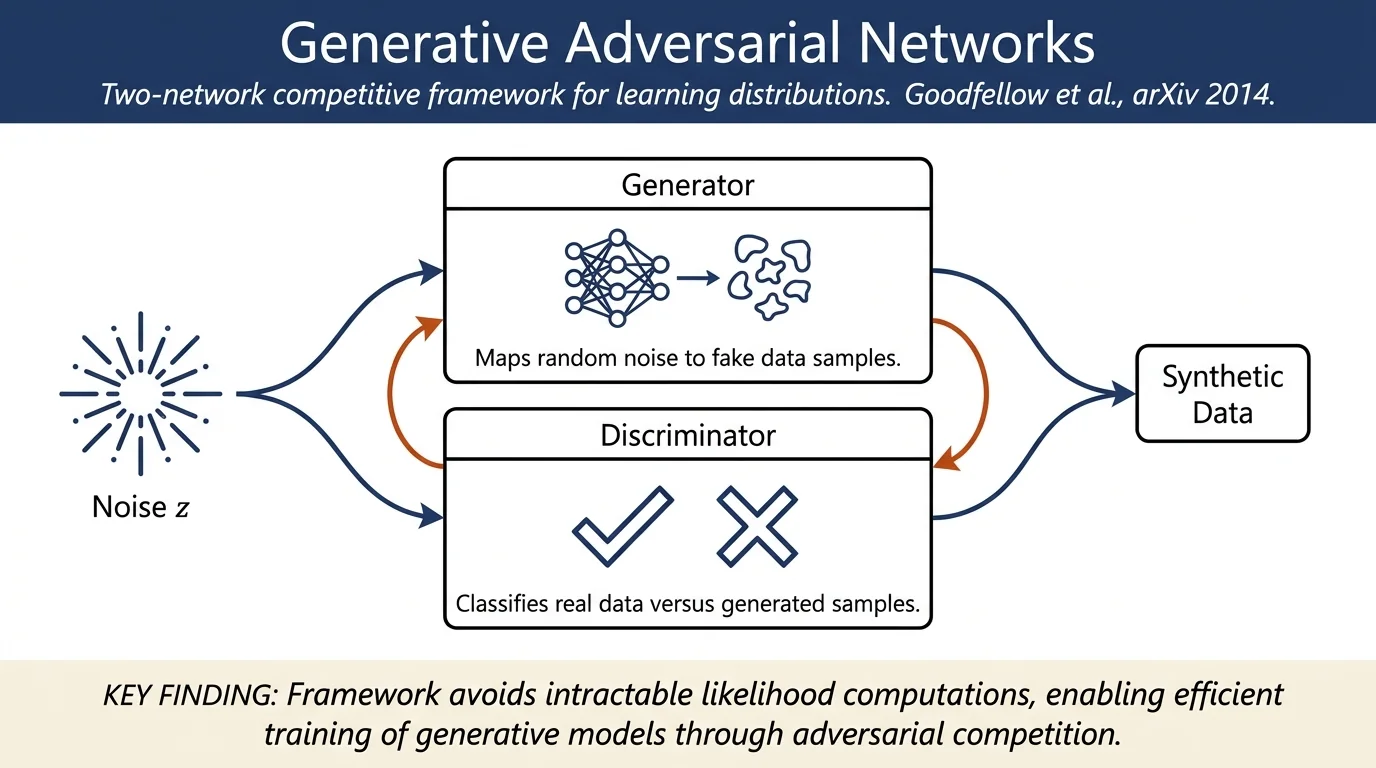
Contributions
- Proposes the adversarial nets framework: a general method for training generative models without explicit maximum likelihood estimation or Markov chains.
- Proves that the minimax game has a global optimum at pg = pdata, with convergence guaranteed under mild assumptions.
- Demonstrates the feasibility of the approach on MNIST, Toronto Faces, and CIFAR-10, showing competitive or superior log-likelihood estimates compared to DBNs, Stacked CAEs, and Deep GSNs.
- Shows that adversarial nets can efficiently sample directly from the generator without feedback loops or approximate inference.
Method
The framework trains two neural networks in parallel. The generator G maps random noise z through parameters θg to produce samples G(z; θg) that mimic the true data distribution pdata. The discriminator D takes a sample x and outputs D(x; θd), the probability that x came from the data rather than G.
Training proceeds via the minimax objective:
$$\min_G \max_D V(D, G) = \mathbb{E}_{x \sim p_{data}}[\log D(x)] + \mathbb{E}_{z \sim p_z}[\log(1 - D(G(z)))]$$
D is trained to maximize this objective (correctly classify real vs generated), while G is trained to minimize it (fool D). In practice, k steps of D optimization are alternated with one step of G optimization per iteration. Theoretically, when both have sufficient capacity and D reaches its optimum at each step, pg converges to pdata.
Results
Parzen window estimation of test-set log-likelihood on MNIST (225 ± 2) and TFD (2057 ± 26) show competitive performance with contemporary models. Visual samples on MNIST, TFD, and CIFAR-10 demonstrate that the generator learns meaningful structure without memorizing training data. Interpolation experiments show that the learned latent space has structure — linear paths in z space produce smooth transitions in generated samples.
Notes
This is a landmark paper that opened an entirely new research direction in generative modeling. The adversarial training paradigm sidesteps intractable likelihood computations that plagued earlier approaches (RBMs, DBMs, DBNs) and avoids the need for Markov chains during generation. The simplicity and flexibility of the framework—any differentiable generator and discriminator architecture works—has made it extraordinarily influential.
Weaknesses include the absence of an explicit representation of pg(x), making density estimation and likelihood-based evaluation difficult (the paper uses Parzen windowing as a workaround). Training instability and mode collapse (where G learns to generate only a narrow subset of the data) emerge in practice, motivating substantial follow-up work on architectural and algorithmic improvements.
The paper's framing of learning as a game between two networks has proven elegant and productive, with extensions to conditional generation, semi-supervised learning, and inference networks discussed in the conclusions.