Contributions
- First large-scale measurement study of Twitter account automation on over 500,000 accounts
- Introduction of entropy-based detection of periodic tweeting behavior as signature of automation
- Identification of machine learning features that effectively distinguish humans from bots and cyborgs
- Empirical characterization of the three account classes via tweeting patterns, device usage, URL inclusion, and network properties
- Framework for understanding hybrid human-bot (cyborg) accounts
Method
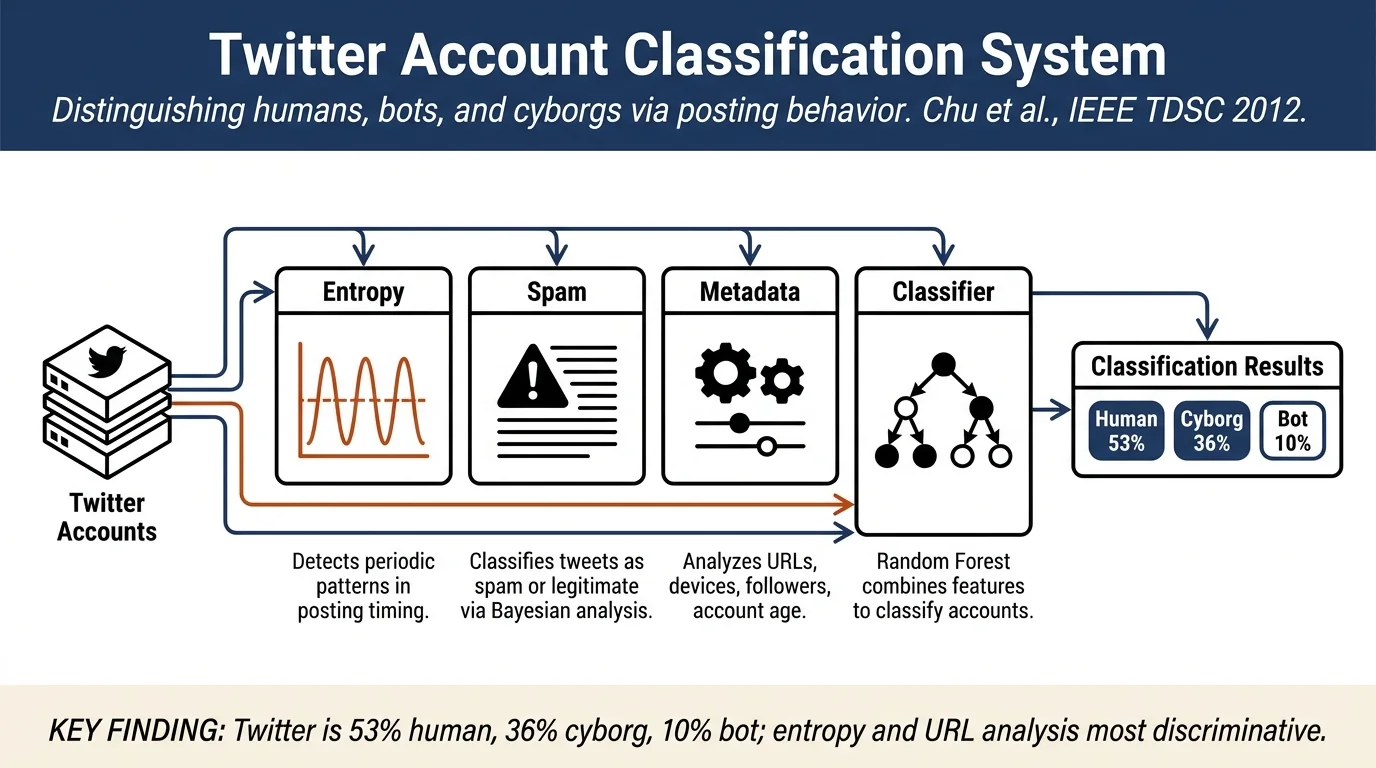
The classification system comprises four components:
Entropy component detects periodic or regular timing of tweets. The entropy rate of a random process measures the complexity of its behavior. Low entropy indicates regular, predictable posting patterns typical of automated accounts; high entropy indicates irregular, human-like behavior. The paper uses corrected conditional entropy to measure the unpredictability of inter-tweet delays.
Spam detection component examines tweet content using Bayesian classification. Automated accounts, particularly malicious bots, generate higher rates of spam tweets. The component learns spam patterns from labeled spam and nonspam datasets and flags accounts with high proportions of spam content.
Account properties component analyzes five features: (1) URL ratio — the proportion of tweets containing external URLs, which bots include more frequently; (2) tweeting device makeup — bots predominantly use API calls and automated tools whereas humans use web or mobile browsers; (3) follower-to-friend ratio; (4) link safety — checking URLs against phishing blacklists; (5) account registration date. Older, initially-created-in-2006-era accounts are less likely to be bots.
Decision maker combines the features from all three components using a Random Forest classifier to assign each account to one of three classes: human, bot, or cyborg (human-assisted bot).
Results
Ground-truth dataset of 2,000 accounts (with 6,000 classified samples) was manually labeled by inspecting posting behavior and account metadata. Evaluation via 10-fold cross-validation achieved 96.0% overall accuracy:
- Human accounts: 1,972 correctly classified (98.6% precision); average 1.10 tweets/day, median 71 minute inter-tweet interval
- Bot accounts: 1,955 correctly classified (97.6% precision); average 0.64 tweets/day, highly regular posting patterns
- Cyborg accounts: classified with lower accuracy, reflecting their mixed behavioral signature
Entropy feature alone achieved 82.8% accuracy. URL ratio achieved 74.9%. Among all features, entropy and URL ratio were most discriminative.
Composition estimate from applying classifier to full 500,000+ account dataset: 53.2% human, 36.2% cyborg, 10.5% bot.
Temporal analysis showed bots tweet during regular hours; humans exhibit circadian rhythms with activity peaks during daytime and evening. Cyborgs show mixed patterns.
Device analysis revealed 46.8% of human tweets from website, 40.2% from third-party applications (e.g., Tweetie, UberTwitter), 3% from mobile. Bots heavily favor API-based tools (42.4% registered apps). Cyborgs mix manual and automated devices.
Notes
This is an early foundational paper in bot detection literature, published at a top security venue. The entropy-based approach to detecting periodic posting behavior has been widely adopted. The three-class taxonomy (human, bot, cyborg) remains influential. Limitations include reliance on 2009-2011 Twitter data and potential evasion by sophisticated bots designed to mimic human behavior; the paper discusses this explicitly in Section 5.5. The cyborg class is harder to detect accurately, a challenge that persists in modern bot detection.