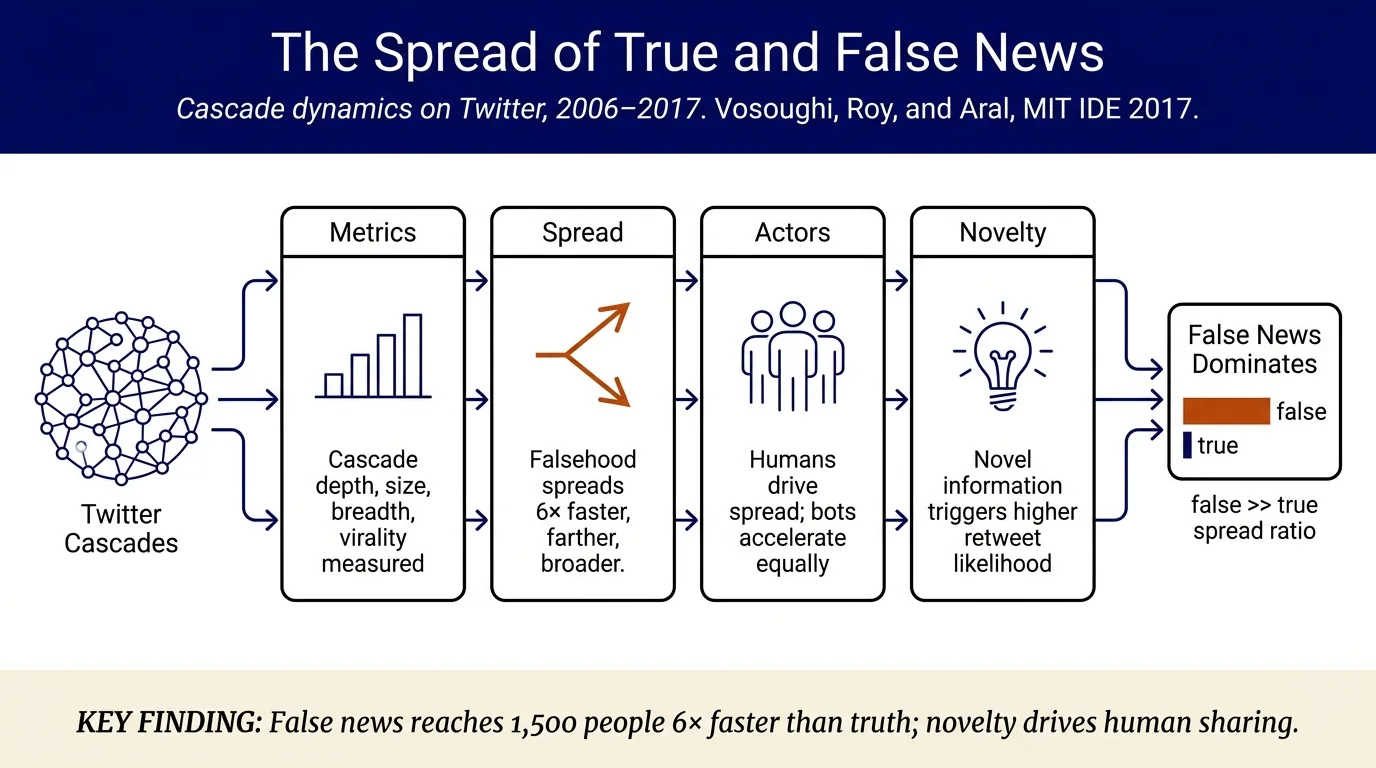
False news encompasses deliberately false or misleading information spread intentionally (disinformation) or unintentionally (misinformation). The study of false news integrates network science (how falsehoods propagate), natural language processing (detecting false claims), behavioral science (why people believe and share falsehoods), and platform design (algorithmic amplification effects).
Research has identified systematic differences in how false and true information spread: some studies find false news spreads faster and reaches broader audiences; others find differences disappear when accounting for cascade size or other confounds. A key finding is that false news often reaches disproportionate audiences not because it spreads through fundamentally different mechanisms, but because of higher "infectiousness"—higher per-step transmission rates or appeal.
The study of false news intersects with multiple dimensions: political polarization (partisan asymmetries in sharing behavior), emotion (moral-emotional language amplifies false claims), platform design (algorithms can amplify unverified content), and interventions (fact-checking, literacy, content moderation).
Key papers
- 2018-vosoughi-spread-false-news — Landmark Science paper analyzing 126,000 cascades of fact-checked true and false content on Twitter; finds false news spreads "faster, farther, deeper, and more broadly" than truth; attributes this to false news being more novel and emotionally arousing; seminal finding reanalyzed and contextualized by subsequent work
- 2021-juul-cascade-size-matching — Reanalysis of Vosoughi et al. showing that reported structural differences between false and true news cascades disappear when controlling for cascade size, suggesting similar underlying mechanisms differing primarily in infectiousness
- 2014-friggeri-rumor-cascades — Analysis of 16,672 rumor cascades on Facebook; demonstrates rumor cascades run deeper than typical content, but true rumors achieve higher virality than false ones
- 2020-freelon-disinformation-political-communication — Examines disinformation as political communication strategy; argues false claims spread through coordinated targeting and algorithmic amplification, not merely individual sharing
- 2021-huszar-algorithmic-amplification — Shows algorithmic amplification (recommendation systems) preferentially promotes right-wing and fringe content on Twitter, demonstrating platform-level mechanisms that boost false and polarizing information
- 2018-bennett-disinformation-order — Historical and political analysis of disinformation's role in disrupting democratic institutions; contextualizes false news within broader information warfare and media dynamics
Related topics
- information-diffusion (how all information, true or false, spreads)
- cascade-analysis (structural properties of false news cascades)
- fact-checking (interventions to counter false claims)
- rumor-propagation (related phenomenon of rumor spread)
- political-polarization (asymmetric sharing and partisan dynamics)
- emotional-language (content properties driving false news virality)