Climate change misinformation encompasses false, misleading, or distorted claims about the reality of climate change, its human causes, its projected impacts, and the feasibility of climate solutions. Research distinguishes between organized denialism (funded by fossil-fuel interests) and grassroots contrarianism (driven by ideological alignment or identity-protective cognition).
Scope and taxonomy
Main categories of contrarian claims (after Coan et al. 2021):
- Existence denial: Claims that global warming is not happening, or that recent warming is within natural variation (categories 1.x in CARDS taxonomy).
- Causation denial: Assertions that observed warming is caused by natural cycles (solar, orbital, volcanic) rather than greenhouse gases (category 2.x).
- Impact minimization: Claims that climate impacts are small, localized, or beneficial; that climate sensitivity is low; that ecosystems will adapt (category 3.x).
- Solution skepticism: Arguments that climate policies are harmful, ineffective, or technologically infeasible; that renewables cannot replace fossil fuels; that adaptation renders mitigation unnecessary (category 4.x).
- Actor/science unreliability: Ad hominem attacks on climate scientists, environmentalists, or policy advocates; claims that the scientific consensus is a hoax or conspiracy; allegations that research is driven by funding bias (category 5.x).
Platform differences: Research reveals that climate contrarianism on social media (Twitter/X) emphasizes ad hominem attacks and conspiracy theories (~60% combined), whereas contrarian blogs and conservative think tanks focus on policy and scientific claims. This distinction has implications for intervention design.
Event-triggered dynamics: Spikes in contrarian messaging correlate with:
- Political events (legislation, climate declarations): shifts arguments toward policy criticism.
- Natural events (hurricanes, heatwaves): trigger arguments denying link between extreme weather and climate change.
- Influencer posts (both pro- and con-climate): amplify conspiracy and natural-cycle narratives.
Key papers
Detection and classification:
- Rojas, Algra-Maschio, Andrejevic, Coan, Cook & Li (2024) — Hierarchical machine learning models can identify stimuli of climate change misinformation on social media — Augmented CARDS model for real-time Twitter misinformation detection; 5M-tweet analysis revealing event-trigger patterns and platform-specific argument distributions
- Coan, Boussalis, Cook & Nanko (2021) — Computer-assisted classification of contrarian claims about climate change — Foundational supervised learning taxonomy identifying 17 categories of climate contrarian arguments; demonstrates strategic shifts in messaging across conservative think tanks and blogs
- Boussalis & Coan (2016) — Text-mining the signals of climate change doubt — Unsupervised topic modeling of CTT texts identifying major themes in organized contrarianism; links funding sources to claim production
Psychology and persuasion:
- Većkalov, Geiger, Ruggeri & van der Linden (2024) — A 27-country test of communicating the scientific consensus on climate change — Largest cross-national test of scientific consensus messaging for climate change (N=10,527 across 27 countries); finds consensus message substantially reduces misperceptions about climate reality (d=0.47) and slightly increases belief in human causation; effects moderated by message familiarity, trust in scientists, and political ideology
- Science by social media: Attitudes towards climate change are mediated by perceived social consensus — Experimental study showing blog comments shift readers' perceived consensus on climate change, which mediates attitudes toward AGW; demonstrates social-proof effects in online contexts
- Van der Linden, Leiserowitz, Rosenthal & Maibach (2017) — Inoculating the public against misinformation about climate change — Pre-emptive inoculation theory applied to climate myths; demonstrates that forewarning about misinformation techniques reduces susceptibility to false claims
- Cook, Lewandowsky & Ecker (2017) — Neutralizing misinformation through inoculation: Exposing misleading argumentation techniques reduces their influence — Empirical evidence that teaching people to recognize logical fallacies (hasty generalization, false balance, etc.) in climate arguments reduces belief in contrarian claims without prior exposure to the false claims themselves
Spread and amplification:
- Falkenberg et al. (2022) — Growing polarization around climate change on social media — Network analysis of Twitter showing stratification into separate pro- and anti-climate clusters; documents growth in contrarian engagement and polarization metrics since 2009; demonstrates geographic variation (conservative U.S. states vs. liberal, Australia, Canada, UK)
- Pearce et al. (2014) — Climate Change on Twitter: Topics, Communities and Conversations about the 2013 IPCC Working Group 1 Report — Early Twitter analysis of IPCC report discussions; finds climate-skeptical tweets most active and uncivil; contrarian tweets show highest virality; demonstrates that aggressive tone amplifies in algorithmic feeds
Related topics
- Climate change denial (synonym; often used interchangeably)
- Science Communication (strategies for effective communication of climate science)
- Polarization and echo chambers (social and political context for misinformation spread)
- Content moderation (platform policies and their effects)
- Fact-checking and verification (responses to misinformation)
- Psychological inoculation theory (prebunking strategies)
Papers on this topic
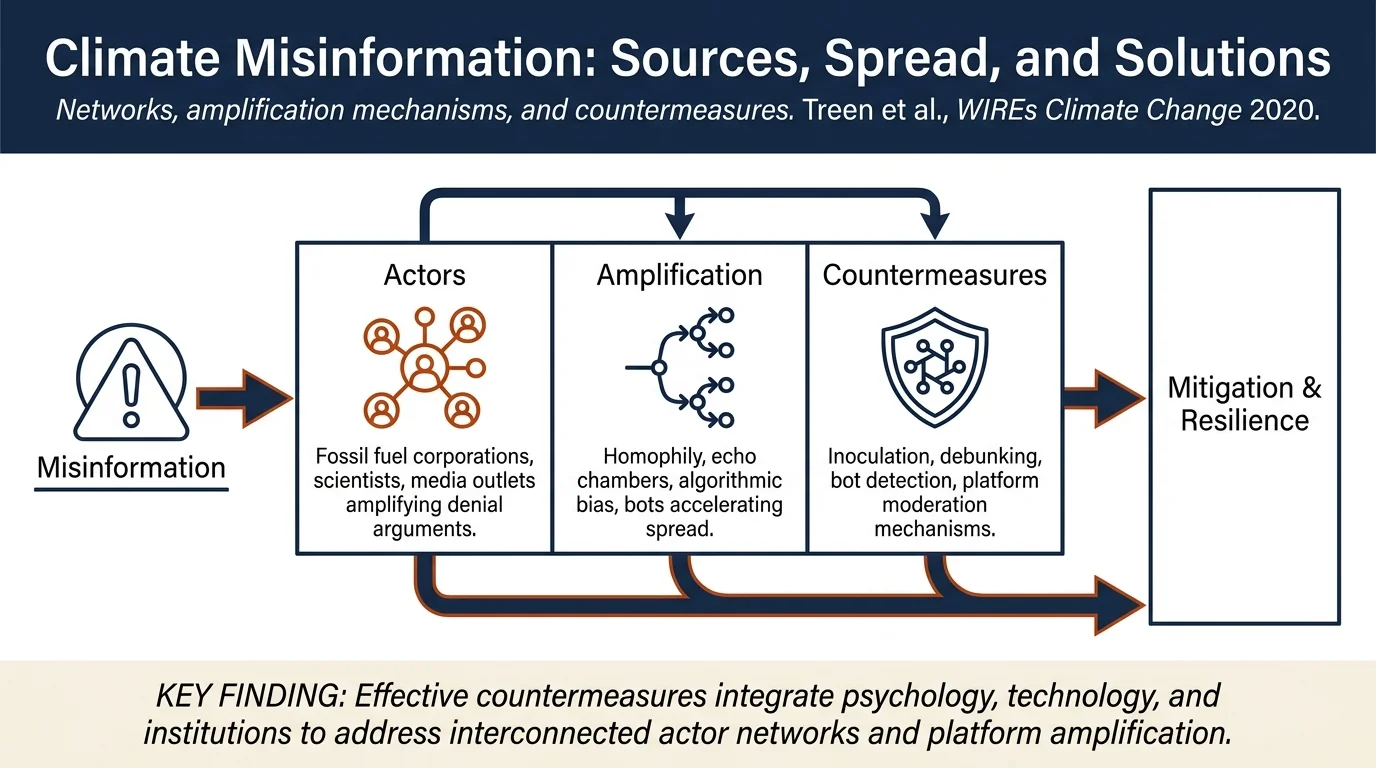 Spread & networksPlatforms, policy & society
Online misinformation about climate change
Psychology & interventionsDetection methods
Science by social media: Attitudes towards climate change are mediated by perceived social consensus
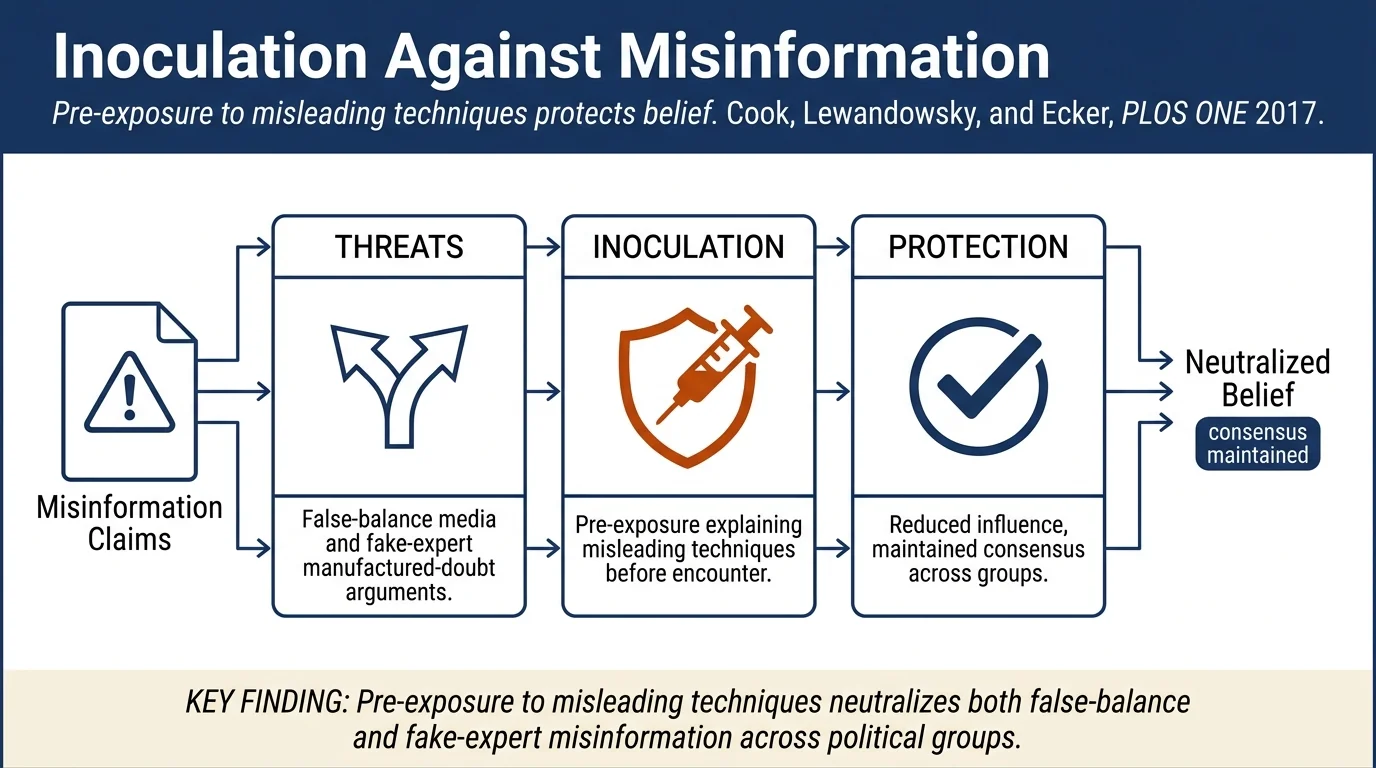 Psychology & interventionsPlatforms, policy & society
Neutralizing misinformation through inoculation: Exposing misleading argumentation techniques reduces their influence