Explore everything
Filter by research area, year and venue. Every filter is in the address bar, so you can share a view as a link.
 Psychology & interventionsFact-checking & verification
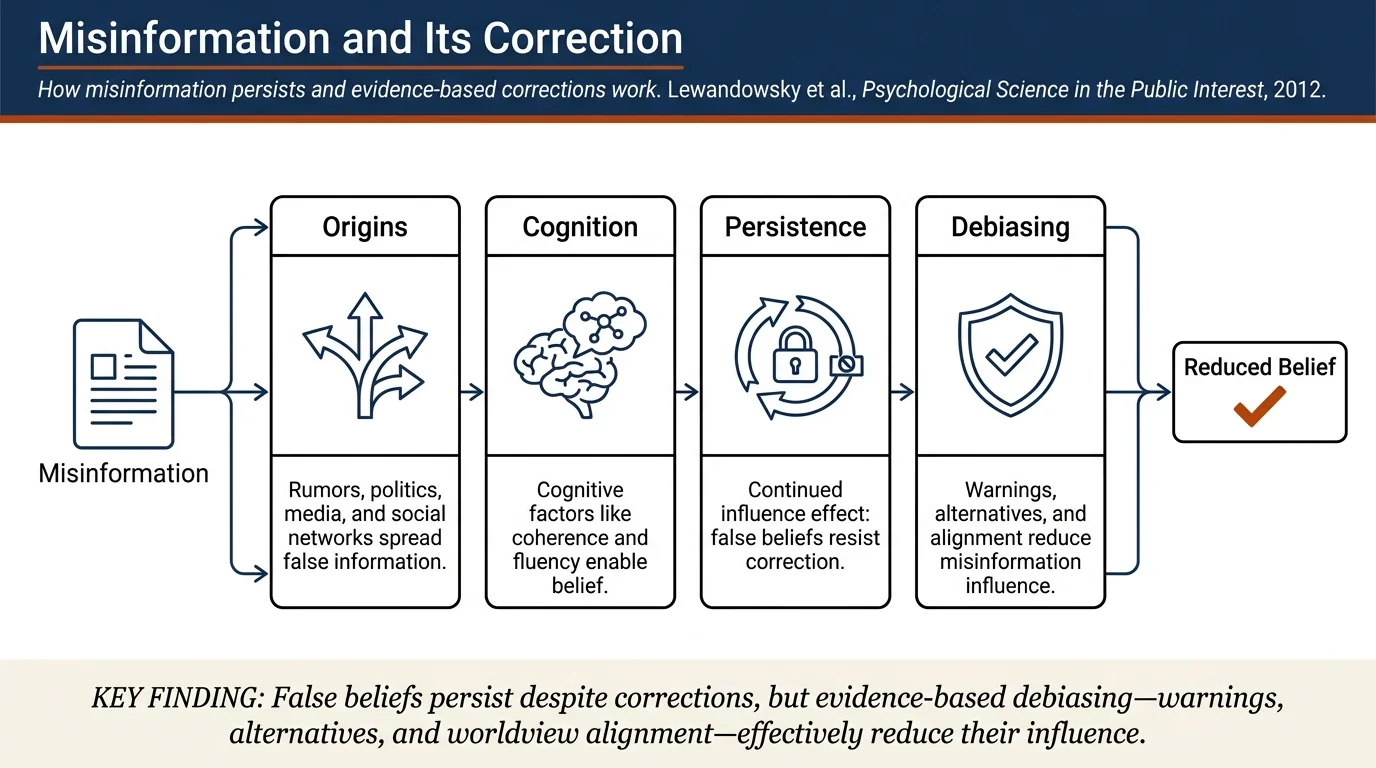
Misinformation and Its Correction: Continued Influence and Successful DebiasingThis comprehensive review synthesizes literature on why false beliefs persist despite corrections, examining cognitive mechanisms (coherence, credibility, source confusion, fluency) that render misinformation resistant to change. The authors propose evidence-based debiasing strategies—warnings, alternative explanations, repeated…
 Psychology & interventionsDetection methods
The Psychology of MisinformationEcker presents evidence that misinformation continues to influence reasoning even after people receive, believe, and remember corrections. Drawing on cognitive psychology, he demonstrates that corrections are only partially effective—typically halving (not eliminating) reliance on misinformation.
 Detection methodsPlatforms, policy & society
Truth DecayTruth Decay—the erosion of reliance on facts and data in policy-making and civil discourse—is not new but cyclically emerges during periods of technological disruption in media. Kavanagh traces this through yellow journalism, radio demagoguery, cable news, and now social media.
 LLMs & generative AIFact-checking & verification
Factuality Challenges in the Era of Large Language ModelsNakov surveys the twin challenges posed by large language models (LLMs) to misinformation detection and fact-checking: (1) LLMs generate coherent, persuasive, and factually-unreliable text—hallucinations are pervasive and often hidden; (2) LLMs can be weaponized to automate misinformation production at scale through paraphrasing, persona…
 Platforms, policy & societyFact-checking & verification
How Polarization Can Help Solve the Misinformation ProblemDavid Rand presents a counter-intuitive argument: while polarization is widely viewed as exacerbating misinformation, it may actually improve crowd-sourced fact-checking systems like Twitter's Birdwatch/Community Notes. Rather than a traditional technology approach (machine learning classifiers), platforms can scale fact-checking by…
 Psychology & interventionsFact-checking & verification
How You Can Help Combat Fake NewsA researcher presents empirical findings challenging the "motivated reasoning" account of why people believe false headlines. Instead, a multi-study investigation with 25,000+ participants shows that critical thinking and cognitive reasoning—not willful bias—are the primary determinants of misinformation susceptibility.
 Psychology & interventionsPlatforms, policy & society
Psychological Inoculation Against Misinformation (Trinity College, Cambridge)Van der Linden presents psychological inoculation as an alternative to reactive fact-checking. Rather than debunking false claims after people have been exposed, inoculation preemptively builds resistance to misinformation techniques.
 Psychology & interventionsPlatforms, policy & society
Prebunking and Inoculating Against DisinformationVan der Linden argues that reactive fact-checking fails to scale and leaves misinformation's psychological influence intact. Instead, he proposes psychological inoculation: preemptively exposing people to weakened examples of misinformation techniques before they encounter the real thing, building cognitive resistance.
Psychology & interventionsSpread & networks
Lazy, not biased: Susceptibility to partisan fake news is better explained by lack of reasoning than by motivated reasoningTwo studies with 3,446 participants found that people who score higher on cognitive reflection tests (measuring analytic thinking) are significantly less likely to believe partisan fake news—contradicting the "motivated reasoning" theory that political bias drives misinformation susceptibility. The effect holds regardless of political…
Platforms, policy & societyPsychology & interventions
Lexicon of Lies: Terms for Problematic InformationWords matter in describing problematic information. This guide clarifies distinctions between misinformation (unintentional inaccuracy), disinformation (deliberate deception), propaganda, publicity, gaslighting, and related terms.