 Gordon Pennycook
 David Rand
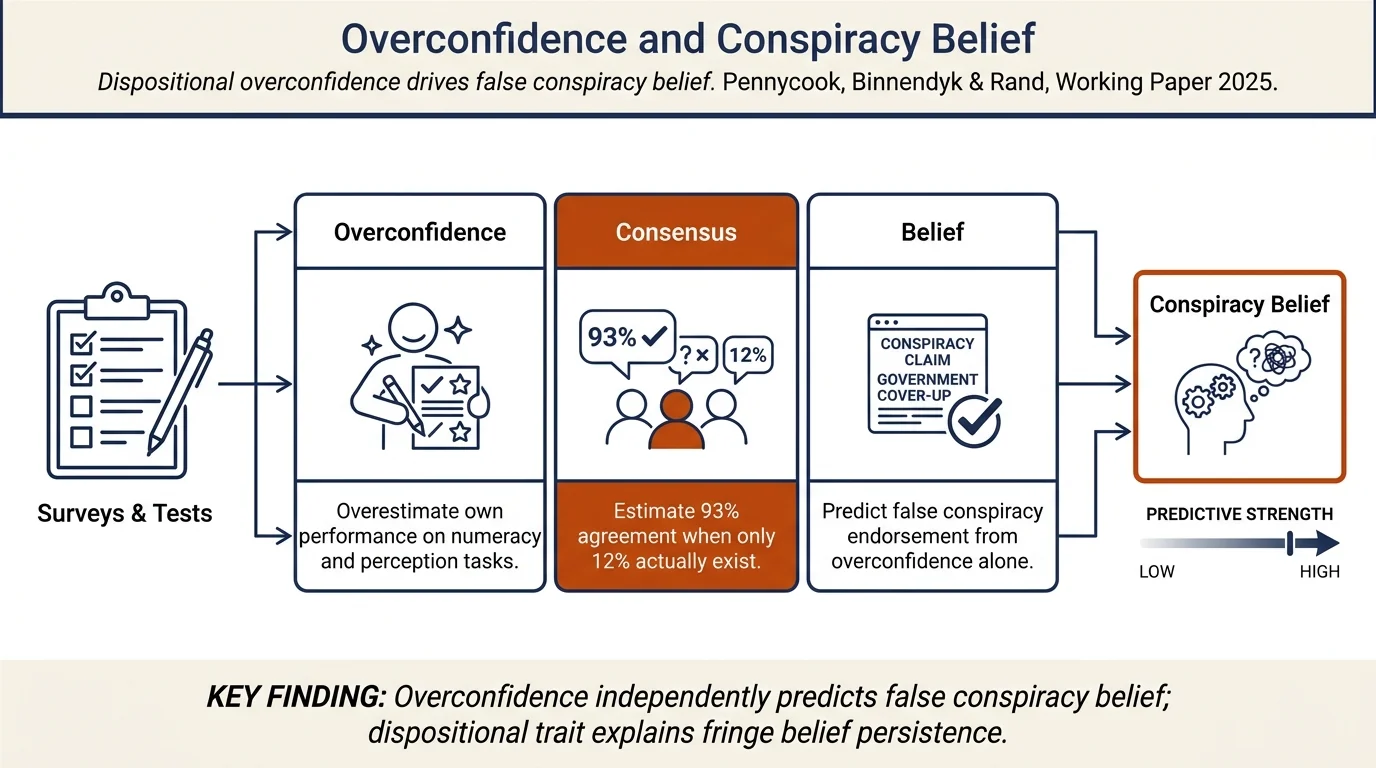
Contributions
-
Measurement of dispositional overconfidence: Develops methods to measure overconfidence independent of task performance by controlling for actual accuracy, isolating confidence as a distinct construct.
-
Robust correlation with conspiracy belief: Demonstrates across multiple tasks (Cognitive Reflection Test, numeracy, perception) that overconfidence predicts conspiracy belief even when accounting for cognitive sophistication.
-
False consensus effect in conspiracies: Documents that conspiracy believers dramatically overestimate consensus around their views (>4× the actual proportion), suggesting they lack awareness that their beliefs are fringe.
-
Mechanism evidence: Shows that overconfidence predicts conspiracy belief more strongly for implausible (fringe) conspiracies than plausible ones, and that overconfidence remains predictive even when cognitive sophistication is controlled.
Method
Participants: 4,181 U.S. adults across eight studies (Studies 1–4: numeracy and perception tests; Studies 5–7: extended conspiracy inventory; Study 8: 50 false and 16 true conspiracy claims with plausibility ratings).
Overconfidence measures: Three methods across studies:
- Overconfidence 1: Estimated performance minus actual accuracy (basic overconfidence).
- Overconfidence 2: Estimated performance after controlling for actual accuracy via regression (dispositional overconfidence independent of performance).
- Estimated consensus: Participants rated what percentage of others agreed with conspiracy views; actual consensus computed from sample responses.
Conspiracy belief: 15-item Belief in Conspiracy Theory Inventory (BCTI) measuring agreement with false conspiracy claims on 1–9 scales. Study 4 expanded this to include contemporary and historically true conspiracies.
Cognitive measures: Cognitive Reflection Test (CRT; 7 items), numeracy test (7 items), analytic thinking scales, and demographic/political variables.
Results
Key findings:
-
Overconfidence predicts conspiracy belief: Across all studies, simple overconfidence (estimated − actual performance) was positively correlated with false conspiracy belief (r's range .14–.51). After controlling for actual performance, overconfidence remained a significant predictor (Overconfidence 2: r's range .11–.30), indicating a disposition toward overconfidence independent of task difficulty.
-
Consensus overestimation: Conspiracy believers massively overestimated agreement with their views. When only 12% of participants believed a false conspiracy claim, conspiracy believers thought 93% did. This effect was strongest for the most implausible conspiracies (r = −.86 for item-level correlation between believability and overconfidence effect).
-
Effect stronger for implausible conspiracies: The association between overconfidence and conspiracy belief was magnified for conspiracies ranked as least believable, suggesting overconfidence protects believers from recognizing their views as fringe.
-
True conspiracies unaffected: Belief in historically true conspiracies (e.g., FBI spying on John Lennon) showed no association with overconfidence measures, and in some cases nominal negative associations, supporting the hypothesis that overconfidence is specifically about false belief.
-
Cognitive sophistication does not mediate: The relationship between overconfidence and conspiracy belief persisted even when controlling for analytic thinking, cognitive reflection, and numeracy—suggesting overconfidence operates through a mechanism distinct from deliberative reasoning failures.
Notes
This is an unpublished working paper that provides novel empirical evidence for a dispositional account of conspiracy belief distinct from motivational or purely reasoning-based accounts. The large sample size (4,181 across eight studies) and multiple operationalizations of overconfidence strengthen confidence in the findings. The work complements approaches emphasizing analytic thinking by identifying a cognitive factor—overconfidence as a trait—that operates independently of reasoning ability.
The finding that true conspiracies do not exhibit these relationships validates the measurement approach and suggests overconfidence is specifically about false belief rather than a general confidence calibration problem. The false consensus effect finding is particularly striking and suggests that conspiracy believers operate under a mistaken model of social reality.