 Brendan Nyhan
Contributions
- Demonstrates empirically that media retractions reduce belief in false information more effectively than third-party corrections, but at a cost to media credibility.
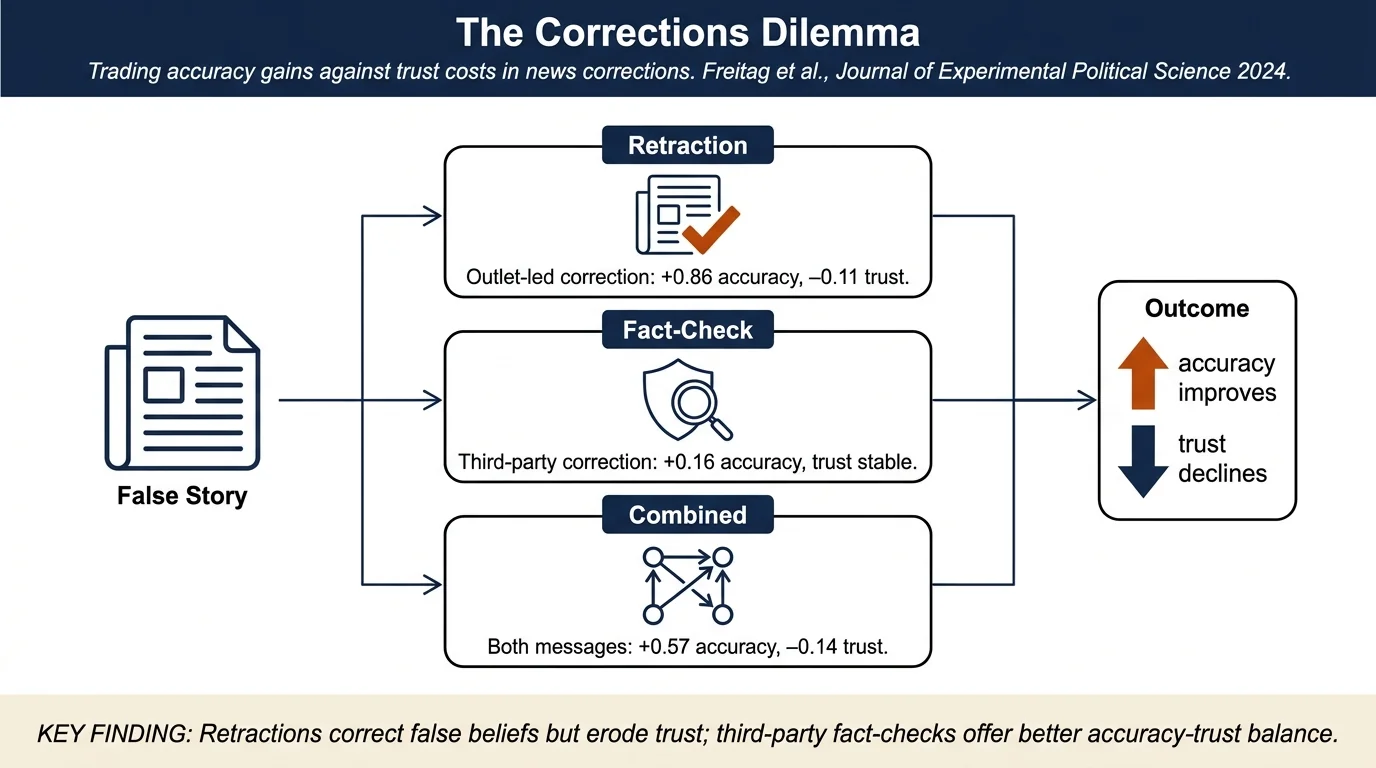
- Identifies the "corrections dilemma" as a fundamental trade-off: corrections improve factual accuracy but paradoxically harm trust in the news organization.
- Shows that order matters: when both news outlet retractions and third-party corrections are presented, the order influences effects on both accuracy and trust.
- Finds that partisan affiliation moderates effects on accuracy (Republicans show smaller accuracy gains from outlet retractions) but trust effects hold across partisan lines.
- Demonstrates that Twitter use predicts smaller negative trust effects, suggesting media environment moderates how audiences respond to corrections.
Method
The authors conducted a between-subjects survey experiment with 2,862 respondents recruited through Amazon Mechanical Turk (screened via CloudResearch for quality; 45% male, 56% college-educated, 74% white, mean age 44, balanced partisan representation). Participants viewed simulated Twitter feeds designed to resemble real newsfeeds, using a modified true story from the Canadian Broadcasting Corporation (CBC) about a 2014 jihadi threat. The story was adapted to describe a fictional "Caliphate" podcast misinformation about a Canadian who allegedly joined ISIS.
Participants were randomly assigned to one of five conditions:
- No correction: Only the original false tweet (baseline)
- News outlet retraction: A tweet from the CBC retracting their story and admitting error
- Third party correction: A tweet from a third party questioning whether the story was accurate
- Both messages (outlet first): CBC retraction followed by third-party questioning
- Both messages (third party first): Third-party questioning followed by CBC retraction
Outcome measures included belief accuracy (four-point scale from "Very accurate" to "Not at all accurate") and news outlet trust (four-point scale from "Great deal" to "None at all"), measured before and after experimental treatment. The researchers used OLS regressions with robust standard errors and controlled for pre-treatment levels of outcome variables, education, age, sex, political interest, and race/ethnicity.
Results
Main effects (Table 1, 95% confidence intervals):
| Condition | Belief Accuracy | News Outlet Trust |
|---|---|---|
| News outlet retraction | +0.86*** [0.77–0.94] | –0.11*** [–0.06 to –0.11] |
| Third party questioning | +0.16*** [0.07–0.24] | –0.06 (ns) |
| Both messages (outlet first) | +0.68*** [0.64–0.72] | –0.17*** [–0.22 to –0.12] |
| Both messages (third party first) | +0.57*** [0.52–0.62] | –0.14*** [–0.19 to –0.09] |
Key findings:
- News outlet retractions were highly effective at correcting false beliefs (accuracy increase of 0.86 points), far more effective than third-party corrections (0.16 points; $p < 0.005$).
- However, retractions from the news outlet also significantly reduced trust (–0.11 points on a 4-point scale; $p < 0.005$), while third-party corrections had no significant effect on trust.
- When both messages were presented, the combined effect on accuracy (0.68–0.57 depending on order) was smaller than the news outlet retraction alone, suggesting that third-party messages diluted the effectiveness of outlet retractions.
- Trust damage was larger when both messages appeared together (–0.17 when outlet retraction came first vs. –0.14 when third-party came first).
- Moderation by partisan affiliation: Among Republicans, outlet retractions had smaller positive effects on accuracy, and trust reduction was larger among those with higher baseline trust in media. The negative trust effects were greatest among those who reported highest initial media trust.
- Twitter use as a moderator: Among Twitter users, the negative effects of retractions on trust were significantly smaller than among non-users, suggesting media platform familiarity shapes responses to corrections.
- No significant effects on "epistemic political efficacy" (confidence in one's ability to understand political reality), indicating corrections focus accuracy without shifting broader confidence in one's political reasoning.
Notes
Strengths:
- Preregistered design with clearly stated hypotheses and research questions, meeting transparency standards for causal inference.
- Ecologically valid stimulus based on a real false news story adapted for the experimental context.
- Large, representative sample with demographic diversity and balanced partisan composition.
- Careful experimental manipulation distinguishing self-correction from third-party fact-checking, isolating the source effect.
- Transparent measurement of both primary outcomes (accuracy, trust) with scale validation.
- Thorough control for confounds (pre-treatment measures, demographic covariates) and testing of moderation by partisan affiliation and media use.
Limitations and open questions:
- Single-exposure design; real-world corrections involve repeated messaging over time, and this design captures only immediate effects of a single simulated tweet feed.
- Artificial social media environment; stimuli were created by the research team rather than presenting actual past news events, potentially reducing generalizability to real-world correction dynamics.
- Short time horizon; effects measured immediately after exposure; decay of accuracy improvements and reversal of trust damage (or recovery) remain unmeasured.
- Low baseline knowledge of the fictional "Caliphate" podcast controversy; real-world corrections operate in contexts where audiences have prior knowledge of events, potentially affecting trust trajectories.
- The focal question was about a single low-salience news story on Twitter; effects may differ for high-salience political events or persistent misinformation.
- Modest standardized effect sizes on trust (Cohen's $d$ = 0.12) despite statistical significance, suggesting limited practical harm to media credibility in this specific context.
- Mechanism unclear: whether trust reduction reflects rational inference that an error-prone outlet is less reliable, or psychological reactance to perceived organizational failure.
Implications for practice:
The paper frames a genuine tension: journalistic norms of correction and accountability improve accuracy but create reputational risk. The modest magnitude of trust reduction (–0.11 on a 4-point scale) in this controlled experiment may understate real-world costs when corrections are visible in algorithmically-driven social media feeds, amplified by partisan networks, or compound over time as multiple errors accumulate. Newsrooms that acknowledge errors transparently may paradoxically build long-term credibility—the paper does not test this—but face immediate trust costs that could affect audience retention.