 Gregory Eady
 Jonathan Nagler
 Joshua A. Tucker
Contributions
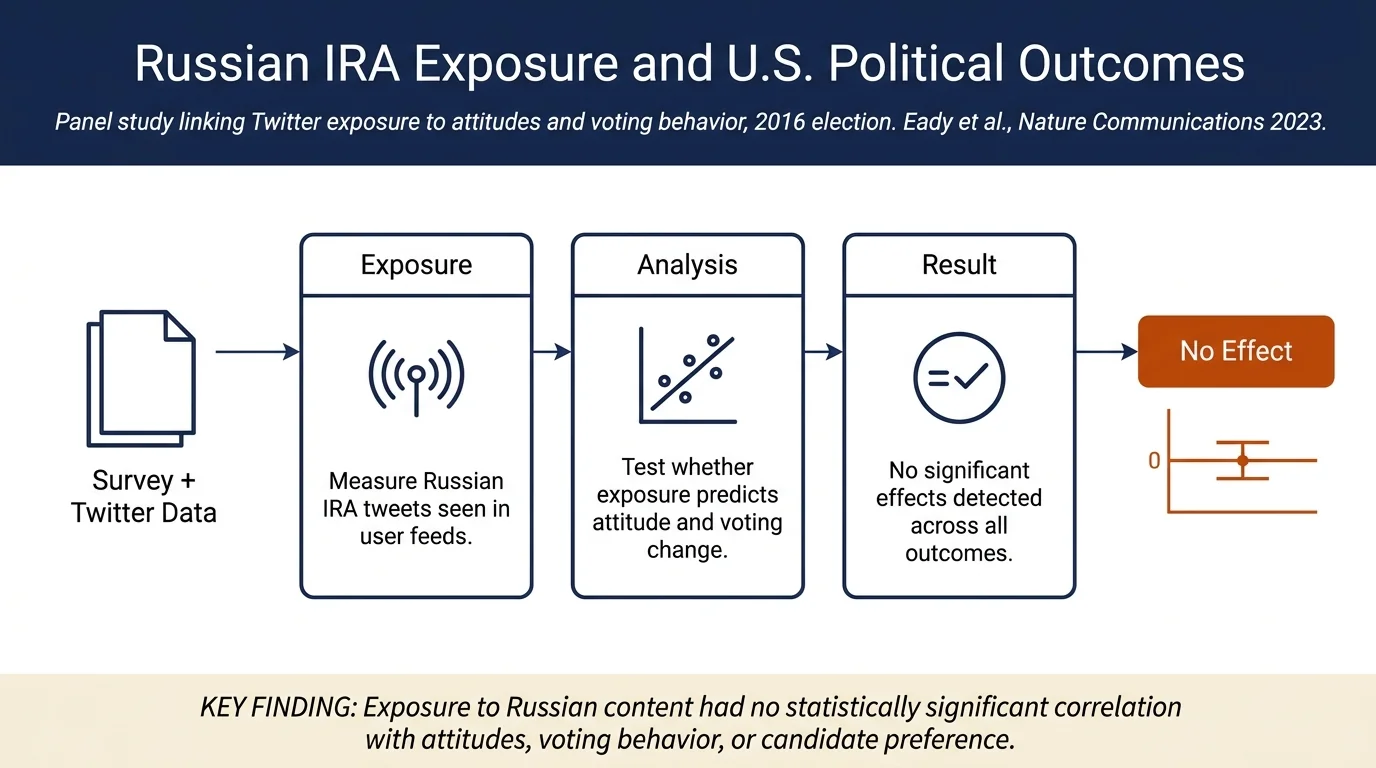
- Representative survey linked to Twitter platform data: First study combining panel survey data from ~1,400 nationally representative US Twitter users with direct Twitter feed analysis to measure actual, documented exposure to IRA accounts during the 2016 campaign period.
- Quantification of exposure concentration: Demonstrates that Russian disinformation reach was far more concentrated than previously understood: 70% of all exposures came through 1% of users; exposure heavily skewed toward users already identifying as strong Republicans.
- Multiple outcome measures: Tests relationship between exposure and attitudes on eight specific election-salient issues (Chinese tariffs, military force, healthcare, Affordable Care Act expansion, border wall, Obamacare, immigration), candidate preference ranking, and binary voting choice.
- Within-respondent causal design: Uses within-subject variation in exposure across multiple survey waves (first and final waves) to control for time-invariant confounders; tests whether respondents' own exposure changes predict their attitude shifts.
- Rigorous null-result reporting: Presents negative results prominently with full methodological detail (power analysis, effect-size bounds, sensitivity tests), enabling interpretation of genuine absence of effects vs. underpowered detection.
Method
Sample: YouGov panel of 1,496 US respondents who consented to share Twitter data, stratified to be representative of US adult population on demographics. Responded to multiple survey waves: first survey April 2016 (measuring pre-campaign baseline), final survey November 2016 (post-election measurement, approximately 0.7 million respondents). Focus on respondents with active Twitter use (followed accounts, tweeted, retweeted).
Exposure measurement: Twitter provided list of IRA accounts active during 2016 election. Exposure defined as log(1 + number of tweets from IRA accounts a respondent potentially saw during April-November 2016). Two operationalizations: (a) continuous exposure measure (log of count), and (b) binary indicator (exposed to at least one IRA post).
Comparisons: Analyzed exposure distribution across three sources: (1) domestic news media accounts, (2) politicians' accounts, (3) Russian IRA accounts. Exposure to domestic and political accounts dwarfed exposure to IRA (orders of magnitude difference).
Outcomes:
- Issue positions (8 salient issues): measured on 0–100 scale (e.g., tariff stance, military intervention, Affordable Care Act support)
- Candidate preference ranking: relative preference for Trump vs. Clinton
- Voting behavior: reported vote choice (Clinton, Trump, third party, abstain) in November wave
Analytical approach: OLS regression models with outcome measured as within-respondent change (attitude at final survey minus attitude at first survey) as a function of (log) exposure to Russian accounts, controlling for demographics, prior political interest, and Twitter frequency. Separate models using binary exposure indicator. Two-sided t-tests; 95% confidence intervals.
Results
Exposure concentration:
- Median exposure among all respondents: zero (last month before election)
- Among those exposed, median exposure ~6 tweets from Russian accounts across entire 8-month period
- Distribution extremely right-skewed: 70% of total exposures concentrated among ~1% of respondents
- Exposure heavily concentrated among respondents who identified as strong Republicans
Comparison to domestic exposure: Domestic news media and politicians' tweets dominated respondents' feeds by multiple orders of magnitude. Average exposure to domestic news: ~100+ tweets; exposure to politicians: ~50+ tweets; exposure to Russian IRA: ~10 median among exposed users.
Main results (issue positions, candidate ranking, voting behavior):
- No statistically significant relationships between exposure to IRA posts and change in any of 8 issue positions (all 95% CIs include zero)
- No relationship between exposure and candidate preference ranking (within-respondent change from first to final survey)
- No relationship between exposure and reported voting behavior (Trump, Clinton, third party, abstention)
- Results hold under both log-exposure and binary exposure operationalizations
- Standardized effect sizes: near zero across all outcomes (~0.02–0.1 standard deviations)
Heterogeneous effects: Examined whether exposure effects varied by political partisanship, news interest, income, age, gender, region. No statistically significant interactions; null effects consistent across subgroups.
Simulated effect sizes: To contextualize results, authors conducted simulation showing what magnitude of observed exposure would be needed to detect effects consistent with prior research on targeted campaign advertising. Conclusion: observed IRA exposure far too concentrated and small to produce measurable attitude shifts even under optimistic assumptions about persuasibility.
Notes
Strengths:
- First platform-linked representative sample: Unlike prior IRA research restricted to convenience samples (Twitter-heavy users, volunteers), this combines representative sampling with direct Twitter feed analysis for a nationally representative population.
- Rigorous null reporting: Presents negative findings prominently, reports effect-size bounds, power analysis, and sensitivity analyses. Enables interpretation of genuine absence of effects rather than underpowered detection.
- Multiple outcome operationalizations: Tests effects across issue positions, candidate preferences, and voting behavior; finds null across all.
- Within-respondent design: leverages multiple survey waves to control for time-invariant confounders; stronger design than cross-sectional exposure–outcome correlations.
- Transparent about limitations: discusses why effects might be undetectable despite real influence (e.g., effects operating through media coverage of IRA rather than direct exposure; effects on salience, agenda-setting, or offline mobilization rather than attitudes; effects on swing voters excluded from sample).
Limitations & caveats:
- Survey non-response and sample selection: Respondents who consent to Twitter data sharing may differ systematically from non-consenters (e.g., more politically engaged, more Twitter use). Analyses show results consistent across TwitterAPI-accessible and less-engaged subgroups, but unmeasured selection bias cannot be ruled out.
- Limited to Twitter: Cannot assess IRA influence through other platforms (Facebook, YouTube, Reddit); Twitter exposure is a partial picture of total exposure.
- Measurement of "exposure": Exposure defined as potential visibility of tweets in respondent's feed, not confirmed viewing, engagement, or comprehension. If IRA posts were systematically scrolled past or ignored, exposure measure overstates actual information intake.
- Attrition in panel: Respondents who drop out between first and final survey may differ in exposure or persuadability; results conditional on panel retention.
- Timing: Survey fielded immediately post-election (November) for final outcome; reported voting behavior is retrospective and subject to recall error and social desirability bias.
- Absence of strong evidence against large effects: Study is powered to detect moderate effects but cannot rule out very small effects at population scale. If true effect is <0.01 SDs, this study would not detect it.
Interpretation: The paper offers two complementary interpretations of null findings:
- IRA's strategic failure or mismatch: Russian accounts may have targeted already-polarized partisans (high echo-chamber homophily, strong Republican identity) who were least susceptible to persuasion, failing to reach persuadable swing voters.
- Mechanism mismatch: IRA's influence may operate through indirect channels not captured by attitude measurement—media agenda-setting (news coverage of IRA amplifies message), offline mobilization, erosion of institutional trust, changes in salience rather than direction of opinion—rather than direct opinion change.
The paper's core claim: "foreign influence campaigns may have weaker direct effects on political attitudes and behavior than commonly assumed, particularly when exposure is both quantitatively small and concentrated among already-entrenched partisans."