Combating Misinformation in the Age of LLMs: Opportunities and Challenges
Authors: Canyu Chen, Kai Shu
Venue: arXiv, 2023 — arxiv:2311.05656
TL;DR
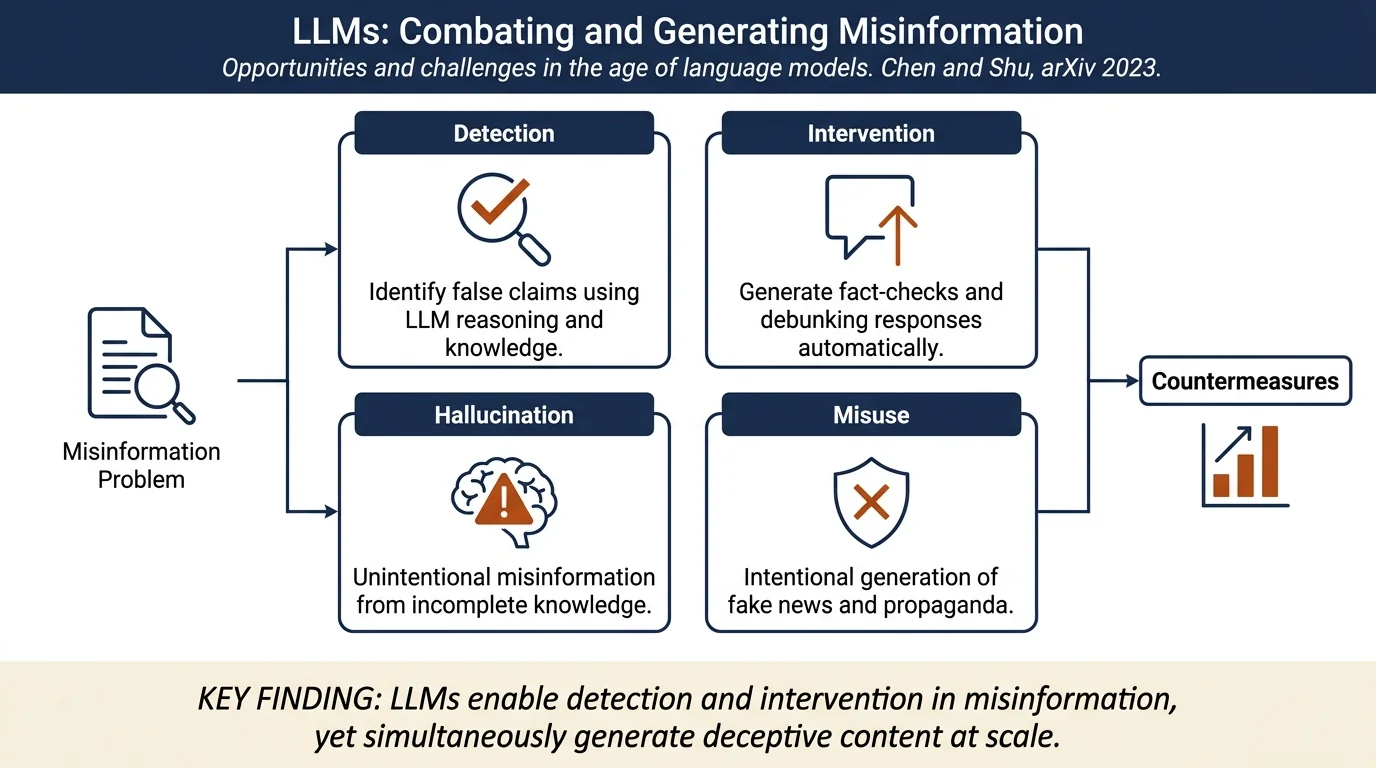
This survey systematically reviews how large language models (LLMs) can both combat misinformation and generate it at scale. LLMs offer opportunities for detection, intervention, and attribution through their world knowledge and reasoning abilities, but also pose challenges as they can create deceptive content intentionally or through hallucinations. The paper discusses emerging threats across journalism, healthcare, finance, and politics, and proposes countermeasures including improved LLM safety and detection methods.
Contributions
- Comprehensive systematic review of misinformation detection techniques before the era of LLMs, providing historical context
- In-depth analysis of how LLMs can be utilized to combat misinformation via detection, intervention, and attribution tasks
- Detailed characterization of LLM-generated misinformation, distinguishing between unintentional generation (hallucinations) and intentional generation (fake news, rumors, clickbait, propaganda)
- Examination of domain-specific threats posed by LLM-generated content in journalism, healthcare, finance, and politics
- Proposed countermeasures including hallucination mitigation, safety improvements, and detection approaches
- Discussion of future challenges including autonomous misinformation agents and cognitive security threats
Method
The paper is a comprehensive survey covering two complementary perspectives:
Opportunities for Combating Misinformation: LLMs possess three key capabilities: - Intrinsic abilities: world knowledge and strong reasoning abilities enable detection and attribution - Augmented abilities: can be enhanced with tool use, retrieval augmentation, and external knowledge - Multimodal and agent capabilities: can process multiple modalities and operate as autonomous agents
LLMs are applied to three core tasks: 1. Detection: leveraging linguistic features, neural models, social context, and external knowledge 2. Intervention: fact-checking and debunking responses with transparency and persuasiveness 3. Attribution: identifying misinformation sources and authors
Challenges: LLM-Generated Misinformation: The paper characterizes two generation modes: - Unintentional generation: hallucinations from LLMs generating false information when lacking knowledge - Intentional generation: deliberate misuse to create fake news, rumors, clickbait, and propaganda at scale
Threats are analyzed across specific domains (journalism, healthcare, finance, politics) and future scenarios (multimodal misinformation, autonomous agents, cognitive manipulation).
Results
The paper identifies key findings:
Detection Opportunities: LLMs can be directly prompted for misinformation detection or augmented with retrieval, knowledge graphs, and external fact-checking tools. Works using GPT-3, ChatGPT, and other models show promise for detection across languages and modalities.
Intervention Approaches: LLMs can generate fact-checking explanations and debunking responses. Research explores strategies like chain-of-thought prompting and multi-agent approaches to improve persuasiveness and transparency.
LLM-Generated Threats: Recent research documents that LLM-generated misinformation can be harder to detect than human-written misinformation due to similar semantics. The paper identifies hallucinations as a primary source of unintentional misinformation and discusses intentional misuse scenarios.
Countermeasures: Four main approaches are discussed: 1. Alleviating hallucinations through improved training and inference-stage techniques 2. Improving LLM safety through RLHF and jailbreak defenses 3. Detecting LLM-generated content through linguistic markers and watermarking techniques 4. Public education about LLM capabilities and limitations
Connections
- Related to Misinformation and fake news detection as a core task surveyed across pre-LLM and LLM eras
- Complements Fact-checking and corrections and Rumor detection on social media work with language model perspectives
- Overlaps with Natural Language Generation concerns about factuality and hallucination
- Discusses applications in Multimodal Misinformation Detection combining text, images, and other modalities
- Connects to Prompt injection and security of LLMs as attack vectors for generating misinformation
- Related to Stance Detection and Sentiment Analysis as auxiliary tasks for detecting misinformation
- Discusses Knowledge graphs as an augmentation method for improving LLM-based detection
Notes
Strengths: - Comprehensive and well-organized coverage of both opportunities and challenges in a timely area - Clear articulation of the dual nature of LLMs: useful tools for combating misinformation, but also capable of generating it at scale - Systematic taxonomy of LLM-generated misinformation types (unintentional vs. intentional) - Cross-domain analysis (journalism, healthcare, finance, politics) provides concrete threat scenarios - Balanced perspective discussing both detection opportunities and generation challenges
Limitations: - As a survey from November 2023, it predates major updates to LLM capabilities and safety research - Limited empirical evaluation of proposed countermeasures; many are preliminary or from cited works - Discussion of human-LLM collaboration could be more developed - Some proposed countermeasures (e.g., public education) are not deeply analyzed regarding effectiveness - The rapidly evolving nature of LLMs means some technical details and recommendations may become outdated quickly
Follow-up questions: - How effective are the proposed detection methods for detecting LLM-generated misinformation in practice? - What are the relative computational costs of different countermeasures? - How do detection approaches generalize across different LLM architectures and fine-tuning approaches? - What longitudinal effects do these interventions have on misinformation spread and user beliefs?