 Brendan Nyhan
 Jason Reifler
Contributions
- Tests experimentally whether official condemnation of conspiracy theorists affects public beliefs about conspiracy theories vs. the politician.
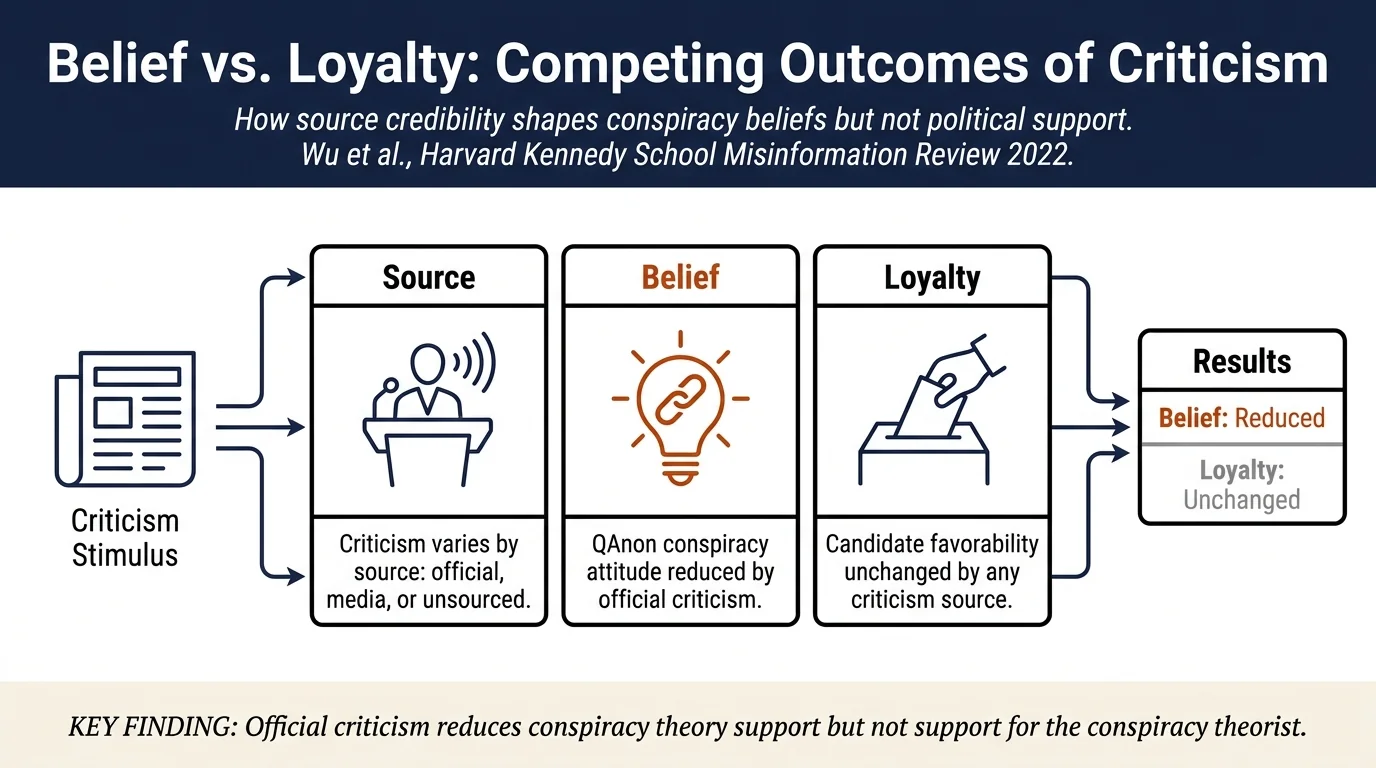
- Manipulates both the source of criticism (Democrat, Republican, media, unsourced) and measures distinct outcomes: attitudes toward Greene and attitudes toward QAnon.
- Finds that source credibility matters for undermining the conspiracy but fails to shift political support—a tension between correcting misinformation and party identity.
Method
Online survey experiment via YouGov (March 9–23, 2021; $N=5,575$; nationally representative sample weighted to U.S. adult population). Respondents were randomly assigned to one of seven conditions:
- Baseline: neutral description of Greene only
- Media criticism (CNN reporters citing her QAnon support)
- Unsourced media criticism
- Sourced criticism from Democrat (Ted Deutch)
- Unsourced criticism from unnamed Democrat
- Sourced criticism from Republican (Young Kim)
- Unsourced criticism from unnamed Republican
Each article presented a consistent description of Greene's election and background, with the criticism conditions adding a quoted statement about her QAnon endorsement. Post-treatment, respondents rated their feelings toward Greene and QAnon on 0–100 feeling thermometers.
Results
Main findings:
- Finding 1: No criticism condition made respondents feel more negatively toward Greene; all criticism had null effects on her favorability (all $p > .05$).
- Finding 2: Criticism from an elected official (Democrat or Republican) reduced negative feelings toward QAnon compared to baseline ($\beta = -1.301, p < .05$ for Democrat; $\beta = -1.242, p < .05$ for Republican). Unsourced and media criticisms had no significant effect on QAnon attitudes.
- Finding 3: Among Democrats, sourced Democrat criticism, media criticism, and unsourced media criticism all reduced feelings toward QAnon ($p < .05$). Among Republicans, no criticism reduced QAnon favorability ($p > .05$ across all conditions).
- Finding 4: Exposure to criticism from Democrats or media did not make Republicans feel more positively toward Greene; Republican criticism of Greene also had no measurable effect.
The study also tested whether counter-attitudinal information might backfire, but found no evidence of boomerang effects.
Notes
Strength: Cleanly isolated source effects by using identical base text, real quotes from actual figures, and large sample with balanced partisan composition. Pre-registered analysis. Clear operationalization of two distinct outcomes (politician vs. conspiracy).
Limitations: Short-term exposure via survey; unclear whether effects persist. The experiment tests immediate response to criticism in a low-attention setting; real-world repeated exposure and reinforcement may differ. Only tests one conspiracy theory and one politician; generalization limited. The null effect on Greene's favorability may reflect ceiling/floor effects (high partisan attachment makes switching unlikely in short term).
Significance: Demonstrates that public officials have a unique responsibility to discredit conspiracy theories but face a partisan bind: criticisms that work on co-partisan audiences may fuel opposition identity or be ignored by out-partisans. Suggests that shifting beliefs about misinformation and shifting political support are partly decoupled—a key distinction for policy makers and researchers.